
SHL Assessment Test 2026: Free Practice Questions, Answers, Tips & Complete Preparation Guide
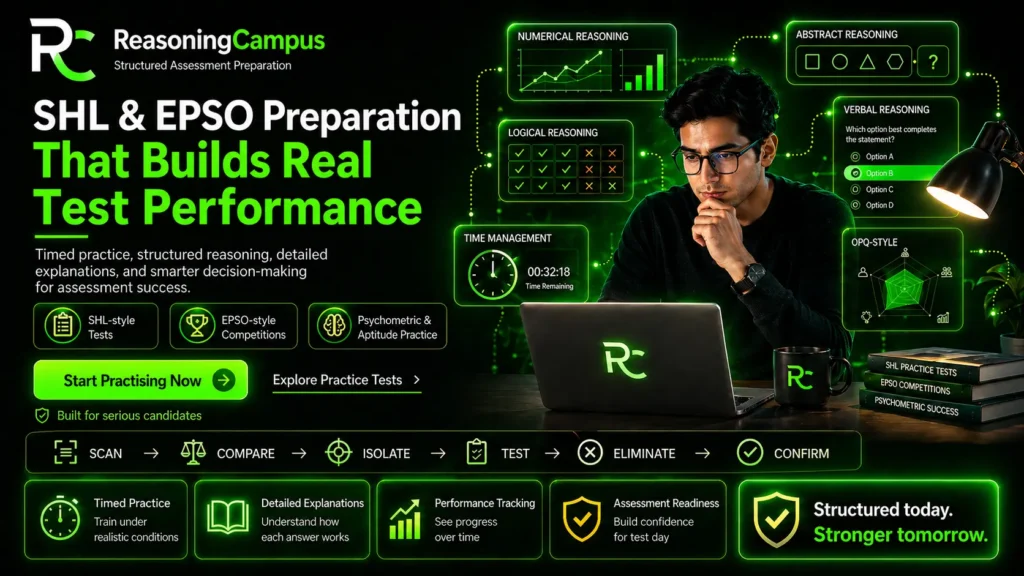
Prepare for the SHL Assessment Test with realistic SHL-style practice questions, worked answers, expert preparation strategies, common candidate mistakes, and a practical study plan for Numerical, Deductive, Inductive, Verbal, Verify G+, OPQ32 and Situational Judgement Tests.
Last updated: June 2026
Written by: Tasos Syrianos
Published by: ReasoningCampus.com
Reviewed by: ReasoningCampus Editorial Team
Independent guide: ReasoningCampus.com is an independent preparation resource. It is not affiliated with, endorsed by, or sponsored by SHL. SHL and related assessment names are trademarks of their respective owners.

Quick Answer: What Is the SHL Assessment Test 2026?
The SHL Assessment Test 2026 is a group of pre-employment assessments used by employers to evaluate reasoning ability, problem-solving, workplace judgement and behavioural preferences. Depending on the role, candidates may face SHL Numerical Reasoning, SHL Deductive Reasoning, SHL Inductive Reasoning, SHL Verbal Reasoning, SHL Verify G+, OPQ32, or a Situational Judgement Test. The best way to prepare is to identify the exact SHL test in your invitation, practise realistic questions, review your mistakes, and complete timed simulations before the real assessment.
SHL Assessment Test 2026 in Brief
- SHL is not one single test. It is a family of employment assessments.
- The most common SHL tests are Numerical Reasoning, Deductive Reasoning, Inductive Reasoning, Verbal Reasoning, SHL Verify G+, OPQ32 and Situational Judgement.
- SHL Verify G+ usually combines numerical, deductive and inductive reasoning.
- OPQ32 is a workplace personality questionnaire, not a traditional right-or-wrong test.
- Most candidates struggle because of time pressure, wording, unfamiliar formats and careless errors.
- The strongest preparation method is to practise realistic questions, review every mistake and simulate test conditions.
- This guide includes free SHL-style questions, worked answers, common traps, study plans, expert notes and an internal candidate-error framework from ReasoningCampus.
SHL Assessment Test 2026 – Table of Contents
- What Is the SHL Assessment Test?
- Why Trust This Guide
- About ReasoningCampus
- About Tasos Syrianos
- SHL Test at a Glance
- Which SHL Test Are You Taking?
- SHL Verify G+
- SHL Numerical Reasoning
- SHL Deductive Reasoning
- SHL Inductive Reasoning
- SHL Verbal Reasoning
- SHL OPQ32 Personality Questionnaire
- SHL Situational Judgement Test
- SHL Interactive vs Non-Interactive Tests
- SHL vs Aon, Pearson, Watson Glaser, Cubiks and ASEP-Style Tests
- Most Common Candidate Errors
- The ReasoningCampus SHL Error Framework
- 3-Day, 7-Day and 30-Day Preparation Plans
- Free SHL Practice PDF
- Frequently Asked Questions
- Final Recommendations
- Disclaimer
Why Trust This SHL Preparation Guide?
SHL Assessment Test 2026: This guide was created for candidates who need practical, clear and realistic preparation — not vague advice.
ReasoningCampus focuses on reasoning-based preparation, including numerical reasoning, verbal reasoning, deductive reasoning, inductive reasoning, psychometric-style exercises, workplace judgement and skills-based written competitions.
This article is designed to be useful because it includes:
- Original SHL-style practice questions
- Worked explanations for every answer
- Common traps for each test type
- Candidate-error analysis framework
- Preparation plans for different timelines
- Direct answer blocks for fast understanding
- Comparison sections for related assessments
- Clear distinction between reasoning tests and personality questionnaires
- Independent disclaimer and source-aware editorial approach
Editorial note: The practice questions in this guide are original preparation examples. They are not real SHL questions and should not be treated as official SHL test material.
About ReasoningCampus
ReasoningCampus.com is an educational preparation platform focused on reasoning tests, skills assessments and structured candidate preparation. The platform supports candidates who need to improve numerical reasoning, verbal reasoning, deductive reasoning, inductive reasoning, critical thinking and workplace judgement.
ReasoningCampus is especially useful for candidates preparing for aptitude tests, psychometric-style assessments, graduate recruitment, public-sector written competitions and reasoning-heavy selection procedures.
The aim is simple: help candidates think more clearly, avoid common mistakes and build confidence before test day.
About Tasos Syrianos
Tasos Syrianos is the creator of ReasoningCampus.com and develops preparation material for reasoning tests, written competitions and skills-based candidate assessments. His work focuses on helping candidates understand how reasoning questions are built, how mistakes happen and how to improve performance through structured practice.
Areas of focus include:
- Numerical reasoning
- Verbal reasoning
- Deductive reasoning
- Inductive reasoning
- Psychometric-style test preparation
- ASEP-style skills and reasoning tests
- Candidate error analysis
- Structured preparation for written assessments
Author page: Add your author profile URL here
Contact: Add your professional contact email here
LinkedIn / Social profile: Add verified profile link here
How This SHL Guide Was Created
This guide was developed by combining:
- Analysis of common SHL-style reasoning formats
- Review of recurring candidate mistakes in preparation exercises
- Standard psychometric preparation principles
- Practical experience from reasoning-test training
- Comparison with related assessment formats such as Aon, Watson Glaser, Cubiks and ASEP-style reasoning tests
- Official terminology from SHL assessment categories
- People-first content principles for candidates who need practical preparation
The goal is not to “game” the test. The goal is to help candidates understand the format, practise responsibly and perform closer to their real ability under time pressure.
SHL Test at a Glance
| SHL Test | What It Measures | Common Format | Main Difficulty | Best Preparation |
|---|---|---|---|---|
| SHL Numerical Reasoning | Data interpretation and numerical accuracy | Tables, charts, percentages, ratios | Choosing the correct calculation quickly | Timed data interpretation practice |
| SHL Deductive Reasoning | Rule-based logic | Ordering, scheduling, conditions | Applying every rule without assumptions | Elimination method and rule mapping |
| SHL Inductive Reasoning | Pattern recognition | Sequences, shapes, matrices | Finding the hidden rule | Pattern drills and systematic checking |
| SHL Verbal Reasoning | Text comprehension and inference | True / False / Cannot Say | Avoiding outside assumptions | Passage-only reasoning practice |
| SHL Verify G+ | General cognitive ability | Numerical, deductive and inductive reasoning | Switching between reasoning types | Mixed timed practice |
| SHL OPQ32 | Workplace personality | Forced-choice questionnaire | Consistency and role relevance | Work-focused self-awareness |
| SHL SJT | Workplace judgement | Scenarios and response ranking | Choosing proportionate professional action | Scenario-based judgement practice |
How to Identify Which SHL Test You Are Taking
Before practising, check your invitation email carefully. Many candidates prepare inefficiently because they do not identify the exact assessment first.
Look for terms such as:
- SHL Verify G+
- SHL General Ability
- Numerical Reasoning
- Deductive Reasoning
- Inductive Reasoning
- Verbal Reasoning
- OPQ32
- Occupational Personality Questionnaire
- Situational Judgement Test
- SJT
- Calculation Test
- Checking Test
- Smart Interview
- Video Interview
If your invitation mentions Verify G+, you are probably facing a mixed reasoning assessment. If it mentions OPQ32, you are facing a workplace personality questionnaire. If it mentions SJT, you will answer workplace scenario questions. Candidates who want additional familiarisation can also review the official SHL practice tests, which provide examples of the assessment formats commonly used in recruitment processes.
What Is SHL Verify G+?
SHL Verify G+ is a general cognitive ability assessment that commonly measures three reasoning areas: numerical, deductive and inductive reasoning.
In simple terms:
- Numerical reasoning checks how well you interpret data.
- Deductive reasoning checks how well you apply rules.
- Inductive reasoning checks how well you identify patterns.
SHL Verify G+ may appear in an interactive or non-interactive format. In the interactive format, candidates may need to drag items, adjust values, connect nodes, rank answers or interact with visual elements.
Is SHL Verify G+ Hard?
SHL Verify G+ can be hard because it combines different reasoning types under time pressure. Candidates may understand each skill separately but struggle when numerical, deductive and inductive questions appear together. The best preparation is mixed practice: do not prepare numerical reasoning only if your test also includes rule-based and pattern-recognition questions.
SHL Verify G+ Key Takeaways
- SHL Verify G+ is a mixed reasoning assessment.
- It is usually broader than a single numerical or verbal reasoning test.
- The challenge is not only solving questions but switching quickly between question types.
- Mixed timed practice is essential.
SHL Numerical Reasoning Test
The SHL Numerical Reasoning Test measures your ability to interpret numerical information and make accurate calculations based on data.
You may need to work with:
- Tables
- Charts
- Percentages
- Ratios
- Averages
- Currency values
- Cost comparisons
- Revenue and profit figures
- Business performance data
- Trends over time
The maths is usually not advanced. The main challenge is identifying the correct calculation quickly and avoiding traps.
Is SHL Numerical Reasoning Difficult?
SHL Numerical Reasoning is difficult mainly because of time pressure and data interpretation. Most questions rely on basic arithmetic, percentages, ratios and averages. Candidates usually lose marks because they misread the question, choose the wrong numbers, round too early or confuse percentage increase with percentage share.
SHL Numerical Reasoning Practice Question 1: Revenue Share
A company sells three products in one month.
| Product | Units Sold | Price per Unit |
|---|---|---|
| Product A | 120 | $15 |
| Product B | 80 | $25 |
| Product C | 100 | $18 |
What percentage of total revenue came from Product B?
A. 31.2%
B. 33.8%
C. 35.7%
D. 38.4%
Correct Answer: C. 35.7%
Explanation
Product A revenue:
120 × $15 = $1,800
Product B revenue:
80 × $25 = $2,000
Product C revenue:
100 × $18 = $1,800
Total revenue:
$1,800 + $2,000 + $1,800 = $5,600
Product B revenue share:
$2,000 ÷ $5,600 × 100 = 35.7%
The correct answer is C. 35.7%.
SHL Numerical Reasoning Practice Question 2: Percentage Increase
A department received 240 applications in March and 300 applications in April.
What was the percentage increase from March to April?
A. 20%
B. 25%
C. 30%
D. 60%
Correct Answer: B. 25%
Explanation
The increase is:
300 − 240 = 60
Percentage increase:
60 ÷ 240 × 100 = 25%
The correct answer is B. 25%.
SHL Numerical Reasoning Practice Question 3: Average Cost
A company bought:
- 12 chairs for $75 each
- 8 desks for $180 each
- 10 lamps for $30 each
What was the average cost per item?
A. $82
B. $86
C. $88
D. $92
Correct Answer: C. $88
Explanation
Chairs:
12 × $75 = $900
Desks:
8 × $180 = $1,440
Lamps:
10 × $30 = $300
Total cost:
$900 + $1,440 + $300 = $2,640
Total number of items:
12 + 8 + 10 = 30
Average cost:
$2,640 ÷ 30 = $88
The correct answer is C. $88.
SHL Numerical Reasoning Common Traps
| Trap | Why It Causes Mistakes | How to Avoid It |
|---|---|---|
| Percentage increase vs percentage share | Candidates divide by the wrong base number | Identify whether the question asks “increase from” or “share of total” |
| Rounding too early | Early rounding changes the final answer | Round only at the final step |
| Revenue vs profit | Candidates use total sales when the question asks for profit | Check whether costs are included |
| Wrong units | Candidates compare dollars, units or percentages incorrectly | Write the unit before calculating |
| Irrelevant data | Extra information slows candidates down | Identify only the data needed for the question |
SHL Numerical Reasoning Expert Tip
Before you calculate, name the task. Say to yourself: “I need a percentage increase,” “I need a share of total,” or “I need an average.” This simple habit prevents many numerical reasoning errors.
SHL Deductive Reasoning Test
The SHL Deductive Reasoning Test measures your ability to apply rules to specific situations.
You are usually given a set of conditions. Your task is to decide what must be true, what could be true or which option satisfies all rules.
Common formats include:
- Ordering problems
- Scheduling problems
- Calendar questions
- Seating arrangements
- Work planning questions
- Conditional logic
- True / False / Cannot Say logic
Deductive reasoning is not about guessing. It is about checking whether each option follows every rule.
What Does SHL Deductive Reasoning Measure?
SHL Deductive Reasoning measures rule application. Candidates are given rules or conditions and must apply them accurately. Strong candidates eliminate any answer that breaks even one rule. The safest strategy is to map the rules first, then test each option against them.
SHL Deductive Reasoning Practice Question 1: Training Schedule
Four employees — Liam, Maya, Noor and Sofia — attend one training session each. The sessions are on Monday, Tuesday, Wednesday and Thursday.
The rules are:
- Maya attends before Sofia.
- Liam attends after Noor.
- Sofia does not attend on Thursday.
- Noor attends on Monday or Tuesday.
Which schedule is possible?
A. Monday Noor, Tuesday Maya, Wednesday Sofia, Thursday Liam
B. Monday Maya, Tuesday Noor, Wednesday Liam, Thursday Sofia
C. Monday Noor, Tuesday Liam, Wednesday Maya, Thursday Sofia
D. Monday Sofia, Tuesday Noor, Wednesday Maya, Thursday Liam
Correct Answer: A. Monday Noor, Tuesday Maya, Wednesday Sofia, Thursday Liam
Explanation
Option A satisfies all rules:
- Maya is before Sofia.
- Liam is after Noor.
- Sofia is not on Thursday.
- Noor is on Monday.
Options B and C are wrong because Sofia is on Thursday.
Option D is wrong because Sofia is before Maya.
The correct answer is A.
SHL Deductive Reasoning Practice Question 2: Arrival Order
Five employees arrive at work: Anna, Ben, Chloe, Daniel and Eva.
The rules are:
- Eva arrives before Anna.
- Anna arrives before Daniel.
- Ben arrives after Chloe.
- Daniel is not last.
- Chloe arrives first or second.
Which order is possible?
A. Chloe, Eva, Anna, Daniel, Ben
B. Eva, Anna, Chloe, Ben, Daniel
C. Chloe, Ben, Eva, Anna, Daniel
D. Anna, Eva, Chloe, Daniel, Ben
Correct Answer: A. Chloe, Eva, Anna, Daniel, Ben
Explanation
Option A satisfies every rule:
- Eva is before Anna.
- Anna is before Daniel.
- Ben is after Chloe.
- Daniel is not last.
- Chloe arrives first.
Option B is wrong because Chloe is third and Daniel is last.
Option C is wrong because Daniel is last.
Option D is wrong because Anna arrives before Eva.
The correct answer is A.
SHL Deductive Reasoning Common Traps
| Trap | Example | Solution |
|---|---|---|
| Ignoring one rule | An answer satisfies 4 out of 5 rules | Check every rule before choosing |
| Assuming extra information | “If A is before B, A must be first” | Use only what is stated |
| Confusing could and must | Treating possible as certain | Separate “possible” from “proven” |
| Misreading before/after | Reversing the order | Draw arrows between items |
| Choosing by intuition | Selecting the option that looks right | Eliminate options systematically |
SHL Deductive Reasoning Expert Tip
Deductive reasoning becomes easier when you stop looking for the answer and start looking for contradictions. One broken rule is enough to eliminate an option.
SHL Inductive Reasoning Test
The SHL Inductive Reasoning Test measures pattern recognition. You are shown information and must infer the rule behind it.
Common question types include:
- Number sequences
- Letter sequences
- Shape patterns
- Matrix problems
- Abstract reasoning
- Next-in-series questions
- Rules combination problems
Inductive reasoning is different from deductive reasoning. In deductive reasoning, the rules are given. In inductive reasoning, you must discover the rules.
What Does SHL Inductive Reasoning Measure?
SHL Inductive Reasoning is a pattern-recognition test. Candidates must identify the rule connecting numbers, letters, shapes, symbols or visual elements. The best strategy is to test changes systematically: position, number, direction, rotation, colour, size, alternation and sequence.
SHL Inductive Reasoning Practice Question 1: Number Pattern
Complete the sequence:
2, 6, 12, 20, 30, ?
A. 36
B. 40
C. 42
D. 44
Correct Answer: C. 42
Explanation
Look at the differences:
6 − 2 = 4
12 − 6 = 6
20 − 12 = 8
30 − 20 = 10
The differences increase by 2:
4, 6, 8, 10, next difference = 12
So:
30 + 12 = 42
The correct answer is C. 42.
SHL Inductive Reasoning Practice Question 2: Letter Pattern
Complete the sequence:
A, C, F, J, O, ?
A. S
B. T
C. U
D. V
Correct Answer: C. U
Explanation
Convert letters to positions:
A = 1
C = 3
F = 6
J = 10
O = 15
The differences are:
+2, +3, +4, +5
The next difference is +6:
15 + 6 = 21
The 21st letter is U.
The correct answer is C. U.
SHL Inductive Reasoning Common Traps
| Trap | Why It Happens | How to Avoid It |
|---|---|---|
| First-pattern bias | The first visible rule feels correct | Test the rule across the whole sequence |
| Overcomplication | Candidates create a complex rule unnecessarily | Start with simple changes first |
| Ignoring alternation | Every second item follows a different rule | Check odd and even positions separately |
| Looking only at numbers | Visual questions may use position or rotation | Track direction, size and location |
| Not verifying | The rule works once but not consistently | Apply the rule to every step |
SHL Inductive Reasoning Expert Tip
A pattern is not correct because it works once. It is correct only if it explains the full sequence.
SHL Verbal Reasoning Test
The SHL Verbal Reasoning Test measures your ability to understand written information and draw conclusions based only on the passage.
The answer options are usually:
- True
- False
- Cannot Say
This test is not about what you know in real life. It is about what the passage proves.
How Do You Pass SHL Verbal Reasoning?
To perform well in SHL Verbal Reasoning, answer only from the passage. If the passage proves the statement, choose True. If the passage contradicts it, choose False. If the passage does not give enough information, choose Cannot Say. Do not use outside knowledge or personal opinion.
SHL Verbal Reasoning Practice Question 1: Hybrid Work
Passage
Many companies now use hybrid working models. Some employees work from home several days per week, while others attend the office more frequently. Managers often report that hybrid work can improve flexibility, but they also note that communication needs to be planned carefully to avoid delays.
Statement
Hybrid work always improves communication between employees.
A. True
B. False
C. Cannot Say
Correct Answer: C. Cannot Say
Explanation
The passage says hybrid work can improve flexibility. It also says communication needs to be planned carefully.
It does not say hybrid work always improves communication. The word “always” is too strong.
The correct answer is C. Cannot Say.
SHL Verbal Reasoning Practice Question 2: Training Programme
Passage
A company introduced a new training programme for customer service employees. After six months, customer satisfaction scores increased by 12%. During the same period, the company also hired additional staff and reduced average waiting times.
Statement
The training programme was the only reason customer satisfaction improved.
A. True
B. False
C. Cannot Say
Correct Answer: C. Cannot Say
Explanation
The passage says customer satisfaction improved after the training programme. However, it also says the company hired more staff and reduced waiting times.
The passage does not prove that training was the only reason for the improvement.
The correct answer is C. Cannot Say.
SHL Verbal Reasoning Common Traps
| Trap | Example | Better Approach |
|---|---|---|
| Outside knowledge | “I know this is true in real life” | Use only the passage |
| Strong wording | Always, never, all, only | Check whether the passage proves the exact wording |
| Cause vs correlation | A happened before B, so A caused B | Look for proof of causation |
| Some vs most | “Some employees” becomes “most employees” | Keep the quantity precise |
| Fast reading | Missing one key word | Slow down on the statement |
SHL Verbal Reasoning Rule: Answer Only from the Passage
In SHL Verbal Reasoning, outside knowledge is irrelevant. If the passage does not prove the statement, choose Cannot Say.
SHL OPQ32 Personality Questionnaire
The SHL OPQ32, or Occupational Personality Questionnaire, assesses workplace personality and behavioural preferences.
It is not a cognitive test. It does not work like numerical or deductive reasoning. Instead, it looks at how your preferred work style may fit the requirements of a role.
OPQ32 may assess areas such as:
- Leadership
- Teamwork
- Influence
- Decision-making
- Resilience
- Attention to detail
- Adaptability
- Independence
- Motivation
- Communication style
- Preference for structure
- Comfort with change
Can You Fail OPQ32?
OPQ32 is not usually passed or failed like a reasoning test. It produces a workplace personality profile that may be compared with the requirements of a role. However, careless, inconsistent or unrealistic answers may weaken your profile. The best approach is to answer honestly, professionally and from a workplace perspective.
SHL OPQ32 Practice Question
Choose the statement that is most like you and the statement that is least like you.
A. I enjoy taking responsibility when a group needs direction.
B. I prefer creating new ideas rather than following established methods.
C. I like checking details carefully before making a final decision.
How to Approach SHL OPQ32 Questions
There is no single correct answer. Your response should reflect your real workplace style and the role you are applying for.
If the role requires leadership, statement A may be highly relevant.
If the role requires creativity, statement B may be highly relevant.
If the role requires accuracy, statement C may be highly relevant.
The key is consistency. Do not answer as your social self or as an exaggerated version of the ideal candidate. Answer as your professional work self.
SHL Situational Judgement Test
The SHL Situational Judgement Test, often called an SJT, presents workplace scenarios and asks you to choose or rank possible responses.
These questions assess:
- Professional judgement
- Teamwork
- Communication
- Conflict handling
- Decision-making
- Ethical awareness
- Customer focus
- Prioritisation
SHL Situational Judgement Practice Question
You are working on a project with a tight deadline. A colleague sends you their part of the work, but you notice several errors that could affect the final result. The colleague is busy and may react defensively if you point this out.
What is the best response?
A. Ignore the errors because the deadline is more important.
B. Correct the errors yourself without telling your colleague.
C. Politely explain the issue and suggest a quick way to fix it together.
D. Report your colleague immediately to your manager.
Correct Answer: C. Politely explain the issue and suggest a quick way to fix it together.
Explanation
Option C is the best response because it addresses the problem, protects work quality and keeps communication professional.
Option A is poor because ignoring the errors could harm the project.
Option B avoids communication and may create problems later.
Option D may be too extreme as a first response unless the issue is serious or repeated.
SHL Interactive vs Non-Interactive Tests
SHL assessments may be interactive or non-interactive.
What Is the SHL Interactive Test Format?
In an interactive SHL test, candidates may need to:
- Drag and drop answers
- Rank items
- Adjust charts
- Move sliders
- Select values on a number line
- Connect nodes
- Complete visual sequences
- Interact with tables or diagrams
What Is the SHL Non-Interactive Test Format?
In a non-interactive SHL test, candidates usually select an answer from multiple-choice options.
Why Candidates Lose Time in Interactive SHL Tests
The reasoning skills may be similar, but the interactive format can feel harder because candidates must also understand how to input the answer quickly.
SHL vs Aon, Pearson, Watson Glaser, Cubiks and ASEP-Style Tests
| Assessment | Main Focus | Similar to SHL? | Main Difference |
|---|---|---|---|
| SHL | Reasoning, personality and workplace judgement | Yes | Broad employment-assessment provider |
| Aon | Cognitive, behavioural and game-based assessments | Partly | Often uses short, interactive or gamified tasks |
| Pearson | Academic, professional and certification assessments | Partly | Depends heavily on the specific test product |
| Watson Glaser | Critical thinking | Partly | Focuses on arguments, assumptions and inference |
| Cubiks | Reasoning and personality assessment | Yes | Different provider and format style |
| ASEP-style tests | Reasoning, comprehension and public-sector skills | Partly | More connected to public-sector written competition logic |
SHL
SHL is a global talent assessment provider known for employment assessments, cognitive ability tests, personality questionnaires and workplace assessment solutions. Candidates often encounter SHL tests during graduate recruitment, corporate hiring and professional selection processes.
Aon
Aon is a global professional services firm that also provides assessment solutions. Aon-style tests may include cognitive ability tasks, behavioural assessments and interactive or game-based formats.
Pearson
Pearson is a major education and assessment company. Pearson-related assessments vary widely depending on the context, ranging from academic testing to professional and certification-based assessments.
Watson Glaser
Watson Glaser is commonly associated with critical thinking assessment. It is often used in fields where argument evaluation, inference and analytical judgement are important.
ASEP-Style Reasoning Tests
ASEP-style reasoning tests are linked with Greek public-sector selection and written competitions. They may overlap with SHL in verbal reasoning, numerical reasoning, logical reasoning and time management, although the context and exam logic are different.
Is SHL Harder Than ASEP?
SHL is not directly harder or easier than ASEP-style tests because the formats are different. SHL is usually used in corporate recruitment and often includes psychometric-style reasoning, interactive formats or personality questionnaires. ASEP-style tests are linked with public-sector written competitions and may place more emphasis on administrative reasoning, legal-institutional understanding, verbal comprehension and structured written performance.
Candidates with strong ASEP preparation may already have useful reasoning skills, especially in verbal, numerical and deductive tasks. However, they should still practise SHL-style timing and formats.
Is SHL Harder Than Watson Glaser?
SHL and Watson Glaser test different skills. SHL may include numerical, deductive, inductive and personality assessments, while Watson Glaser focuses more narrowly on critical thinking, arguments, assumptions and inference.
Watson Glaser may feel harder for candidates who struggle with abstract argument evaluation. SHL may feel harder for candidates who struggle with switching between different reasoning formats under time pressure.
Can I Pass SHL Without Preparation?
Some candidates can perform well without preparation, especially if they already have strong reasoning skills and test experience. However, preparation usually helps because SHL tests are timed and format-sensitive.
Even strong candidates can lose marks if they:
- Misread instructions
- Use the wrong calculation
- Spend too long on one item
- Misunderstand interactive question formats
- Treat OPQ32 like a casual personality quiz
- Use outside knowledge in verbal reasoning
Preparation reduces avoidable mistakes.
How Many Hours Should I Study for SHL?
The number of study hours depends on your current level and test date.
| Time Available | Suggested Study Time | Focus |
|---|---|---|
| 1–3 days | 3–6 focused hours | Identify format, practise weak areas, complete timed sets |
| 1 week | 7–10 hours | Cover all relevant sections and review mistakes |
| 2 weeks | 12–18 hours | Build accuracy and pacing |
| 1 month | 20–30 hours | Full preparation with simulations and targeted improvement |
Quality matters more than total hours. One hour of careful mistake review is often more useful than three hours of random practice.
Most Common SHL Candidate Errors
Important editorial instruction: Replace the figures below with your verified internal data before publication. Do not publish invented numbers. If you have not yet collected enough data, publish this as a “sample of observed preparation mistakes” without percentages.
ReasoningCampus Candidate Error Snapshot
Based on an internal review of [INSERT NUMBER] ReasoningCampus candidate practice responses collected from [INSERT PERIOD], the most common error patterns were:
| Candidate Error | Frequency | What It Usually Means |
|---|---|---|
| Misreading a condition in deductive reasoning | [31%] | The candidate understood the logic but missed one rule |
| Using the wrong percentage formula | [22%] | The candidate confused percentage increase with percentage share |
| Losing accuracy under time pressure | [18%] | The candidate could solve the question untimed but rushed |
| Choosing “True” or “False” instead of “Cannot Say” | [14%] | The candidate used outside knowledge in verbal reasoning |
| Selecting the first visible pattern | [9%] | The candidate did not verify the rule across the full sequence |
| Other errors | [6%] | Mixed calculation, reading or pacing issues |
What This Means
The biggest lesson is that many SHL-style mistakes are not knowledge gaps. They are process mistakes.
Candidates often know enough to solve the question, but they lose marks because they:
- Start too quickly
- Miss a word
- Use the wrong base number
- Fail to test every rule
- Panic under time pressure
- Do not review mistakes after practice
This is why ReasoningCampus preparation focuses not only on questions and answers, but also on error diagnosis.
The ReasoningCampus SHL Error Framework
We classify SHL-style mistakes into five main categories.
Reading Errors
The candidate misses or misinterprets a key word.
Example: reading “after” as “before” or ignoring “only”.
Calculation Errors
The candidate understands the question but makes an arithmetic mistake.
Example: calculating the increase correctly but dividing by the final value instead of the original value.
Logic Errors
The candidate fails to apply every rule.
Example: selecting an option that satisfies four rules but breaks the fifth.
Pattern Errors
The candidate identifies a possible pattern but does not verify it fully.
Example: choosing a number sequence rule that works for two steps but fails later.
Time-Pressure Errors
The candidate can solve the question untimed but loses accuracy when the timer is running.
Example: rushing, skipping a condition or guessing too early.
The 4-Step SHL Preparation Method
Use this simple preparation process:
UNDERSTAND
    ↓
PRACTISE
    ↓
REVIEW
    ↓
SIMULATE
Step 1: Understand the Test
Identify the test type and question format.
Step 2: Practise Realistic Questions
Use realistic SHL-style questions for the exact test you are taking.
Step 3: Review Every Mistake
Analyse every mistake and classify it as reading, calculation, logic, pattern or time-pressure error.
Step 4: Simulate Test Conditions
Complete timed practice before the real assessment.
SHL Question Decision Tree
START
  ↓
What type of question is it?
  ↓
Numerical → Identify calculation → Check units → Calculate → Round at the end
  ↓
Deductive → List rules → Eliminate contradictions → Check every condition
  ↓
Inductive → Test patterns → Verify full sequence → Choose consistent rule
  ↓
Verbal → Read passage → Check proof → True / False / Cannot Say
  ↓
SJT → Identify professional response → Choose proportionate action
Free SHL Practice PDF
Want a printable practice file?
Download the free SHL Practice PDF:
“20 SHL-Style Practice Questions with Answers and Explanations”
What the Free SHL Practice PDF Should Include
The PDF should include:
- 5 Numerical Reasoning questions
- 5 Deductive Reasoning questions
- 5 Inductive Reasoning questions
- 3 Verbal Reasoning questions
- 2 Situational Judgement questions
- Answer key
- Mistake review checklist
- 7-day preparation planner
Suggested CTA: Download the Free SHL Practice PDF
Suggested CTA button text:
Download the Free SHL Practice PDF
Suggested lead magnet description:
Get a printable SHL-style practice pack with questions, answers and explanations to help you prepare before test day.
3-Day SHL Preparation Plan
Use this plan if your test is very soon.
Day 1: Identify and Understand
- Read your invitation email
- Identify the test type
- Complete untimed examples
- Learn the format
Day 2: Practise Weak Areas
- Focus on your weakest section
- Review every mistake
- Practise common traps
- Build accuracy before speed
Day 3: Timed Simulation
- Complete timed mixed practice
- Review final mistakes
- Prepare your test environment
- Avoid overloading yourself before the assessment
7-Day SHL Preparation Plan
| Day | Focus | Goal |
|---|---|---|
| Day 1 | Identify the test | Know exactly what you are preparing for |
| Day 2 | Numerical reasoning | Practise percentages, ratios and tables |
| Day 3 | Deductive reasoning | Practise rules, ordering and elimination |
| Day 4 | Inductive reasoning | Practise sequences and pattern recognition |
| Day 5 | Verbal reasoning | Practise True / False / Cannot Say |
| Day 6 | Mixed timed practice | Improve pacing |
| Day 7 | Review and rest | Reduce careless mistakes |
30-Day SHL Preparation Plan
Week 1: Foundations
Learn each relevant test type and practise slowly.
Week 2: Skill Building
Work separately on numerical, deductive, inductive and verbal reasoning.
Week 3: Timed Practice
Complete timed sets and track your accuracy.
Week 4: Simulation
Complete full mixed simulations and review your most common error types.
When Should You Guess on an SHL Test?
If there is no penalty for wrong answers and time is running out, guessing may be better than leaving questions blank. However, guessing should be strategic.
Before guessing:
- Eliminate impossible answers
- Remove options that break rules
- Reject numerical answers that are clearly too high or too low
- Avoid spending too long on one item
- Move on if the question blocks your progress
Time management is part of the test.
People Also Ask: SHL Assessment Questions
Is SHL harder than Aon?
SHL and Aon can both be challenging, but they often feel different. SHL commonly includes reasoning, personality and judgement assessments, while Aon may include shorter cognitive tasks, interactive formats or game-based assessment elements. The harder test depends on your strengths.
Is SHL harder than Pearson assessments?
It depends on the specific Pearson assessment. Pearson is a broad education and assessment company, while SHL is strongly associated with employment assessment. SHL may feel harder if you are not used to timed reasoning or workplace-style psychometric tests.
Is SHL harder than ASEP-style reasoning?
SHL and ASEP-style tests are different. SHL is usually used in corporate recruitment and may include psychometric-style reasoning, while ASEP-style tests are linked with public-sector written competitions and may include broader administrative reasoning.
Can I pass SHL without preparation?
Yes, some candidates can. But preparation improves familiarity, reduces careless mistakes and helps with timing. Even strong candidates benefit from practising the format.
How many hours should I study for SHL?
If your test is soon, 3–6 focused hours can help. If you have one week, aim for 7–10 hours. If you have a month, 20–30 hours allows deeper improvement and simulation practice.
What is the hardest part of SHL?
For many candidates, the hardest part is not the content but the time pressure. Others struggle with inductive patterns, verbal “Cannot Say” questions or numerical data interpretation.
SHL Assessment in 60 Seconds
| Question | Answer |
|---|---|
| What is SHL? | A provider of employment assessments used in recruitment |
| What does SHL measure? | Reasoning ability, judgement, personality and role-related skills |
| Main SHL tests | Numerical, Deductive, Inductive, Verbal, Verify G+, OPQ32, SJT |
| Is SHL difficult? | It can be challenging because of timing and precise wording |
| Can you prepare? | Yes, through realistic practice and mistake review |
| Is OPQ32 right-or-wrong? | No, it is a workplace personality questionnaire |
| Best strategy | Identify the test, practise, review, simulate |
Recommended Images and Infographics
Add original visuals to improve user experience and make the article more useful.
Infographic 1: SHL Test Types
Suggested image title:
SHL Assessment Test Types
Alt text:
SHL Assessment Test types including numerical, deductive, inductive, verbal reasoning, OPQ32 and situational judgement tests
Infographic 2: SHL Preparation Roadmap
Suggested image title:
4-Step SHL Preparation Method
Alt text:
Four-step SHL preparation method showing understand, practise, review and simulate
Infographic 3: Common Candidate Errors
Suggested image title:
Most Common SHL Candidate Mistakes
Alt text:
Most common SHL test mistakes including misreading conditions, wrong percentage formula and time pressure errors
Infographic 4: Verbal Reasoning Rule
Suggested image title:
True False Cannot Say Rule
Alt text:
SHL verbal reasoning rule explaining when to choose true, false or cannot say
Sources and Further Reading
When publishing this article, add links to authoritative sources where relevant:
- Official SHL assessment information
- Official SHL Verify G+ information
- Official SHL OPQ32 information
- Google Search Central helpful content guidance
- Google Search Central structured data guidance
- Society for Industrial and Organizational Psychology resources on personnel selection
- ReasoningCampus internal preparation resources
Use external sources to support definitions and terminology, not to send users away unnecessarily.
Frequently Asked Questions About SHL Tests
What is the SHL Assessment Test?
The SHL Assessment Test is a group of employment assessments used by employers to evaluate reasoning ability, workplace judgement, behavioural preferences and job-related skills.
Is SHL one test or several tests?
SHL is not one single test. It includes several assessment types, such as Numerical Reasoning, Deductive Reasoning, Inductive Reasoning, Verbal Reasoning, Verify G+, OPQ32 and Situational Judgement.
What is SHL Verify G+?
SHL Verify G+ is a general cognitive ability assessment that commonly measures numerical, deductive and inductive reasoning.
Is SHL Verify G+ hard?
SHL Verify G+ can be hard because it combines different reasoning skills under time pressure. Candidates must switch quickly between numerical interpretation, rule application and pattern recognition.
What is SHL Numerical Reasoning?
SHL Numerical Reasoning measures your ability to interpret data, tables, charts, percentages, ratios and numerical information.
What is SHL Deductive Reasoning?
SHL Deductive Reasoning measures your ability to apply rules and reach logically certain conclusions.
What is SHL Inductive Reasoning?
SHL Inductive Reasoning measures your ability to identify patterns and infer rules from sequences, shapes or abstract information.
What is SHL Verbal Reasoning?
SHL Verbal Reasoning measures your ability to understand written passages and decide whether statements are true, false or cannot be determined.
What is SHL OPQ32?
OPQ32 is the SHL Occupational Personality Questionnaire. It assesses workplace personality and behavioural preferences.
Can you fail OPQ32?
OPQ32 is not usually passed or failed like a reasoning test. It produces a profile that may be compared with the requirements of a role.
Is SHL an IQ test?
No. SHL tests are employment assessments. Some measure cognitive ability, but they are designed for workplace selection rather than traditional IQ testing.
Can I use a calculator in SHL Numerical Reasoning?
This depends on the specific test instructions. Always check your invitation and test guidance before starting.
Are SHL tests timed?
Many SHL cognitive assessments are timed. Personality questionnaires may feel less time-pressured, but candidates should still follow the instructions carefully.
Can SHL detect cheating?
Many online assessments may include security measures, identity checks, monitoring or consistency checks depending on the employer and test setup. Candidates should follow all instructions honestly.
Is the SHL test recorded?
Some assessments or video interviews may involve recording or monitoring. This depends on the employer and platform instructions.
Are SHL questions repeated?
Do not rely on repeated questions. It is safer to prepare the reasoning skills and question formats.
What companies use SHL assessments?
SHL assessments may be used by large employers, graduate recruiters, consulting firms, banks and corporate organisations. The exact assessment provider depends on the employer.
Is SHL similar to Aon?
SHL and Aon both provide employment assessments, but the format and question style may differ.
Is SHL similar to Watson Glaser?
SHL may include several reasoning types, while Watson Glaser focuses more specifically on critical thinking, arguments and inference.
Is SHL similar to ASEP-style skills tests?
There is some overlap in reasoning skills, especially verbal, numerical and logical reasoning. However, SHL and ASEP-style tests have different contexts and formats.
How do I prepare for SHL in 3 days?
Identify the exact test, practise the most relevant question types, review your mistakes and complete at least one timed simulation.
How do I improve my SHL score quickly?
Focus on reducing careless mistakes. Read the question carefully, identify the task, avoid early rounding and review every error.
Should I skip difficult SHL questions?
If the test allows you to move forward and time is limited, it may be better to make a strategic choice and continue rather than spending too long on one difficult item.
What is the best SHL preparation strategy?
The best strategy is to identify the test type, practise realistic questions, review mistakes by category and complete timed simulations.
Final Recommendations
The SHL Assessment can feel stressful because it is timed, precise and often unfamiliar. But the test becomes much more manageable when you understand the format and practise correctly.
To prepare effectively:
- Identify your exact SHL test
- Practise realistic questions
- Review every mistake
- Learn the common traps
- Build speed gradually
- Simulate the real test
- Treat OPQ32 as a workplace-style questionnaire
- Use only the passage in verbal reasoning
- Check every rule in deductive reasoning
- Round only at the final step in numerical reasoning
At ReasoningCampus.com, our approach is based on structured reasoning practice, clear explanations and mistake analysis. The goal is not just to answer more questions, but to think more clearly under pressure.
Call to Action
Want targeted preparation for SHL-style reasoning, aptitude tests and workplace assessments?
Explore the preparation resources at ReasoningCampus.com and start practising with structured material designed to help you improve accuracy, avoid common mistakes and approach test day with confidence.
Recommended CTA button:
Start Practising SHL-Style Questions
Secondary CTA:
Download the Free SHL Practice PDF
Disclaimer
ReasoningCampus.com is an independent educational and test preparation resource. SHL and related assessment names are trademarks of their respective owners. ReasoningCampus.com is not affiliated with, endorsed by, sponsored by or connected to SHL or any employer using SHL assessments. The examples in this guide are original SHL-style practice questions created for educational purposes and are not real SHL test questions.
Contact Reasoning Campus
Email: info@reasoningcampus.com
Phone: +30 210 2602957
