
SHL Inductive Reasoning Test Practice 2026: Patterns, Examples, Strategy and the ReasoningCampus Method

SHL Inductive Reasoning Test Practice 2026: Patterns, Examples & Strategy
Explore eight interactive questions, follow the worked solutions and learn a practical method for recognising visual rules. Take your time with each pattern, then build your speed as your understanding grows.
Test Your Inductive Reasoning
Complete the interactive exercises first, check your score and open the worked solution only after making an attempt.
Five Moderate Visual Challenges
These questions require two or more linked observations. Work through them before opening the written solution.
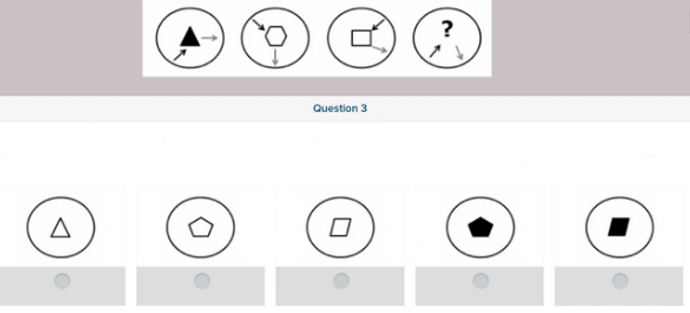
Which shape replaces the question mark?
Answer and complete explanation
Correct answer: D — filled pentagon.
Read the grey arrow as a clock hand: it points to 3, 6 and 4 in the completed panels, matching the triangle, hexagon and quadrilateral. In the missing panel it points to 5, so the shape must be a pentagon. Check the black arrow separately. It points upwards in the filled example and downwards in the two outline examples. In the missing panel it points upwards, so the pentagon must be filled. The answer is D.
Why B fails: B has five sides but is an outline shape; it fails the fill rule indicated by the black arrow.
Which panel completes the arrow-and-dot sequence?
Answer and complete explanation
Correct answer: E — upward arrow with five dots.
Track two independent rules across all four panels. The arrow turns 90 degrees clockwise: up, right, down, left, so it must point up next. The number of black dots increases by one: 1, 2, 3, 4, so the next panel must contain 5. Only E combines an upward arrow with five dots.
Check every option: A has the correct arrow but only four dots. B and D have five dots but the wrong arrow direction. C has the correct arrow but only three dots.
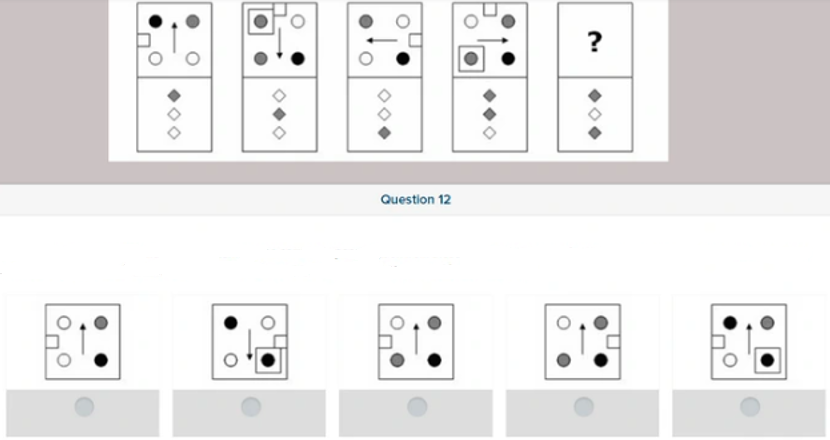
Which upper panel completes the sequence?
Answer and complete explanation
Correct answer: A.
Use two directly repeatable features. The large box highlighting a circle is absent, present, absent, present, so it must be absent in panel 5. The number of grey circles is 1, 2, 1, 2, so the next panel must contain one grey circle. B and E have a highlight box; C and D have two grey circles. Only A satisfies both rules. These two checks are sufficient: the side marker and arrow do not need an additional assumed rule.
Elimination: B and E break the box alternation. C and D break the one-grey-circle requirement.
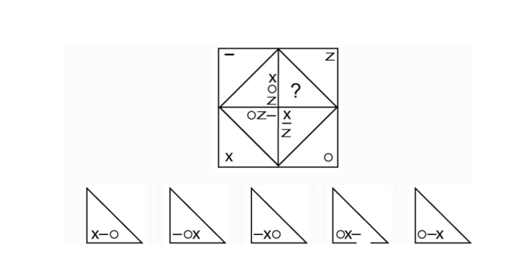
Which triangular response completes the diagram?
Answer and complete explanation
Correct answer: D — OX–.
Each inner triangle contains the three outer-corner symbols other than its own corner symbol. Starting at that corner, follow the other corners anticlockwise and read the inner symbols from the outer edge towards the centre. The completed triangles give X-O-Z at the top left, O-Z-dash at the bottom left and Z-dash-X at the bottom right. For the top-right corner Z, the required inward order is dash-X-O. Here inward runs from right to left, so the answer as printed from left to right is O-X-dash: D.
Why the alternatives fail: C prints dash-X-O from left to right. That is the correct inward order written in the wrong spatial direction. E places the dash in the middle and does not follow the established order.
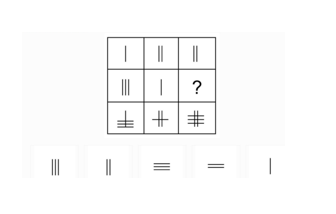
Which symbol completes the matrix?
Answer and complete explanation
- Three vertical lines
- Two vertical lines
- Three horizontal lines
- Two horizontal lines
- One vertical line
Correct answer: A — Three vertical lines.
Worked explanation: Analyse the matrix by columns rather than by rows. In each column, the top cell determines the vertical-line contribution. The middle cell contributes horizontal lines after a 90-degree rotation. In the third column, the final combined cell shows two vertical and three horizontal lines. Since the horizontal part comes from the rotated middle cell, the missing middle-right item must be three vertical lines before rotation. Therefore option A is correct.
Strongest distractor: Option B focuses only on the visible two vertical lines in the final cell and ignores that the middle cell contributes the horizontal component after rotation.
Finish with These Easy SHL-Style Inductive Tests
End the free practice with three simpler questions covering rotation, a basic matrix and a mobile-friendly drag-and-drop movement rule.
Which figure comes next in the sequence?
Answer and complete explanation
- Outline triangle pointing left
- Filled triangle pointing up
- Outline triangle pointing right
- Filled triangle pointing left
Correct answer: D — Filled triangle pointing left.
Worked explanation: The triangle rotates 90 degrees clockwise in every step. At the same time, fill alternates outline, filled, outline, filled. Both rules must be satisfied.
Strongest distractor: Option A has the correct direction but ignores the alternating fill rule.
Which figure completes the lower-right cell?
Answer and complete explanation
- Outline circle
- Filled triangle
- Filled square
- Outline square
Correct answer: C — Filled square.
Worked explanation: Moving from left to right changes circle into square. Moving from top to bottom changes outline into filled. The missing cell must satisfy both relationships.
Strongest distractor: Option D follows the row rule but fails the column fill rule.
Drag the panel that completes the clockwise movement rule
Answer and complete explanation
- Marker at top-right
- Marker at bottom-left
- Marker at centre
- Marker at bottom-right
Correct answer: B — Marker at bottom-left.
Worked explanation: The marker visits the four corners clockwise: top-left, top-right, bottom-right, bottom-left.
Strongest distractor: Option D repeats the previous position instead of continuing the cycle.
Practice score: 0 / 8.
Two Worked Visual Examples
Study the diagram first, form your own rule and then compare it with the complete explanation.
Triangle and Circle Dependency Pattern
One visual zone controls the colour distribution in another zone.
The upper and lower zones repeat the same black-to-white distribution.
Each filled circle produces a filled triangle and each outline circle produces an outline triangle.
E — three filled triangles and one outline triangle.
Read the complete explanation
- Separate every panel into an upper circle zone and a lower triangle zone.
- Count filled and outline circles independently.
- Compare that count with the triangles directly below.
- The distribution is preserved in both completed panels.
- The target therefore needs three filled triangles and one outline triangle.
Why option D fails: it copies only the filled shapes and ignores the outline circle.
Lines, Circles and Squares Matrix
The number of connecting lines controls the number of filled circles.
The square is only a frame. The active features are the horizontal lines and filled circles.
The number of horizontal lines equals the number of filled circles.
A — three lines and three filled circles.
Read the complete explanation
- Ignore the outer square temporarily.
- Count the lines and circles in each completed panel.
- The first panel contains one of each; the second contains two of each.
- The missing panel must therefore contain three lines and three filled circles.
Why option B fails: it contains three circles but only two lines, so it preserves only half of the relationship.
What to Do After the Questions
Your score matters less than the reason behind each mistake. Use the sequence below to turn every question into a reusable skill.
Identify the rule family
Was the question testing count, movement, rotation, matrix logic or dependency?
Explain the complete rule
State the rule in one sentence and verify it against every panel or matrix cell.
Review the distractor
Record which partial rule made the wrong answer look attractive.
Add time pressure gradually
Move from untimed accuracy to short timed sets and then to a complete mock test.
Understand the Test
Build a reliable mental model of the assessment before studying advanced rules or adding time pressure.
Foundation: What SHL Inductive Reasoning Measures
What Is the SHL Inductive Reasoning Test?
The SHL Inductive Reasoning Test is a pre-employment reasoning assessment. It usually presents non-verbal information such as shapes, symbols, lines, grids, colours, rotations or matrices. Your task is to infer the hidden rule and select the answer that completes the pattern.
Inductive reasoning is different from memorisation. You are not asked to recall facts. You are asked to infer a probable rule from the evidence shown.
Common SHL-style tasks include:
- completing a sequence
- filling a missing matrix cell
- identifying the next figure
- detecting a visual relationship
- solving a diagrammatic pattern
- completing an interactive reasoning task.
SHL Direct describes inductive reasoning examples as tasks where the candidate must identify the underlying pattern in the information shown.
Important Independence Notice
ReasoningCampus provides independent SHL-style practice and learning resources.
The purpose of this page is educational: to help candidates build the pattern recognition, visual reasoning and timed problem-solving skills commonly required in SHL-style inductive reasoning assessments.
What to Expect on the SHL Inductive Reasoning Test
Candidates may encounter SHL-style inductive reasoning in different formats depending on the employer, role, assessment platform and test invitation.
The exact structure can vary, but most SHL-style inductive reasoning questions test the same core skill: identifying a hidden visual rule and applying it quickly.
Main SHL-Style Inductive Test Formats
| Format | What You Usually Do | Main Candidate Challenge |
|---|---|---|
| Interactive inductive reasoning | Click, drag, connect or manipulate visual elements | Understanding the task quickly before solving |
| Non-interactive inductive reasoning | Choose the correct option from multiple answers | Fast rule detection and elimination |
| Matrix completion | Select the missing figure in a grid | Row and column verification |
| Sequence completion | Choose the next or missing figure in a sequence | Tracking progression, movement and transformation |
| Diagrammatic reasoning | Interpret relationships between symbols or figures | Mapping rules and dependencies |
| Legacy-style logical / inductive questions | Solve classic abstract or figural patterns | Recognising older pattern formats |
Interactive vs Non-Interactive SHL-Style Questions
Interactive questions require the candidate to do something on screen. This may involve dragging, connecting, selecting or manipulating visual elements.
Non-interactive questions are usually closer to classic multiple-choice abstract reasoning. The candidate selects one answer from several options.
SHL Direct provides practice tests and candidate-facing example questions, which can help candidates become familiar with assessment styles before taking a real test.
Candidate Note
Always check the exact instructions in your assessment invitation. The test name, timing, number of questions and interaction style may vary depending on the employer and assessment setup.
The safest preparation strategy is not to memorise one format. It is to train the underlying reasoning skill: pattern recognition, rule testing, feature separation and timed elimination.
SHL Inductive vs Deductive vs Numerical Reasoning
Many candidates confuse inductive, deductive and numerical reasoning because they may appear in the same assessment ecosystem.
They test different thinking skills.
| Reasoning Type | What It Tests | Typical Format | Main Skill |
|---|---|---|---|
| Inductive reasoning | Inferring a hidden rule from examples | Shapes, symbols, sequences, matrices | Pattern recognition |
| Deductive reasoning | Applying given rules to reach a logical conclusion | Rules, statements, logical conditions | Rule application |
| Numerical reasoning | Interpreting numerical data | Tables, charts, percentages, ratios | Data interpretation |
| Verbal reasoning | Evaluating written information | Passages and statements | Evidence-based reading |
| Diagrammatic reasoning | Understanding visual relationships | Symbols, flows, diagrams | Relationship mapping |
| Abstract reasoning | Solving non-verbal visual patterns | Shapes and transformations | Visual logic |
Simple Difference
Inductive reasoning asks:
“What rule can I infer from what I see?”
Deductive reasoning asks:
“What conclusion follows from the rules I am given?”
Numerical reasoning asks:
“What does the data show?”
This distinction matters because many candidates practise the wrong skill. A candidate who is strong in verbal reasoning may still struggle with inductive reasoning if they have not trained visual rule detection.
SHL Verify G+ and Test Formats
SHL’s Verify G+ product factsheet describes Verify G+ as measuring three types of ability: Numerical, Deductive and Inductive. The factsheet states that the test has 30 questions, with 10 questions for each of the three abilities measured.
This means candidates may encounter inductive reasoning as part of a broader general ability assessment, depending on the employer and assessment setup.
SHL Verify G+ Style Reasoning
SHL Verify G+ style reasoning may include:
- numerical reasoning
- deductive reasoning
- inductive reasoning
- mixed cognitive ability tasks
- timed online assessment conditions.
Interactive SHL Verify G+ Style Reasoning
Interactive SHL-style reasoning can feel harder than classic multiple-choice reasoning because the candidate must first understand what action is required.
Instead of only selecting an answer, the candidate may need to:
- drag a line
- complete a sequence
- connect visual elements
- click or manipulate parts of the screen
- understand a dynamic rule
- remember how elements behave.
Why Interactive Questions Feel Harder
Interactive questions add an extra layer of difficulty.
The candidate must solve two problems:
- What does the task want me to do?
- What is the hidden reasoning rule?
- This is why interactive reasoning practice should train both task comprehension and pattern recognition.
ReasoningCampus Strategy for Interactive Questions
For interactive SHL-style questions, use this order:
- Read the instruction carefully.
- Identify what action is required.
- Ignore unnecessary visual noise.
- Find the rule family.
- Complete the action.
- Check that the result follows the rule.
Non-Interactive SHL Inductive Reasoning
Non-interactive SHL-style inductive reasoning is usually closer to classic multiple-choice abstract reasoning.
The candidate sees a sequence, matrix or visual pattern and selects the correct answer from several options.
Main Non-Interactive Question Types
- next figure in a sequence
- missing figure in a matrix
- pattern completion
- odd one out
- visual analogy
- diagrammatic relationship.
Why Non-Interactive Questions Are Still Difficult
They may look simpler because you only click an answer, but the distractors can be very strong.
A wrong answer may:
- match the shape but not the colour
- match the count but not the position
- match the row but not the column
- match one rule but break another
- look visually close but fail the dependency.
Legacy / CEB-Style Logical-Inductive Formats
Candidates may also see online references to older CEB/SHL logical or inductive reasoning formats. These references can be useful for understanding classic abstract reasoning patterns, but your current employer invitation should always be treated as the most reliable source for the actual test format.
SHL has also announced the retirement of some legacy Verify tests, which is why candidates should rely on their current assessment invitation and current SHL product information rather than older online descriptions.
Why Official Practice Alone May Not Be Enough
Official practice is useful because it helps candidates understand the test environment, instructions and general style.
However, many candidates need more than a few familiarisation questions.
Official SHL practice pages are useful for understanding the assessment environment and seeing candidate-facing examples, but structured preparation helps candidates go beyond exposure and learn how to recognise, classify and solve rule families.
Structured preparation helps you understand:
- why the correct answer is correct
- why the wrong answers are wrong
- which rule family is being tested
- which mistakes you repeat
- which pattern types take you too long
- how to improve under timed conditions.
The Difference Between Familiarisation and Training
| Practice Type | Main Purpose |
|---|---|
| Familiarisation practice | Understand the test style and interface |
| Skill training | Learn rule families and solving methods |
| Timed mock testing | Build speed and assessment readiness |
| Error review | Fix repeated mistakes |
| Pattern classification | Understand the structure behind questions |
ReasoningCampus focuses on training, not just exposure.
The aim is not to show candidates a few examples. The aim is to help them build a repeatable solving system.
SHL Inductive Reasoning Scores Explained
Candidates often want to know what score they need.
The answer depends on the employer, role, comparison group and assessment process. SHL’s ability report materials describe reporting that includes overall General Ability as well as Numerical, Deductive and Inductive Reasoning results.
What This Means Practically
A candidate should not prepare only to “get a few questions right”.
The real goal is to become consistent across unfamiliar questions under time pressure.
How to Think About Performance
| Candidate Level | Typical Behaviour |
|---|---|
| Weak preparation | Guesses based on visual similarity |
| Basic preparation | Solves simple count and rotation rules |
| Good preparation | Recognises common pattern families |
| Strong preparation | Handles matrices, dependencies and distractors |
| Assessment-ready preparation | Applies a consistent method under time pressure |
Important Note
Learn the Solving Method
Move from random visual inspection to a repeatable process for isolating, testing and confirming the rule.
Common Patterns to Track
To solve visual puzzles under time pressure, focus on how each feature changes from one panel, cell or zone to the next.
Rotation
Check clockwise or anticlockwise movement and test likely angles such as 45°, 90° and 180°.
Movement & Position
Track a symbol through corners, rows, columns, diagonals, circular paths or alternating sides.
Shading & Colour
Look for alternating fill, colour-dependent actions, inversion, solid/outline cycles or category-specific counts.
Shape Counting
Count sides, objects, intersections and filled versus empty elements separately.
Frequency & Alternation
Test whether a transformation repeats every second, third or fourth frame or resets after a cycle.
Dependencies
Ask whether one feature controls another—for example, colour controlling movement or dot count controlling lines.
Theory: How Inductive Reasoning Works
Inductive Reasoning Knowledge Graph
- Inductive Reasoning
- → Abstract Reasoning
- → Diagrammatic Reasoning
- → Non-Verbal Reasoning
- → Figural Reasoning
- → Visual Reasoning
- → Pattern Recognition
- → Fluid Reasoning
- → Cognitive Ability
- → Psychometric Assessment
- → Online Recruitment
- → Graduate Assessment
- → Assessment Centre
Assessment labels can overlap, but they are not interchangeable. Check the examples and instructions in your invitation: a sequence task, a matrix task and an operator diagram can require different methods.
Cognitive Science Behind Inductive Reasoning
Inductive reasoning feels difficult because it activates several cognitive systems at the same time.
Working Memory Working memory helps you hold and manipulate information temporarily. In an SHL-style matrix, you may need to remember the number of black circles, movement direction, row logic, column logic and answer options at the same time.
Research has found a strong relationship between working memory and fluid intelligence, although the exact nature of that relationship remains debated.
Selective Attention Selective attention helps you focus on relevant visual features and ignore distractors. In abstract reasoning, the most visible feature is not always the rule.
Executive Function Executive functions support control processes such as switching strategies, inhibiting premature answers and managing novel tasks. Research on executive functions describes them as supporting activities such as thinking before acting, handling novel challenges, resisting distractions and staying focused.
Visual Search Visual search is the ability to scan the image efficiently. A candidate may understand the logic but still solve slowly if their eyes move randomly across the figure.
Why Candidates Misidentify the Rule
Candidates usually misidentify rules for five reasons:
- They notice the most visually obvious feature first.
- They stop after finding one partial rule.
- They do not separate black, white, filled and empty objects.
- They ignore row-column verification in matrices.
- They choose the answer that looks closest rather than the answer that follows the rule.
Concept Card: Dependency Rule
Definition
A dependency rule exists when one visual feature controls another visual feature.
Visual Indicators
- one area appears to “code” another area
- the number of one object matches the number of another object
- lines correspond to active shapes
- colour controls movement
- position controls fill.
Difficulty
Usually moderate to advanced.
Typical Errors
Candidates often treat all features as independent and miss the controlling relationship.
Related Rules
- RC-801 Count Controls Lines
- RC-805 Top Zone Controls Bottom Zone
- RC-610 Matrix Transformation
- Visual Complexity VC-5 to VC-7
Concept Card: Matrix Operator
Definition
A matrix operator is a rule that explains how rows, columns or cells interact in a grid.
Visual Indicators
- each row follows a pattern
- each column follows a pattern
- two cells combine to produce a third
- repeated elements disappear
- each row or column contains a fixed distribution.
Difficulty
Usually intermediate to advanced.
Typical Errors
Candidates solve a row but forget to verify the column.
Related Rules
- RC-601 Row Addition
- RC-606 Column Distribution
- RC-607 Third Cell Combination
- RC-703 Cancellation
Methodology: The ReasoningCampus System
The ReasoningCampus Method
The ReasoningCampus Method is our step-by-step approach for solving SHL-style inductive reasoning questions.
We call it the OSCC-VEC Method:
Observe → Separate → Count → Compare → Connect → Verify → Eliminate → Confirm
Step 1: Observe
Identify the question format.
Ask:
- Is it a sequence?
- Is it a matrix?
- Is it an analogy?
- Is it an odd-one-out question?
- Is it interactive?
- Is the missing item at the end, middle or inside a grid?
Step 2: Separate
Break the figure into features.
Separate:
- shape type
- number of objects
- colour or fill
- position
- rotation
- size
- connection lines
- symmetry
- row logic
- column logic.
Step 3: Count
Count by category.
Do not count all objects together.
Count:
- black circles
- white circles
- filled shapes
- empty shapes
- lines
- intersections
- triangles
- squares
- repeated objects.
Step 4: Compare
Compare neighbouring figures, rows and columns.
Ask:
- What changes?
- What stays the same?
- Does the rule repeat?
- Does the rule alternate?
- Is one feature increasing while another decreases?
Step 5: Connect
Look for dependencies.
A dependency exists when one feature controls another.
Examples:
- black circles control the number of lines
- top symbols control bottom shapes
- arrow direction controls movement
- number of corners controls number of dots.
Step 6: Verify
Test the rule across the whole question.
- A weak rule works once.
- A strong rule works across the full pattern.
Step 7: Eliminate
Remove options that break a confirmed rule.
Elimination is essential when time is limited.
Step 8: Confirm
Before selecting the answer, confirm it with a second feature.
For example:
- count is correct
- colour is correct
- position is correct
- line relationship is correct.
Visual Search Strategy
Use this eye path when a question looks complex.
For Sequences
- First figure
- Second figure
- Third figure
- Change between figures
- Answer options
- Eliminate options that break the change rule
For Matrices
- Top row
- Second row
- Left column
- Second column
- Missing row/column intersection
- Answer options
- Confirm both row and column logic
For Two-Zone Figures
- Top zone
- Bottom zone
- Left-to-right relationship
- Colour and count relationship
- Answer options
Pattern Recognition Checklist
Before answering, ask:
- Is there a count rule?
- Is there a rotation rule?
- Is there a movement rule?
- Is there a colour or fill rule?
- Is there a symmetry rule?
- Is there a line or connector rule?
- Is there a matrix row rule?
- Is there a matrix column rule?
- Is one feature controlling another?
- Can I eliminate at least two options?
- Does my answer satisfy more than one feature?
Question Taxonomy
Pattern families are not the same as question types. A question type is the format. A pattern family is the underlying rule.
| Question Type | What It Asks | Common Pattern Families |
|---|---|---|
| Sequence | What comes next? | Movement, rotation, count, alternation |
| Matrix | What completes the grid? | Row operators, column operators, distribution |
| Odd One Out | Which figure breaks the rule? | Symmetry, count, colour, transformation |
| Analogy | A is to B as C is to ? | Transformation, rotation, substitution |
| Interactive | Complete by clicking or dragging | Sequence, line connection, dynamic rule |
| Grid | Fill a missing cell | Matrix, distribution, row-column logic |
| Dependency | What feature controls another? | Count-line, top-bottom, colour-position |
| Transformation | How does the figure change? | Rotation, reflection, overlay, cancellation |
ReasoningCampus Pattern Classification System
The ReasoningCampus Pattern Classification System assigns RC codes to recurring SHL-style rule families.
This is not an official SHL taxonomy. It is a ReasoningCampus educational system for organising practice.
| Code Range | Pattern Family |
|---|---|
| RC-100 | Counting Rules |
| RC-200 | Movement Rules |
| RC-300 | Rotation Rules |
| RC-400 | Colour and Fill Rules |
| RC-500 | Symmetry and Reflection Rules |
| RC-600 | Matrix Operator Rules |
| RC-700 | Overlay and Boolean Rules |
| RC-800 | Dependency Rules |
| RC-900 | Interactive Reasoning Rules |
| RC-1000 | Compound and Expert Rules |
Pattern Evolution Tree
- Count
- Simple Count
- Dual Count
- Conditional Count
- Dependency Count
- Matrix Count
- Compound Count
- Movement
- Linear Movement
- Circular Movement
- Alternating Movement
- Movement + Colour
- Movement + Rotation
- Conditional Movement
- Rotation
- Single Rotation
- Alternating Rotation
- Nested Rotation
- Double Rotation
- Rotation + Matrix
- Compound Rotation
ReasoningCampus Difficulty Index
The ReasoningCampus Difficulty Index, or RCDI, is a training scale from 1 to 100.
It is not an official SHL score. It is a ReasoningCampus learning tool used to estimate how demanding a question is.
| Factor | Meaning |
|---|---|
| Visual Complexity | How visually dense the item is |
| Rule Complexity | How many rules are active |
| Working Memory Load | How many features must be tracked |
| Time Pressure | How quickly the rule must be found |
| Distractor Strength | How convincing the wrong options are |
| Transfer Difficulty | How hard it is to recognise the rule in a new format |
RCDI Scale
| RCDI Score | Level | Meaning |
|---|---|---|
| 1–15 | Very easy | One obvious rule |
| 16–30 | Easy | One rule with mild distractors |
| 31–45 | Moderate | Two features to track |
| 46–60 | Challenging | Matrix or multi-feature logic |
| 61–75 | Difficult | Dependency or compound rule |
| 76–90 | Very difficult | Several interacting rules |
| 91–100 | Expert | High density, hidden dependency and strong distractors |
Visual Complexity Scale
| Level | Visual Features | Candidate Challenge |
|---|---|---|
| VC-1 | Few objects, one colour | Easy scanning |
| VC-2 | Multiple objects, one main rule | Basic feature tracking |
| VC-3 | Multiple colours or fills | Separate counting |
| VC-4 | Several positions or directions | Movement tracking |
| VC-5 | Lines, connectors or zones | Relationship tracking |
| VC-6 | Matrix with row and column logic | Dual verification |
| VC-7 | Multiple dependencies | High working memory load |
| VC-8 | Compound transformations | Expert-level reasoning |
ReasoningCampus Error Taxonomy
A vague statement such as “I did not see the pattern” is not useful.
At ReasoningCampus, we classify mistakes so candidates know what to fix.
| Error Type | Description | Example |
|---|---|---|
| Visual Error | Missing a visible feature | Ignoring white circles |
| Scanning Error | Looking in the wrong order | Checking options too early |
| Counting Error | Counting the wrong objects | Counting all circles together |
| Dependency Error | Missing a controlling relationship | Lines depend on black circles |
| Inference Error | Inferring too early | Choosing after one observation |
| Matrix Error | Solving only row or column | Ignoring column logic |
| Working Memory Error | Losing track of features | Forgetting the colour rule |
| Distractor Error | Choosing a similar wrong option | Picking the closest-looking figure |
| Strategy Error | Spending too long on one path | Refusing to eliminate |
| Transfer Error | Knowing a rule but missing it in a new form | Failing a rotated version of a familiar rule |
Prerequisite Graph
Before learning matrix operators, you should already know:
- counting
- colour and fill rules
- basic rotation
- position movement
- row comparison
- column comparison
- elimination.
- Before learning dependency rules, you should already know:
- feature separation
- category counting
- line recognition
- zone comparison
- answer verification.
- Before doing timed mixed mock tests, you should already know:
- the main RC pattern families
- the OSCC-VEC Method
- the Pattern Recognition Checklist
- your most common error types.
Study the Pattern Library
Use the classification system to connect unfamiliar diagrams with recurring rule families and worked examples.
Practice: Examples, Checklists and Mock Test Strategy
Pattern Database: Core RC Pattern Families
RC-100: Counting Rules
| Code | Pattern |
|---|---|
| RC-101 | Simple count increase |
| RC-102 | Simple count decrease |
| RC-103 | Dual count |
| RC-104 | Nested count |
| RC-105 | Conditional count |
| RC-106 | Alternating count |
| RC-107 | Row count |
| RC-108 | Column count |
| RC-109 | Filled vs empty count |
| RC-110 | Shape-specific count |
RC-200: Movement Rules
| Code | Pattern |
|---|---|
| RC-201 | Linear movement |
| RC-202 | Circular movement |
| RC-203 | Diagonal movement |
| RC-204 | Corner-to-corner movement |
| RC-205 | Alternating movement |
| RC-206 | Two-object movement |
| RC-207 | Opposite-direction movement |
| RC-208 | Step-size movement |
| RC-209 | Hidden position cycle |
| RC-210 | Movement controlled by colour |
RC-300: Rotation Rules
| Code | Pattern |
|---|---|
| RC-301 | 45-degree rotation |
| RC-302 | 90-degree rotation |
| RC-303 | 180-degree rotation |
| RC-304 | Alternating rotation |
| RC-305 | Clockwise rotation |
| RC-306 | Anti-clockwise rotation |
| RC-307 | Double rotation |
| RC-308 | Nested rotation |
| RC-309 | Rotation plus movement |
| RC-310 | Rotation controlled by position |
RC-600: Matrix Operator Rules
| Code | Pattern |
|---|---|
| RC-601 | Row addition |
| RC-602 | Column addition |
| RC-603 | Row subtraction |
| RC-604 | Column subtraction |
| RC-605 | Row distribution |
| RC-606 | Column distribution |
| RC-607 | Third cell combination |
| RC-608 | Missing-set completion |
| RC-609 | Row-column intersection |
| RC-610 | Matrix transformation |
RC-800: Dependency Rules
| Code | Pattern |
|---|---|
| RC-801 | Count controls lines |
| RC-802 | Colour controls movement |
| RC-803 | Shape controls rotation |
| RC-804 | Position controls fill |
| RC-805 | Top zone controls bottom zone |
| RC-806 | Left side controls right side |
| RC-807 | Number of corners controls dots |
| RC-808 | Arrow direction controls sequence |
| RC-809 | Matrix cell controls another cell |
| RC-810 | Dependency plus distractor feature |
- RC-801 Count Controls Lines
- RC-610 Matrix Transformation
- Matrix Operator Rules
Mastery Indicators
You have mastered dependency questions if you can:
- identify when one zone controls another
- separate controlling and controlled features
- count by category
- explain why a distractor fails
- transfer the same logic to a new figure.
- You have mastered matrix questions if you can:
- compare rows
- compare columns
- identify the operator
- test the answer in two directions
- avoid choosing an answer that satisfies only one rule.
Resources, FAQ and Next Steps
Review the essential study resources, common candidate questions and the best next step for your preparation.
Designed for Clear, Transferable Reasoning
The ReasoningCampus Assessment Editorial Team reviews every worked solution for rule consistency, answer-choice quality, accessibility and practical value.
Glossary of Pattern and Reasoning Terms
| Term | Meaning |
|---|---|
| Abstract reasoning | Reasoning with shapes, symbols or non-verbal patterns |
| Alternation | A rule that switches between states |
| Analogy | A relationship where one pair mirrors another |
| Cognitive ability | Mental ability used to learn, reason and solve problems |
| Dependency | A rule where one feature controls another |
| Diagrammatic reasoning | Reasoning with diagrams and symbolic relationships |
| Distractor | A wrong answer designed to look plausible |
| Error taxonomy | A classification system for mistakes |
| Figural reasoning | Reasoning with visual figures |
| Inductive reasoning | Inferring a rule from examples |
| Matrix | A grid-based reasoning question |
| Pattern family | A group of questions based on the same rule type |
| RCDI | ReasoningCampus Difficulty Index |
| Rotation | A rule involving angle change |
| Sequence | A series of figures following a rule |
| Visual complexity | The density and difficulty of visual information |
| Working memory | Holding and manipulating information in mind |
Inductive Reasoning Guides and Official SHL Resources
Use the ReasoningCampus guides for deeper preparation and the official SHL pages for first-party examples, practice information and product updates.
ReasoningCampus In-Depth Guides
Complete SHL Inductive Reasoning Test Guide Test overview, formats, pattern types and candidate preparation. SHL Inductive Test Rules, Patterns and Strategy Rule families, visual dependencies and systematic solving techniques. How to Prepare for SHL Inductive Reasoning Tests A progressive study plan from untimed accuracy to timed practice.Official SHL Resources
SHL Direct Inductive Reasoning Example Questions Official short examples with answer feedback. SHL Direct Practice Tests Official practice-test area for candidates. SHL Practice Tests and Assessment Advice Official candidate guidance and practice information. SHL Verify Inductive-Reasoning Product Update Official information on the move from legacy Verify tests to the interactive assessment.SHL Inductive Reasoning Practice FAQs
Is SHL inductive reasoning the same as abstract reasoning?
They are closely related. SHL-style inductive reasoning commonly uses abstract, diagrammatic, figural and non-verbal information.
What is SHL Verify G+?
Verify Interactive G+ assesses general cognitive ability through Numerical, Deductive and Inductive Reasoning. The exact configuration, timing and question count depend on the current assessment selected by the employer.
Are SHL questions repeated?
Do not rely on repeated questions. A safer strategy is to learn transferable rule families that can appear in unfamiliar visual forms.
How should I approach interactive questions?
Identify the required screen action first, then solve the reasoning rule. Do not start dragging, connecting or clicking before you understand the instruction.
What is the ReasoningCampus Difficulty Index?
RCDI is an internal 1–100 training scale based on visual density, rule complexity, working-memory load, distractor strength and transfer difficulty. It is not an official SHL score.
How long should I spend on one inductive reasoning question?
During untimed practice, spend enough time to state the complete rule clearly. During timed sets, use an initial scan, test the strongest rule and move on when the question is consuming disproportionate time.
Continue your preparation at your own pace
Explore the full ReasoningCampus programme, see what is included and choose the next step that fits your assessment.
View full preparation