
How to Prepare for SHL Inductive Reasoning Tests
If you are preparing for an SHL inductive reasoning test, the most important thing to understand is that these questions are not really about guessing shapes. They are about recognising rules.
Many candidates approach SHL inductive reasoning questions the wrong way. They look at the figures, jump to the answer options, and choose the option that looks most similar or most balanced. That is one of the most common reasons people lose marks.
In this type of test, visual similarity can be misleading. A wrong option may look tidy, familiar, or close to the pattern, while still breaking the real rule. The correct answer is not the one that looks nicest. It is the one that continues the logic exactly.
That is the mindset you need from the start:
do not guess the picture — decode the rule.
This guide explains how SHL inductive reasoning tests work, what types of rule patterns appear most often, what mistakes candidates make, and how to use SHL inductive reasoning practice more effectively.
Contents
- What Is SHL Inductive Reasoning?
- Why SHL Inductive Reasoning Questions Feel Difficult
- The Best Mindset for SHL Inductive Reasoning Practice
- The First Rule: Count Before You Interpret
- The Second Rule: Do Not Solve the Whole Figure at Once
- The Most Common Rule Types in SHL Inductive Reasoning Questions
- Movement Versus Relationship: A Critical Distinction
- Not Every Visible Feature Is Important
- Hidden Symbols Still Matter
- Many SHL Inductive Reasoning Questions Contain More Than One Rule
- What to Do in the First 10 Seconds of a Question
- A Practical Order of Attack
- What to Do When You Get Stuck
- How to Tell a Real Rule from a Coincidence
- Use Elimination Early
- The Most Common SHL Inductive Reasoning Traps
- How to Use SHL Inductive Reasoning Practice Tests Properly
- Final Thoughts
- FAQ
Editorial Note – How this guide was prepared
This guide is based on long-term work with reasoning-test preparation and structured review of SHL-style inductive reasoning material. Our editorial process focuses on recurring rule patterns, common candidate mistakes, and practical solving methods that can be applied under time pressure.
To improve accuracy and usefulness, this article was developed through:
- review of SHL-style inductive and abstract reasoning question formats
- analysis of common solving errors made by candidates
- comparison of recurring rule families across preparation materials
- editorial review for clarity, consistency, and instructional value
The goal of this guide is not to overwhelm candidates with theory, but to provide a method that is clear, practical, and easy to apply during real test practice.
Written by: Preparation Editorial Team – Reasoning Campus
Reviewed by: Reasoning Test Content Reviewer
Last updated: March 2026
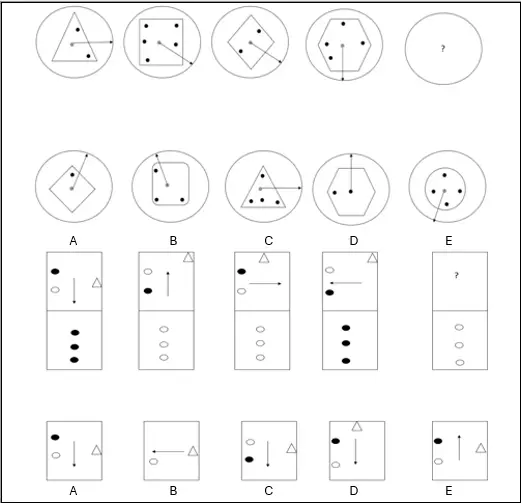
What Really is an SHL Inductive Reasoning Test?
An SHL inductive reasoning test is designed to assess how well you can identify patterns, detect logical rules, and work out what should come next in a sequence of figures.
Instead of using written passages or numerical tables, these questions usually use shapes, symbols, positions, lines, shading, or figure transformations. You are expected to identify the underlying rule and apply it accurately.
This is why many candidates describe SHL inductive reasoning as abstract or visual reasoning. But the strongest candidates do not rely on visual instinct alone. They use a method.
In most cases, these questions test whether you can:
- identify what changes from one figure to the next
- separate important changes from distractions
- spot recurring rule types quickly
- recognise when more than one rule is active
- make accurate decisions under time pressure
So although the test looks visual, the real skill being measured is structured logical thinking.
Why SHL Inductive Reasoning Questions Feel Difficult
The real difficulty in SHL inductive reasoning questions is usually not that the pattern is impossible. The difficulty is that the figure often contains several moving parts at once.
A single question may include:
- changes in position
- changes in rotation
- changes in shading
- increases or decreases in the number of symbols
- inside and outside movement
- one visible rule
- and then a second hidden rule underneath it
If you try to understand the whole picture in one glance, the question can feel messy and random. But when you split it into smaller parts, the structure usually becomes much clearer.
That is one of the biggest differences between weak and strong performance. Strong candidates do not stare harder at the figure. They organise what they are looking at.
The Useful Mindset for SHL Inductive Reasoning Practice Tests
A lot of candidates think improvement comes mainly from doing more questions. But volume alone is not enough.
The real goal of SHL inductive reasoning practice tests is to train yourself to recognise familiar rule types faster and avoid common traps.
That means good practice is not just about asking:
Did I get the answer right?
It is also about asking:
- What was the real rule?
- What did I notice first?
- Did I focus on the right feature?
- Did I miss a second rule?
- Did I get distracted by visual similarity?
- Could I have eliminated answers earlier?
This is how practice becomes useful. You are not just repeating questions. You are training the way you think.
The First Rule: Count Before You Interpret
One of the best habits in SHL inductive reasoning tests is to count something before trying to explain the full pattern.
Ask questions like:
- How many shapes are there?
- How many are black, white, shaded, or outlined?
- How many circles, triangles, lines, or marks appear?
- Does the number increase?
- Does it decrease?
- Does it alternate?
- Does one count control another?
A lot of questions that look highly visual are actually driven by simple numerical rules. The number of dots may rise by one. The number of lines may alternate. One group of symbols may determine how many of another symbol should appear.
Candidates who ignore counting often make a simple question look harder than it really is.
So when a figure feels crowded, one of the smartest first questions is:
What can I count here?
The Second Rule: Do Not Solve the Whole Figure at Once
One of the biggest mistakes in SHL abstract reasoning test practice is treating the figure as one visual block.
A much better method is to split the figure into layers.
For example, separate:
- the outer frame
- the inner shape
- the moving dot
- the arrow
- the colour pattern
- the count of symbols
- the relationship between opposite positions
When you break the figure down like this, one complicated pattern often becomes two or three smaller and much easier mini-sequences.
A useful mental routine is:
- What is the frame doing?
- What is the inner shape doing?
- What is the black symbol doing?
- What is the white symbol doing?
- What is changing in number?
- What is staying fixed?
This is where real solving begins.
The Most Common Rule Types in SHL Inductive Reasoning Questions
A big part of doing well is learning to recognise the main rule families quickly. The exact shapes may change from test to test, but the logic behind them is often familiar.
1. Increase and decrease
Something goes up or down over the sequence.
For example:
- more dots
- fewer lines
- more sides
- fewer marks
- more filled shapes
- fewer empty shapes
These are often among the fastest rules to detect.
2. Alternation
Something flips between two states.
For example:
- black / white
- left / right
- top / bottom
- one line / two lines
- visible / hidden
Alternation is extremely common, and many candidates miss it because they assume the rule must be more complicated than it really is.
3. Rotation
A shape or marker may turn:
- clockwise
- anticlockwise
- by 90 degrees
- by 180 degrees
- by one step each frame
- by two steps each frame
Whenever direction changes, always test whether rotation is happening at a fixed rate.
4. Movement across space
Sometimes an object is not rotating at all. It is moving position.
For example, it may move:
- horizontally
- vertically
- diagonally
- through the corners
- along the edges
- through the centre
This is a position rule, not necessarily a rotation rule.
5. Coding the SHL algorithm
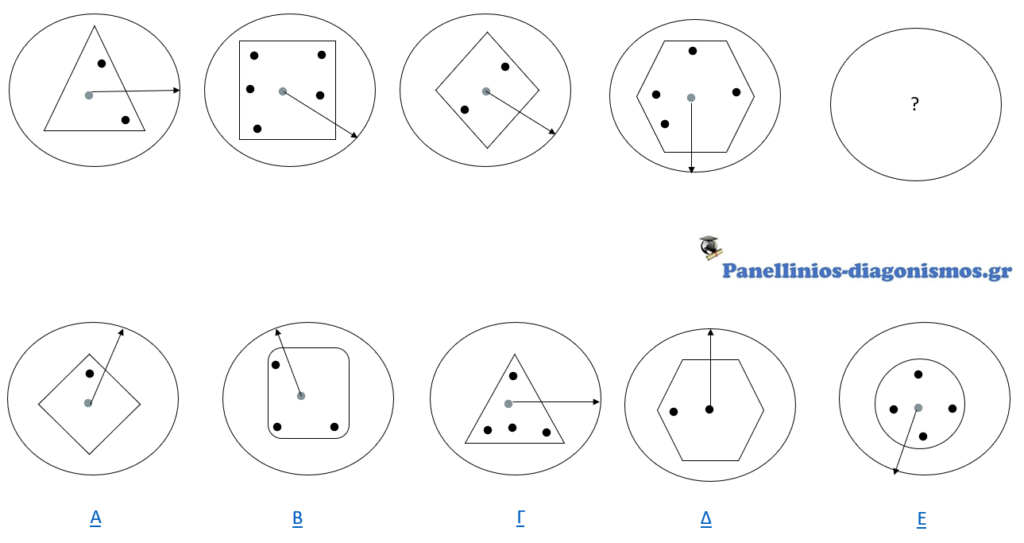
Sometimes one symbol is not changing for its own sake. It is describing another part of the figure.
For example:
- an arrow may show where another symbol will go next
- a pointer may indicate quantity
- a marker may encode direction
- one small symbol may predict what another symbol will do
This kind of rule is easy to miss if you assume every element is acting independently.
6. Replacement or transfer
Some questions are not really about movement. They are about one role replacing another.
For example:
- one shape moves from inside to outside
- one region changes while the rest stays fixed
- one symbol takes the place of another
- an inner role becomes an outer role
7. Balance and distribution
Not every question asks what moves next. Sometimes the real rule is about keeping the set balanced.
For example:
- preserving symmetry
- avoiding repetition
- maintaining variety
- keeping categories separate
- balancing black and white elements
This type of rule is easy to miss if you focus only on movement.
Movement Versus Relationship: A Critical Distinction
One of the most useful questions you can ask in an SHL inductive reasoning test is this:
Am I tracking movement, or am I preserving a relationship?
Some questions are clearly about movement:
- a circle travels through the corners
- an arrow rotates
- a marker shifts clockwise
- a dot moves across the frame
But others are really about structure:
- one count must equal another
- two colours must stay opposite
- the inner shape must maintain a fixed relation to the outer one
- the missing figure must preserve variety rather than repeat a type
This distinction is extremely valuable.
If you use a movement mindset on a relationship question, the puzzle can feel impossible. If you use a relationship mindset on a movement question, you may overcomplicate something simple.
Not Every Visible Feature Is Important
This is one of the biggest traps in SHL inductive reasoning questions.
The most noticeable feature in the figure is not always the real clue.
Sometimes:
- the outer frame is only a container
- a bold line grabs attention but is not the main rule
- the busiest part of the figure is there to distract you
- a central symbol looks important but is actually secondary
- one visible rule is only superficial, while a deeper rule controls the pattern
So when a question feels confusing, ask:
- Which feature changes most clearly?
- Which feature stays reliable across the sequence?
- Which feature may be noise rather than signal?
Strong candidates do not treat every visible detail as equally important. They filter.
Hidden Symbols Still Matter
In many SHL inductive reasoning practice questions, a symbol may seem to disappear when it is actually only hidden.
For example:
- a circle may move behind a triangle
- a small marker may pass behind a larger shape
- a line may be concealed by overlap
- a shape may look absent because part of it is covered
So whenever something appears to vanish, ask:
Has it really gone, or is it simply hidden?
This one habit prevents a lot of rushed mistakes.
Many SHL Inductive Reasoning Mock Tests Contain More Than One Rule
Another major reason candidates lose marks in SHL Reasoning Mock Tests is that they stop too early.
They notice one pattern, feel confident, and choose an option that fits that one rule but breaks another.
This happens all the time when:
- one object moves while another changes colour
- the outer frame alternates while the centre increases
- one symbol rotates every frame while another changes every second frame
- one part of the figure remains fixed while another is mirrored
A very useful habit is to ask:
Is there another rule running at the same time?
In many questions, the answer is yes.
Similar-Looking Symbols May Not Behave the Same Way
This is one of the classic traps in SHL inductive reasoning test questions.
Two symbols may look similar but follow different rules.
For example:
- two circles may not move in the same way
- two arrows may not rotate in the same direction
- two triangles may not change at the same speed
- one symbol may change every frame while another changes every second frame
So never assume:
same appearance = same behaviour
Always test whether the pattern really applies equally to all similar-looking elements.
What to Do in the First 10 Seconds of a Question – SHL Algorithm Decoding
The start of the question matters more than many candidates realise.
A strong opening routine is:
- check whether the number of elements changes
- check whether position changes
- check whether colour or shading changes
- check whether direction or rotation changes
- check whether one symbol may be coding another
- ask whether the sequence looks like one clean rule or two interlocking rules
This gives you a disciplined starting point instead of a vague visual reaction.
A Practical Order of Attack
When the figure looks busy, use a fixed order. This helps you stay calm and prevents random scanning.
Step 1: Count
Ask:
- How many objects are there?
- How many are black, white, shaded, or outlined?
- Is the number increasing, decreasing, alternating, or balanced?
Step 2: Check the frame
Ask:
- Is the outer shape changing?
- Is there a quadrant structure?
- Is the frame important, or just a container?
Step 3: Track one feature at a time
Follow a single element only:
- one circle
- one arrow
- one triangle
- one black symbol
- one shaded region
Step 4: Test the common rule families
Check for:
- increase / decrease
- alternation
- rotation
- movement
- coding
- replacement
- balance
Step 5: Ask what stays fixed
Look for:
- same count
- same role
- same pairing
- same orientation
- same opposite-position link
Step 6: Consider sub-sequences
Sometimes figures 1, 3, and 5 follow one rule while 2 and 4 follow another.
Step 7: Eliminate
Remove answer options that clearly break a rule you already trust.
Step 8: Confirm
Choose the only option that fits the whole pattern together.
What to Do When You Get Stuck in SHL Practice Questions
A good SHL inductive reasoning strategy includes recovery, not just ideal solving.
When you get stuck in SHL Practice Questions do the following useful rules below:
- count something
- isolate one symbol only
- compare non-adjacent figures
- test for alternation
- test whether there are two sub-sequences
- ask whether one symbol is coding another
- check whether something is hidden rather than gone
- eliminate whatever you can
- move on and return later if needed
This is not giving up. It is intelligent control under time pressure.
How to Tell a Real Rule from a Coincidence
A lot of weak solving comes from trusting a pattern too quickly.
A better principle is:
Do not trust a rule just because it fits one transition. Trust it when it explains at least two transitions consistently.
For example, it is not enough if a rule seems to work from figure 1 to figure 2. It should also make sense from figure 2 to figure 3, or from figure 3 to figure 4.
This protects you from building your answer around coincidence instead of logic.
Use Elimination Early Wisely
One of the strongest habits in SHL inductive reasoning practice is to eliminate before you have complete certainty.
If you already know:
- the next figure must be shaded
- the next arrow must point left
- the next figure must contain four circles
- the missing shape cannot be a triangle
- the central colours must remain opposite
- the pattern must preserve balance
then use that immediately.
You do not always need the full explanation before removing wrong answers.
A lot of strong performance comes from saying:
This option breaks something I already trust, so it cannot be correct.
A Simple Method You Can Remember
If you want a compact method for SHL inductive reasoning practice, use this:
Count
Split
Track
Compare
Test
Eliminate
Confirm
Count
What changes in number?
Split
Break the figure into layers:
- frame
- symbols
- colour
- count
- orientation
- inside/outside relationship
Track
Follow one feature at a time.
Compare
Check what changes and what stays fixed.
Test
Ask what rule family fits best:
- alternation
- movement
- rotation
- increase / decrease
- coding
- transfer
- pairing
- balance
- concealment
Eliminate
Remove options that clearly break a confirmed rule.
Confirm
Choose the only answer that fits the full system.
This is one of the strongest working methods for SHL inductive reasoning questions.
The Most Common SHL Inductive Reasoning Traps
A lot of wrong answers are designed for candidates who do one of the following:
1. They choose the option that looks most similar
Visual resemblance is not enough.
2. They solve only one rule
Many questions contain two or even three active rules.
3. They treat every visible detail as equally important
Some features are clues. Others are distractions.
4. They ignore simple count rules
A busy figure may still be controlled by a basic numerical pattern.
5. They assume all similar symbols behave the same way
Often they do not.
6. They forget diagonal movement
Many candidates test only horizontal and vertical movement.
7. They miss sub-sequences
Sometimes odd and even figures follow different rules.
8. They trust arrows too quickly
An arrow may indicate movement, prediction, or coding.
9. They treat hidden symbols as absent
A concealed object often still matters.
10. They wait too long to eliminate
You do not need complete certainty to reject impossible options.
How to Use SHL Inductive Reasoning Practice Tests Properly
A lot of candidates do SHL inductive reasoning practice tests without improving much because they focus only on whether the final answer was right or wrong.
That is not enough.
A stronger review process is to ask:
- What was the real rule?
- What did I notice first?
- Was that the right feature to trust?
- Did I miss a second rule?
- Did I ignore a count pattern?
- Did I get trapped by visual similarity?
- Could I have eliminated more options earlier?
This kind of review improves pattern recognition much faster than simply doing more questions.
In other words, effective SHL inductive reasoning practice is not just repetition. It is about learning how you misread figures and correcting that habit.
Final Check Thoughts
You do not need to be naturally gifted at visual puzzles to improve in SHL inductive reasoning tests.
What you need is a method.
A strong candidate does not rush to the option that looks most familiar. They slow the figure down mentally and ask:
- What can I count?
- What is moving?
- What is fixed?
- Is this one sequence or two?
- Is this about position, or about relationship?
- Is this symbol moving, describing, or predicting?
- Is anything hidden?
- Which options can I reject immediately?
Once you build that habit, the figures stop feeling random.
They start feeling structured.
And that is exactly the point at which your performance improves.
FAQ
What is SHL inductive reasoning?
SHL inductive reasoning is a type of assessment that tests your ability to identify patterns, detect rules, and work out what should happen next in a sequence of figures or symbols.
How do you prepare for SHL inductive reasoning tests?
The best way to prepare is to practise common rule types, learn how to break figures into layers, review mistakes carefully, and build a consistent solving method instead of relying on instinct.
What are the most common SHL inductive reasoning rules?
The most common rule types include increase and decrease, alternation, rotation, movement, coding, replacement, balance, and hidden or overlapping elements.
Why are SHL inductive reasoning questions difficult?
They feel difficult because many questions contain more than one moving part or more than one rule at the same time. The difficulty often comes from misreading the figure, not from impossible logic.
Can SHL inductive reasoning scores improve with practice?
Yes. Many candidates improve when they stop guessing visually, recognise common pattern families faster, and review their mistakes more carefully.
What is the biggest mistake in SHL inductive reasoning practice?
One of the biggest mistakes is choosing the answer that looks most similar instead of checking which option continues the real rule.
