
SHL Inductive Test Rules & Pattern Strategy: 30 Solving Principles and 5 Interactive Questions
Learn how to identify the rule behind a visual pattern with greater speed, accuracy and control. This guide organises sequences, matrices, coding relationships, hidden objects, multiple rules, distractors and exam-time decisions into one progressive route.
Build Accuracy First, Then Add Realistic Time Pressure
The free material below teaches the method. The complete ReasoningCampus package provides a progressive practice system for recognising recurring visual rules, diagnosing mistakes and maintaining control across harder mixed sets.
Inductive reasoning practice
- Visual sequences, transformations and matrices.
- Counting, movement, rotation, fill and position rules.
- Coding, dependencies, transfer and multi-rule patterns.
- Easy, intermediate, advanced and extreme questions.
- Worked explanations and distractor analysis.
Complete reasoning preparation
- Inductive reasoning.
- Numerical reasoning.
- Verbal reasoning.
- Deductive reasoning.
- English-language online access and repeat practice.
What every explanation teaches
- Which rule family controls the item.
- Which features are signal and which are noise.
- Why the correct answer satisfies all active rules.
- Why the strongest distractor fails.
- How to transfer the method to a new diagram.
Recommended practice route
- Learn the main formats.
- Practise one rule family at a time.
- Review every error.
- Repeat weak categories.
- Add timed sets after accuracy stabilises.
- Finish with mixed mock-test conditions.
How to Approach SHL Inductive Reasoning
The key skill is not learning to guess shapes more quickly. It is learning to identify the rule behind a pattern with speed, accuracy and control. Candidates lose control when they treat the item as one crowded visual block and try to absorb movement, rotation, colour, number, inside/outside relationships and hidden rules in a single glance.
A figure may contain movement, rotation, colour change, number change, an inside/outside relationship, balance between shape types, one visible rule and a second rule underneath it. The logic is usually structured and limited; the difficulty comes from the way the diagram is being scanned.
These questions are not solved by staring harder. They are solved by learning how to look in an organised way.
A strong candidate does not ask, “Which answer looks most similar?” A strong candidate asks:
- What is changing?
- What is staying fixed?
- What type of rule could explain the pattern?
- What can I prove before I inspect the answer options?
You are not trying to admire the figure. You are trying to decode the system behind it. The chapters below therefore separate counting, movement, relationships, coding, hidden objects, distractors, verification and time management into a controlled sequence.
Follow the Guide in This Sequence
The page is organised as a learning journey, so candidates can move from practice to explanation without jumping randomly between disconnected tips.
What This Guide Covers
The original article’s full learning scope is retained and reorganised into the five chapters below.
- what the test SHL Inductive Test is really assessing
- the right mindset
- what kinds of rules exist
- what changes vs what stays fixed
- how to classify a question quickly
- how to count first
- how to split into layers
- how to recognise movement vs relationship
- how to recognise coding
- how to recognise pair rules
- how to recognise inside/outside rules
- how to recognise role transfer
- how to recognise balance/distribution
- how to recognise sub-sequences
- how to recognise hidden or misleading features
- how to verify a rule
- how to eliminate early
- how to recover when stuck
- how to manage time
- how distractors are built
- how to do a final answer check
- the most common mistakes
- a compact exam checklist
Five SHL-Style Inductive Reasoning Questions
Select an answer or drag an answer card into the response area. Every answer and worked explanation is also written as standard HTML, so the reasoning remains accessible to candidates, search engines and AI systems rather than being locked inside an image.
Which figure completes the sequence?
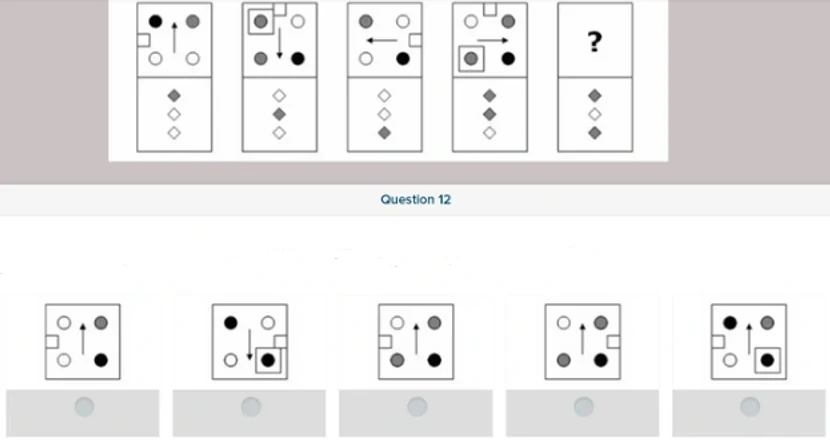
Open the worked solution
Correct answer: A.
- The square that highlights a circle alternates off, on, off, on. The missing panel must therefore have no highlight box.
- The number of grey circles alternates one, two, one, two. The missing panel must contain one grey circle.
- Options B and E fail the box alternation. Options C and D fail the grey-circle placement/count pattern used by the intended item.
- Only option A satisfies both dependable rules together.
Lesson: when several elements are present, first identify the binary on/off rule and the count rule. Arrows and edge markers may be secondary or distracting.
Which symbol sequence belongs in the missing triangle?
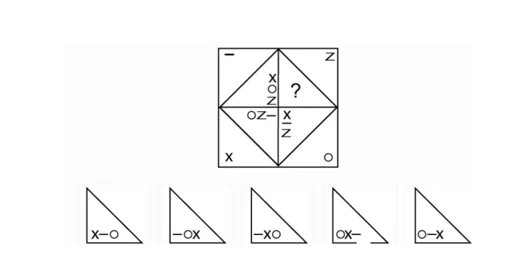
Open the worked solution
Correct answer: D — OX–.
Each inner triangle contains the three outer-corner symbols other than its own corner symbol. Starting at that corner, follow the other corners anticlockwise and read the inner symbols from the outer edge towards the centre. The completed triangles give X-O-Z at the top left, O-Z-dash at the bottom left and Z-dash-X at the bottom right. For the top-right corner Z, the required inward order is dash-X-O. Here inward runs from right to left, so the answer as printed from left to right is O-X-dash: D.
Why the alternatives fail: C prints dash-X-O from left to right. That is the correct inward order written in the wrong spatial direction. E places the dash in the middle and does not follow the established order.
Which line group replaces the question mark?
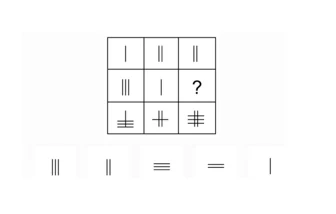
Open the worked solution
Correct answer: A.
- In each column, the bottom cell combines the two cells above it.
- The top-cell lines remain vertical.
- The middle-cell lines are rotated by 90 degrees and become horizontal.
- Column one produces one vertical plus three horizontal lines. Column two produces two vertical plus one horizontal line.
- The bottom-right cell contains the two vertical lines from the top-right cell and three horizontal lines, so the missing middle-right cell must contain three vertical lines.
Which polygon belongs in the missing circle?
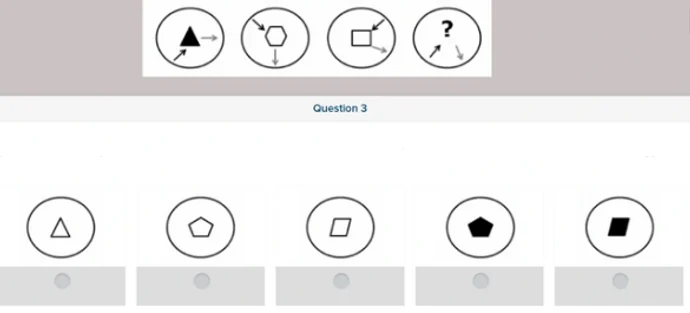
Open the worked solution
Correct answer: D.
- The grey arrow acts like the hour hand of a clock. Its direction indicates the number of sides required.
- In the missing panel, the grey arrow points to approximately five o’clock, so the shape must have five sides: a pentagon.
- The black arrow controls fill. An upward-pointing black arrow corresponds to a filled black shape, while the downward orientation corresponds to an outline shape.
- The answer must therefore be a filled pentagon.
Lesson: one visual element can code a non-binary property such as side count, while another controls a binary property such as filled versus outline.
Which panel completes the arrow-and-dot sequence?
Open the worked solution
Correct answer: E — upward arrow with five dots.
Track two independent rules across all four panels. The arrow turns 90 degrees clockwise: up, right, down, left, so it must point up next. The number of black dots increases by one: 1, 2, 3, 4, so the next panel must contain 5. Only E combines an upward arrow with five dots.
Check every option: A has the correct arrow but only four dots. B and D have five dots but the wrong arrow direction. C has the correct arrow but only three dots.
Turn Every Error into a Rule-Family Diagnosis
Do not record only whether an answer was right or wrong. Record what you missed: count, position, rotation, timing, coding, transfer, balance, concealment or interaction between rules.
Foundations: how to look at the diagram
Build the right mindset, classify the information and learn what to count or separate before you attempt a full rule.
01What the test is really assessing
At first glance, these questions may look like visual puzzles. But the deeper skill they test is not “being good at shapes.” It is the ability to stay organised when information is incomplete.
More specifically, the test rewards candidates who can:
- notice structure inside visual change
- separate a big problem into smaller parts
- resist distraction
- test possibilities in a sensible order
- use partial certainty well
- and make decisions from logic rather than appearance
So this is not really a test of artistic perception. It is a test of disciplined pattern recognition. That is why intuition alone is not enough. You need method.
02The right mindset before you begin
Before you start any question, remember one thing:
The correct answer is not the one that looks nicest. It is the one that continues the logic exactly.
That sounds obvious, but it matters a lot. Many wrong answers are designed to look:
- neat
- symmetrical
- familiar
- balanced
- close to earlier figures
That does not make them correct.
So the mindset to build is this:
- do not guess from appearance
- do not reward partial correctness
- do not assume the most visible feature is the real clue
do not rush into the options hoping one will “feel right”
Instead, slow the problem down mentally and ask:
- What can I count?
- What can I track?
- What might be a distraction?
- Is the figure showing me a result, or giving me an instruction?
That is the beginning of real control.
03What candidates are likely to encounter
SHL-style inductive reasoning questions tend to recycle the same broad families of logic. The exact drawings vary, but the rule types are usually familiar.
A candidate may encounter questions based on:
Movement
- clockwise movement
- anticlockwise movement
- horizontal travel
- vertical travel
- diagonal travel
- corner-to-corner movement
- edge-to-edge movement
- movement through the centre
Rotation and orientation
- 90° turns
- 180° flips
- repeated turns by a fixed amount
- alternating directions
- same orientation vs opposite orientation
Counting
- number of shapes increasing
- number of shapes decreasing
- one quantity rising while another falls
- odd/even patterns
- one count controlling another
Alternation
- black / white
- filled / empty
- one line / two lines
- left / right
- up / down
- visible / hidden
Replacement or transfer
- one part changes while others stay constant
- one quadrant changes
- one sector changes
- inner becomes middle
- middle becomes outer
- one texture appears inside another shape
Relationships
- one symbol describes another
- one feature represents a number
- inner and outer shapes are linked
- two groups stay balanced
- opposite sectors match
- one pair must be different or opposite
Multi-rule questions
- one object moves
- another rotates
- another changes colour
- another changes only every second or third frame
Concealment and distraction
- a symbol is partly hidden
- a feature is visually loud but logically irrelevant
- the obvious clue is not the real one
Once a candidate understands that these are the main families, the figures stop feeling mysterious. They start feeling classifiable. And classification is the first step toward solving.
04Count before you interpret
One of the strongest habits in an SHL-style inductive reasoning test is to count something before trying to explain the whole picture.
Ask:
- How many shapes are there?
- How many black, white, grey, shaded, or outlined?
- How many circles, triangles, squares, marks, arrows, lines?
- Is the number increasing, decreasing, alternating, or staying balanced?
- Is one quantity determining another quantity?
A lot of questions that look spatial are actually controlled by a simple numerical rule.
For example, a question may depend on:
- circles increasing by +1
- circles increasing by +2
- one side disappearing each frame
- lines increasing by +1
- one type of mark matching the number of sides of another shape
- black symbols balancing white symbols
- two different black shapes requiring two different grey shapes
So when a figure feels busy, one of the best first questions is:
“What can I count here?”
That often gives you a stable starting point before you get lost in movement and detail.
05Separate the figure into layers
Many candidates make the same mistake: they treat the whole figure as one visual block. That is usually the wrong way in. A much better method is to split the figure into layers or tracks.
For example, a single question may contain:
- an outer frame
- an inner shape
- one or two moving symbols
- an arrow
- a colour rule
- a line direction rule
- a count rule
- and a relationship between two positions
If you try to solve all of that together, it feels hard. If you separate it, it becomes manageable.
A useful internal routine is:
- What is the frame doing?
- What is the arrow doing?
- What is the black shape doing?
- What is the white shape doing?
- What is the count doing?
- What is the colour doing?
- What is fixed?
- Is there another rule on top of the first one?
This is one of the most important habits in the whole test.
06Identify what can change in a sequence
Candidates improve faster when they know what to test for. In these questions, change can appear in many forms.
A figure may change by:
- direction
- position
- rotation
- reversal
- number of symbols
- colour or shading
- presence or absence
- shape type
- size
- symmetry
- movement rhythm
- step size
- role inside the figure
- relationship to another symbol
- being replaced by something new
- returning to an original form
This matters because not every puzzle belongs to the same family.
Sometimes the real change is:
- movement
Sometimes it is:
- quantity
Sometimes it is:
- balance
Sometimes it is:
- what is allowed to repeat and what is not
So the candidate’s first job is not to solve the figure immediately. It is to identify the kind of change that is most likely operating.
Rule families and visual relationships
Move from basic rule recognition to coding, hidden objects, rhythm, role transfer and multi-rule reasoning.
07Test the main rule families
Most items belong to a limited set of recurring pattern types. Test these families systematically rather than inventing an unlimited number of possible rules.
A. Increase and decrease
Something rises or falls: more dots, fewer lines, more sides, fewer marks, more filled shapes or fewer empty shapes. This is often the simplest entry point.
B. Alternation
A feature flips between two states: black/white, one/two, left/right, up/down, visible/hidden or tick/cross.
C. Rotation
A feature turns clockwise or anticlockwise, by 90°, 180°, one step or two steps. One object may rotate while another remains fixed.
D. Translation or travel
An object moves left-to-right, right-to-left, top-to-bottom, bottom-to-top, diagonally, through corners, along edges or through the centre.
E. Cycling
A feature follows a repeating order, such as top-left → bottom-right → bottom-left → top-right, triangle → square → circle, or inner → middle → outer.
F. Coding
One symbol describes another: an arrow predicts a future position, a pointer indicates a side count, marks determine how many shapes appear, or one symbol determines whether another is filled or outlined.
G. Replacement or transfer
One quadrant, texture, role or region changes while the rest remains stable. A missing piece may have to be transferred from another region.
H. Mirroring or reversal
Left becomes right, upper becomes lower, vertical becomes horizontal, or the pattern restarts from the opposite side.
I. Balance and distribution
The figure preserves variety, difference, equal representation, controlled contrast or non-repetition. Candidates often expect motion when the actual rule is balance.
08Movement is not the same as relationship
This distinction is essential.
Some questions are clearly about movement:
- a circle travels through the corners
- an arrow rotates
- a marker moves clockwise
- a dot shifts across the frame
But other questions are not really about motion. They are about relationship:
- one count equals another
- one symbol describes another
- the inner shape must have one more side than the outer one
- two central colours must oppose one another
- the missing piece must preserve variety rather than repeat a type
If you use a movement mindset on a relationship question, the puzzle may feel impossible. If you use a relationship mindset on a movement question, you may overcomplicate something straightforward.
So a very powerful question is:
“Am I tracking movement, or am I preserving a structural relationship?”
That single distinction saves a great deal of time.
09Position is not always the key: role may matter more
Sometimes the rule is about where something is:
- which corner
- which sector
- which quadrant
- which edge
- which direction
But sometimes the rule is about what role something is playing:
- inner
- middle
- outer
- front
- back
- opposite
- same category
- different category
For example, some figures are not really about a symbol moving through space. They are about:
- a role changing from inner to middle
- one kind of shape staying different from the others
- one set balancing another
- a mark remaining attached to the back of an arrow
So while solving, keep asking:
“Am I supposed to track location, or am I supposed to track role?”
That question prevents a lot of wrong turns.
10Not every visible feature matters equally
This is one of the biggest exam traps. The most obvious thing in the figure is not always the real clue.
Candidates often get trapped by:
- a large outer frame that is only a container
- a bold line that is visually loud but logically secondary
- a black symbol that looks important but is irrelevant
- a busy upper section that distracts from a simple pattern in the lower section
- one apparent rule that works briefly but hides a deeper one
So when a figure feels crowded, ask:
- Which feature changes most clearly?
- Which feature stays reliable across frames?
- Which feature might be noise rather than signal?
- If this visible rule breaks, what deeper rule might be underneath it?
A strong candidate does not treat every visible detail as equally important. They filter.
11Hidden objects still count
A symbol that is partly covered has not necessarily disappeared. This is a classic source of mistakes. A circle may pass behind a triangle. A marker may seem to vanish behind a frame. A smaller symbol may be hidden under a larger one while still continuing its path.
So whenever something seems to disappear, ask:
“Has it really gone, or is it simply hidden?”
This is especially important in questions involving:
- overlap
- opposite-corner movement
- large shapes covering smaller ones
- moving symbols that change colour
- patterns where the same object appears to fade in and out
A hidden symbol is often still part of the rule.
12Expect multiple rules
Many wrong answers come from solving only the most obvious rule. A candidate spots one clear pattern, feels confident, and picks an option that fits that pattern but breaks another one.
This happens when:
- one object moves while another changes colour
- the frame alternates while the centre increases
- one symbol rotates while another changes only every second frame
- one pair is preserved while another is inverted
- one count rises while another falls
So once you spot a rule, do not stop immediately. Ask:
“Is there another rule running at the same time?”
Many SHL-style inductive reasoning questions are layered. A correct answer must satisfy all active rules, not just the easiest one.
13Similar-looking symbols may behave differently
This is one of SHL’s favourite tricks. Two circles may not follow the same rule. Two arrows may not move in the same direction. Two triangles may not change at the same speed. Two similar shapes may belong to different sub-sequences.
So never assume:
- same appearance = same behaviour
Always test whether:
- one symbol moves every frame
- another moves every second frame
- one rotates clockwise
- another rotates anticlockwise
- one changes by +1
- another changes by +2
That difference in behaviour is often the heart of the puzzle.
14Track the rhythm of change
Do not ask only:
“What changes?”
Also ask:
“How often does it change?”
Some features change:
- every frame
- every second frame
- every third frame
- in a repeating 2-step rhythm
- in a repeating 3-step rhythm
- in alternating long and short jumps
This is why many candidates get the general direction right but still choose the wrong answer. They noticed the movement, but missed the rhythm. So after identifying the route, also check the timing.
15A figure may describe the next frame
This is one of the most useful higher-level insights. Sometimes a symbol is not showing what the current figure is doing. It is giving an instruction about what happens next.
For example:
- an arrow may predict where a circle will move in the next frame
- the number of line branches may tell you how many shapes will appear next
- a pointer may indicate the number or colour of the missing figure
- a directional cue may work in reverse and indicate the opposite future location
So a very powerful question is:
“Is this figure showing me a result, or is it giving me an instruction?”
That shift in perspective often unlocks questions that otherwise feel strange.
Verification and layered patterns
Test whether a rule is real, distinguish primary and secondary rules, and compare local, global and non-adjacent changes.
16Separate a real rule from a coincidence
This is an important exam skill. A lot of candidates see something that is true once and assume they have found the rule. That is risky.
A better principle is:
Do not trust a rule just because it fits one transition. Trust it when it explains at least two transitions consistently.
For example:
- not just frame 1 to frame 2
- but also frame 2 to frame 3
- or frame 3 to frame 4
This protects you from building your reasoning on coincidence instead of structure.
17Distinguish the main rule from the secondary rule
Many questions contain:
- one driving rule
- and one supporting rule
For example:
- main rule: rotation
- secondary rule: colour alternation
Or:
- main rule: count increase
- secondary rule: position shift
Candidates often notice both but do not realise that one is the engine and the other is just a refinement.
A useful habit is to ask:
- Which rule changes the structure most strongly?
- Which rule seems to control the sequence?
- Which rule only helps me verify the answer?
That helps a lot in layered puzzles.
18Distinguish local change from global change
Some questions change the whole figure.
Others change only one part:
- one corner
- one quadrant
- one sector
- one symbol
- one internal region
This distinction matters because candidates often look for global movement when the real change is local.
So when solving, ask:
- Is the whole figure evolving?
- Or is one part being replaced while the rest stays stable?
This is especially useful in:
- grids
- matrices
- sectors
- quadrants
- transfer/replacement questions
19Compare non-adjacent frames when necessary
Sometimes the pattern is not clear from:
- frame 1 → frame 2
but becomes obvious in:
- frame 1 → frame 3
- frame 2 → frame 4
- frame 1 → frame 4
This helps especially in:
- alternation
- odd/even sub-sequences
- two-speed patterns
- every-second-frame changes
So if a sequence feels inconsistent, widen the interval before abandoning the rule. Sometimes the problem is not that the pattern is difficult. It is that you are looking at it at the wrong distance.
20Use a fixed order when the figure feels busy
A stable order of attack reduces random scanning and makes a busy figure manageable.
- 1CountHow many shapes, colours, fills, circles, triangles, squares, arrows, marks or lines are present? Is a count increasing, decreasing, alternating or balancing?
- 2Check the frameIs the outer shape changing? Is there a diagonal, sector or quadrant structure? Is the background alternating? Is the frame a real rule or only a container?
- 3Track one feature at a timeFollow one circle, one arrow, one triangle, one black symbol or one shaded region before combining tracks.
- 4Test common rule familiesCheck increase/decrease, alternation, rotation, translation, cycling, coding, replacement, mirroring and balance.
- 5Ask what stays fixedTest count, category, orientation, pairing, opposite relationships and role.
- 6Look for sub-sequencesCompare odd and even figures, separate symbol families and check whether one object changes every frame while another changes more slowly.
- 7EliminateReject options that break direction, count, colour, relationship, corner placement, symmetry or role order.
- 8ConfirmChoose the option that fits all active rules together.
This fixed order is a reliable working method: count, inspect, isolate, classify, preserve, separate, eliminate and confirm.
Exam execution under time pressure
Use a disciplined opening, recover when stuck, manage time, eliminate efficiently and verify the final answer.
21What to do in the first 5–10 seconds
The beginning of the question matters more than most candidates realise.
A useful starting routine is:
- first check whether the number of elements changes
- then check whether position changes
- then whether colour or shading changes
- then whether direction or rotation changes
- then whether one symbol may be coding another
- then whether the sequence looks like one system or two interlocking systems
This gives the candidate a disciplined opening instead of a vague stare.
22What to do when you are stuck
A complete methodology should also teach recovery.
When you are stuck:
- count something
- isolate one symbol only
- compare non-adjacent frames
- test for alternation
- test whether there are two sub-sequences
- ask whether one symbol is coding another
- check whether something is hidden rather than gone
- eliminate any answers you can already reject
- move on if needed, then return later
This is not weakness. It is exam discipline.
23Know when to move on and return
A strong candidate does not let one question consume too much time.
If, after a short structured attempt, you still do not have a solid rule, do not keep staring endlessly. Instead:
- eliminate impossible options
- choose the most defensible remaining option
- move on
- return later if time allows
This matters because good performance is not only about solving well. It is also about managing time wisely.
24Use elimination before full certainty
You do not always need the full explanation before ruling out wrong answers.
If you already know:
- the next figure must be white
- the next arrow must point left
- the answer must contain 9 circles
- the missing piece must include two different grey shapes
- the central pair must have opposite colours
- the shape must be outline, not filled
then use that immediately.
A lot of strong performance comes from saying:
“This option breaks something I already trust, so it cannot be right.”
That is not guessing. It is efficient reasoning.
25Use the minimum-proof principle
When a question feels hard, do not aim for total explanation immediately.
Ask:
“What is the minimum thing I can prove right now?”
Maybe it is:
- the next figure must point upward
- the next answer must contain four circles
- the missing shape cannot be a triangle
- the next frame must belong to the odd-sequence family
- the next answer must be grey, not white
This is powerful because one solid fact is often enough to eliminate several options.
26Use precise mental language
Vague thinking produces weak reasoning.
Avoid vague internal phrases like:
“it sort of turns”
“it moves a bit”
“something changes”
“it kind of swaps”
Instead, use exact language:
- rotates 90° clockwise
- shifts one position to the right
- alternates black and white
- increases by +1
- appears every second frame
- mirrors the opposite sector
- preserves the same orientation as the outer shape
Precise mental language helps you think precisely.
27Complete a final answer check
Before choosing an option, do a short last check:
- Does this answer fit the main rule?
- Does it also fit the secondary rule?
- Does it break any fixed relationship?
- Am I choosing it because it is correct, or because it looks familiar?
- Is there another option that fits the whole structure better?
That small pause prevents many avoidable mistakes.
Traps, memory formula and deeper skill
Review the twelve most common mistakes, remember the seven-part formula and understand what the assessment is actually testing.
28Avoid the twelve most common traps
These are the recurring errors that most often turn a solvable item into an avoidable mistake.
Guessing from visual resemblance
A wrong answer may look convincing.
Solving only one rule
Many questions contain a second or third layer.
Treating every detail equally
Some features are noise.
Ignoring count rules
A crowded figure may hide a simple numerical pattern.
Assuming similar objects behave identically
Often they do not.
Forgetting diagonal movement
Candidates often test only horizontal and vertical movement.
Missing sub-sequences
Odd and even figures may follow different rules.
Trusting arrows too quickly
An arrow may show direct, predictive or reverse movement.
Treating hidden symbols as absent
A concealed object can still be part of the rule.
Waiting too long to eliminate
You do not need complete certainty to reject an impossible option.
Rewarding partial correctness
An answer that satisfies one rule and breaks another is still wrong.
Overcomplicating simple alternation
Sometimes the rule really is A/B/A/B.
29Remember the seven-part exam formula
Under pressure, use one compact sequence rather than restarting your analysis from zero.
Count → Split → Track → Compare → Test → Eliminate → Confirm.
30Understand the deeper skill behind the test
At a deeper level, these questions are not asking whether you are “naturally good at puzzles.”
They are asking whether you can:
- stay calm when information looks messy
- notice what matters and ignore what does not
- separate one rule from another
- test possibilities in the right order
- make logical decisions without complete certainty
- and keep your thinking organised under pressure
That is why method matters so much. You do not need magical intuition. You need disciplined observation.
Slow the Figure Down Mentally
A strong candidate does not rush toward the option that looks most familiar.
They slow the figure down mentally and ask:
- What can I count?
- What is moving?
- What is fixed?
- Is this one sequence or two?
- Is this about position, or about relationship?
- Is this symbol moving, describing, or predicting?
- Is anything hidden?
- Which options can I reject immediately?
That is the real skill behind SHL Inductive Test. Once you build that habit, the figures stop feeling random. They start feeling structured. And that is exactly the point at which performance improves.
Method, Error Review and Deliberate Practice
Improving in an SHL-style inductive reasoning tests is not about guessing patterns more quickly. It is about learning how to identify the rule behind the sequence, separate signal from distraction, and apply a clear solving method under time pressure.
The strongest candidates do not rely on instinct alone. They recognise common rule types, test patterns carefully, and eliminate weak answer options before committing to a final choice. That is why effective SHL inductive reasoning practice is not just about volume. It is about better pattern recognition, better error review, and better decision-making.
Once you start approaching SHL inductive test questions as structured logic rather than random visual puzzles, the test becomes much easier to manage. The figures feel less confusing, the rules become easier to spot, and your answers become more accurate.
If your goal is to perform better in SHL inductive reasoning, focus on method first. Learn the common rule families, practise with purpose, and build the habit of solving each question in a more controlled and analytical way. That is what leads to stronger performance over time.
Use These Related ReasoningCampus Guides
Each page has a distinct purpose, helping candidates move from understanding to practice and then to a complete preparation plan.
Frequently Asked Questions
What is an SHL inductive reasoning test?
It is a visual reasoning assessment in which candidates infer rules from unfamiliar shapes, symbols, positions, counts, shading or transformations and apply those rules to a missing or next figure.
What rule families should I check first?
Start with counting, alternation, movement, rotation, cycling, coding, replacement, mirroring and balance. Then test whether multiple rules operate at the same time.
What is the fastest reliable solving approach?
Count first, split the figure into layers, track one feature at a time, compare changes and fixed relationships, test recurring rule families, eliminate contradictions and confirm the full rule.
Why do inductive reasoning questions feel difficult?
They often place several changes inside one diagram. Difficulty usually comes from scanning everything at once, following a distractor or accepting an option that satisfies only one rule.
Should I look at the answer options immediately?
First prove at least one feature of the answer, such as count, colour, direction or position. Then use the options to eliminate contradictions.
Can a question contain more than one rule?
Yes. One feature may move, another may rotate, and a third may change colour or count on a slower rhythm. The correct answer must satisfy every active rule.
What should I do when I am stuck?
Count something, isolate one symbol, compare non-adjacent frames, test sub-sequences, check for hidden objects, eliminate impossible options and move on if the time cost becomes too high.
How should I practise inductive reasoning?
Build untimed accuracy first, review errors by rule family, repeat weak categories and introduce realistic time pressure only after you can explain the rules consistently.
Is ReasoningCampus affiliated with SHL?
No. ReasoningCampus is an independent preparation provider. SHL is a separate assessment company and its trademarks belong to their respective owner.
What does the ReasoningCampus preparation package include?
The package includes 150 targeted inductive reasoning exercises, four progressive difficulty levels, worked explanations, repeat online access and preparation across inductive, numerical, verbal and deductive reasoning.
Build a Repeatable Method, Then Build Speed
Use the guide to classify the rule, the worked solutions to diagnose mistakes and the complete programme to repeat the process across progressively harder questions.
Purchase now