
Need Help with the SHL Inductive Reasoning Test?
If you’re looking for help with the SHL Inductive Reasoning Test, this guide explains how the assessment works, the types of questions you can expect, common pattern-recognition techniques, practical strategies, and realistic SHL-style practice examples.

SHL Inductive Reasoning Test Guide 2026
Recognise complex rules faster, avoid incomplete-pattern traps and learn a structured solving method through selected free examples. The complete preparation package includes 150 interactive inductive-reasoning exercises, full worked solutions and a clear progression from easy foundations to extreme multi-rule challenges.
English-language preparation • Interactive practice • Detailed explanations • Unlimited access
One Structured Package for Complete SHL-Style Reasoning Preparation
The programme combines intensive inductive-reasoning training with numerical, verbal and deductive reasoning preparation. It is designed to replace random question practice with a clear cycle: learn the rule, practise it, analyse the mistake and repeat it until recognition becomes reliable.
150 targeted inductive-reasoning exercises organised for progressive mastery
The complete package covers recurring visual and alphanumeric structures, including movement, rotation, counting, alternation, matrices, coded relationships and multi-rule transformations. The public guide includes selected free examples that demonstrate the teaching and solution method.
Choose an option, receive immediate feedback and review the complete reasoning path.
Understand the rule, the correct answer and why the strongest distractor is incomplete.
Easy, intermediate, advanced and extreme questions organised as a deliberate progression.
Repeat weak categories and return to difficult exercises whenever further revision is needed.
Inductive, numerical, verbal and deductive reasoning inside one preparation programme.
Identify recurring errors in counting, movement, rotation, alternation, matrices and codes.
Evaluate the teaching approach directly on this page
You do not have to rely on vague promises. The free guide lets you inspect the visual exercises, explanations, weakness feedback and adaptive-practice logic before deciding whether the complete programme is right for you.
Answer visual questions and receive immediate feedback rather than reading answer-only claims.
See how rules are isolated, validated and compared with the strongest distractor.
Receive direct advice based on accuracy and the exact rule families that caused errors.
Try shape, matrix, movement, fill, numerical and alphanumeric questions at levels 3–5.
What You Will Learn: From First Principles to Expert Challenges
The preparation is organised as a deliberate progression. You first learn how to isolate one rule, then combine independent changes, validate matrices and solve questions whose answer choices are designed to reward complete—not partial—reasoning.
Foundation
Easy introductory patternsCounting, simple movement, rotation, fill changes and basic letter or number sequences.
Intermediate
Two-rule combinationsAlternation, simultaneous movement and fill rules, paired sequences and stronger distractors.
Advanced
Complex matrices and transformationsRow-and-column logic, overlays, conditional changes, multiple objects and coded relationships.
Expert Challenge
Questions that initially look impossibleSeveral interacting rules, irrelevant details, time pressure and answer choices designed to exploit incomplete reasoning.
The free exercises on this page are introductory examples. The €99 package contains much harder, more complex and time-pressured exercises, together with complete educational explanations.
Start SHL Preparation — €99See exactly what changes when you enter the complete programme
| Preparation feature | Free guide | Complete €99 package |
|---|---|---|
| Inductive-reasoning practice | Selected introductory and visual examples | 150 targeted interactive exercises |
| Difficulty progression | Introductory and selected advanced previews | Easy, intermediate, advanced and extreme |
| Worked explanations | Selected explanations | Detailed solutions throughout the programme |
| Access | Public-page practice | Unlimited online access in English |
| Reasoning categories | Mainly inductive-reasoning examples | Inductive, numerical, verbal and deductive |
| Performance feedback | Mini diagnostics | Structured revision and repeated error analysis |
The free guide helps you understand the method. The complete package gives you enough targeted repetition to make the method dependable under pressure.
Start SHL Preparation — €99Begin with These Visual Reasoning Challenges
Begin with five demanding visual challenges. Continue directly with the additional practice set, the adaptive drill and the advanced worked solutions.
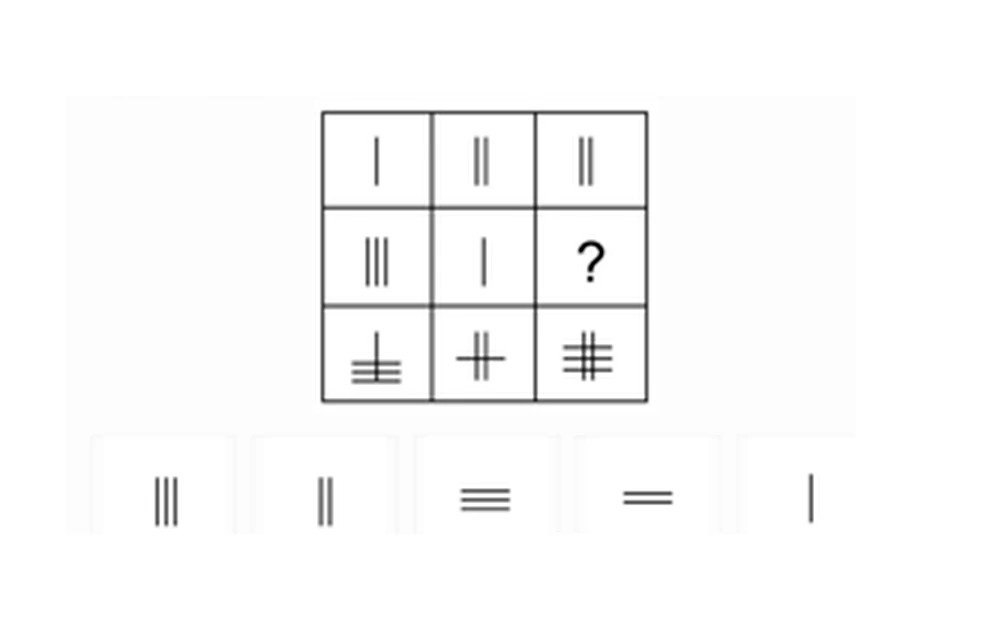
Which symbol completes the matrix?
Question Review and Worked Solution
Question: Which symbol completes the matrix?
Skills assessed: count, orientation, matrix
Correct answer: A. Three vertical lines
Worked explanation: Read each column vertically. The top cell supplies the number of vertical lines. The middle cell supplies the number of horizontal lines after a 90-degree rotation. In the third column, the result contains two vertical and three horizontal lines, so the missing middle cell must contain three vertical lines.
Why the strongest distractor fails: Three horizontal lines use the source count but ignore the rotation required by the matrix.
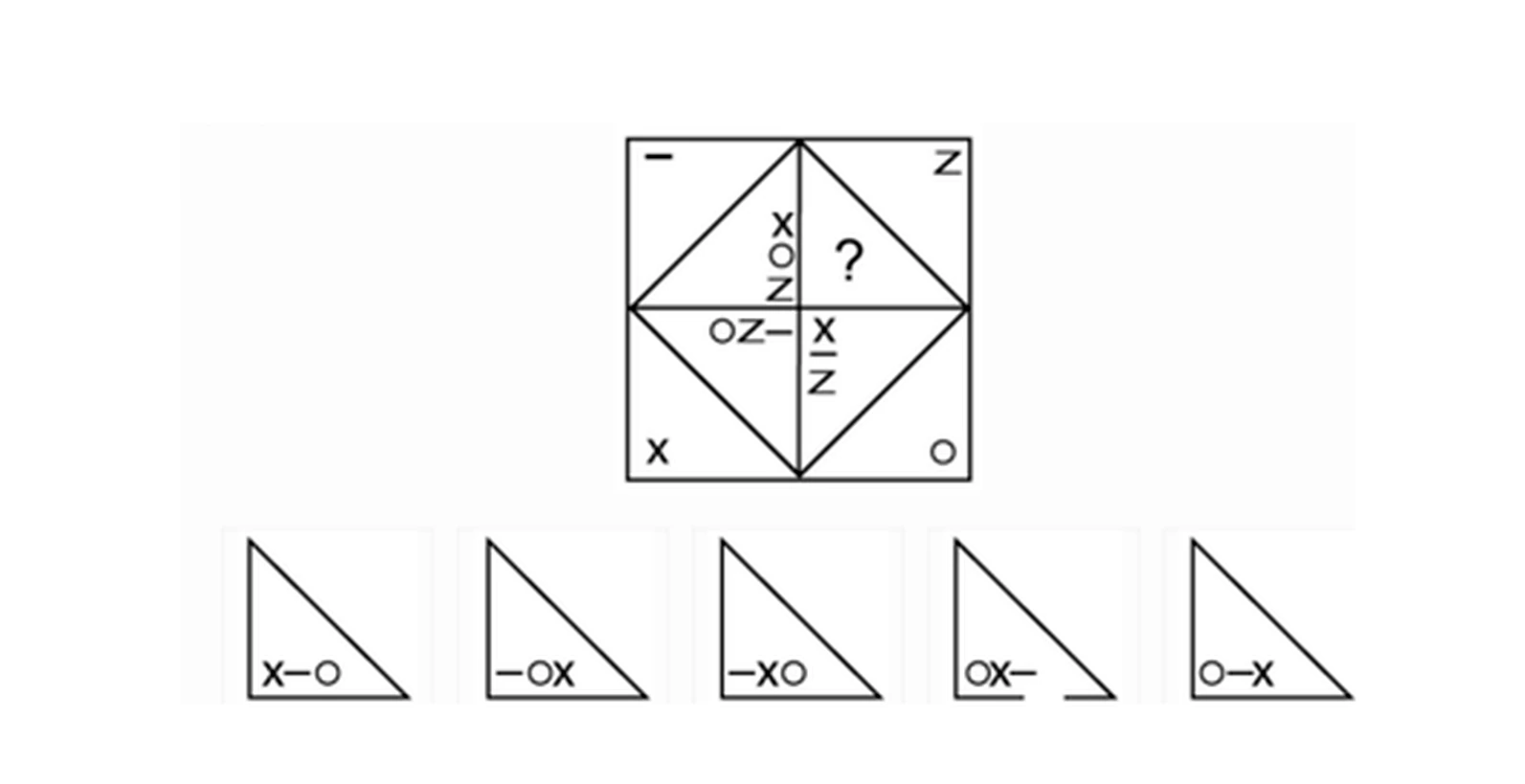
Which triangular response completes the diagram?
Question Review and Worked Solution
Correct answer: D — OX–.
Each inner triangle contains the three outer-corner symbols other than its own corner symbol. Starting at that corner, follow the other corners anticlockwise and read the inner symbols from the outer edge towards the centre. The completed triangles give X-O-Z at the top left, O-Z-dash at the bottom left and Z-dash-X at the bottom right. For the top-right corner Z, the required inward order is dash-X-O. Here inward runs from right to left, so the answer as printed from left to right is O-X-dash: D.
Why the alternatives fail: C prints dash-X-O from left to right. That is the correct inward order written in the wrong spatial direction. E places the dash in the middle and does not follow the established order.
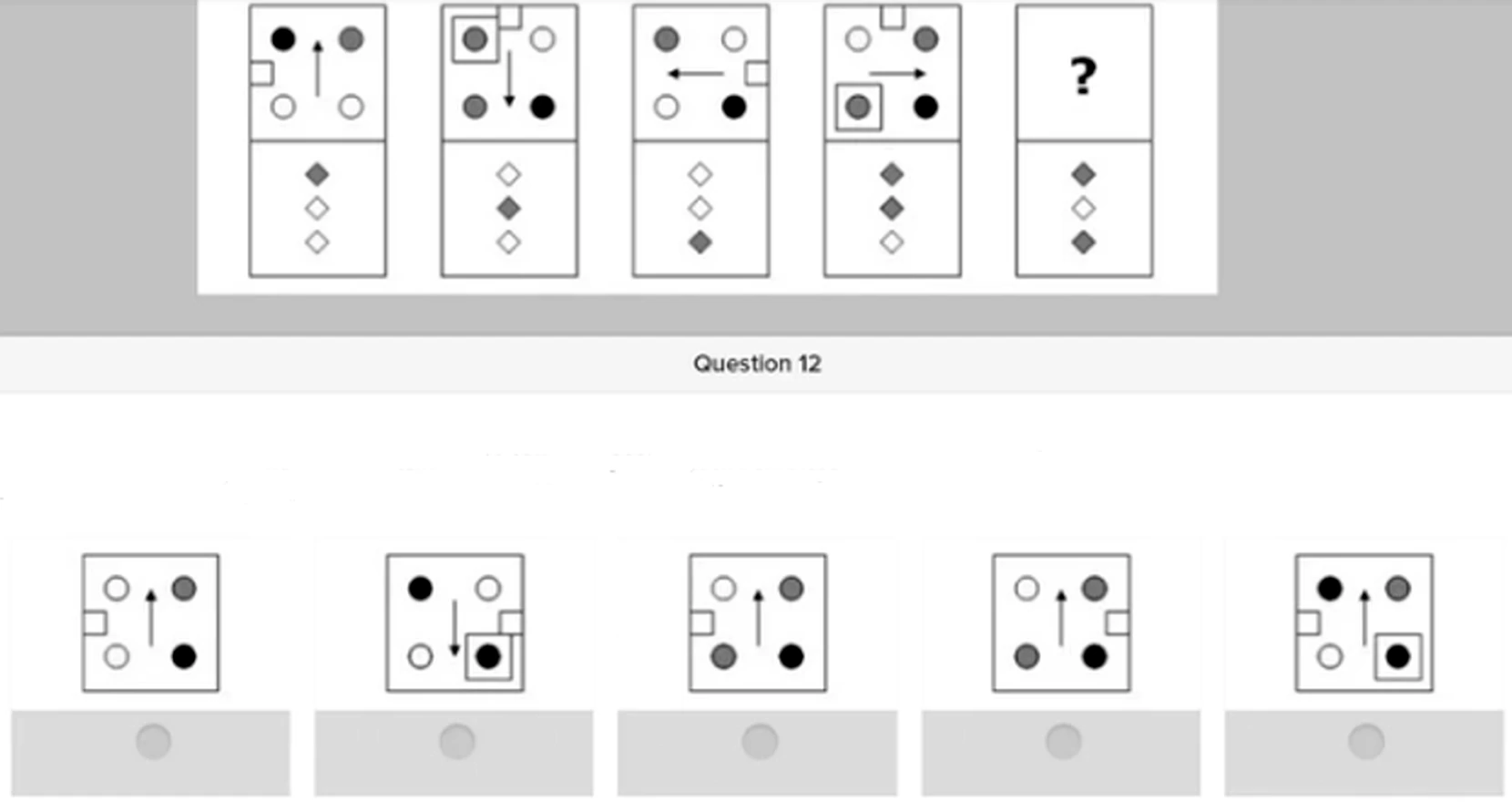
Which upper panel completes the sequence?
Question Review and Worked Solution
Correct answer: A.
Use two directly repeatable features. The large box highlighting a circle is absent, present, absent, present, so it must be absent in panel 5. The number of grey circles is 1, 2, 1, 2, so the next panel must contain one grey circle. B and E have a highlight box; C and D have two grey circles. Only A satisfies both rules. These two checks are sufficient: the side marker and arrow do not need an additional assumed rule.
Elimination: B and E break the box alternation. C and D break the one-grey-circle requirement.
Which panel completes the arrow-and-dot sequence?
Question Review and Worked Solution
Correct answer: E — upward arrow with five dots.
Track two independent rules across all four panels. The arrow turns 90 degrees clockwise: up, right, down, left, so it must point up next. The number of black dots increases by one: 1, 2, 3, 4, so the next panel must contain 5. Only E combines an upward arrow with five dots.
Check every option: A has the correct arrow but only four dots. B and D have five dots but the wrong arrow direction. C has the correct arrow but only three dots.
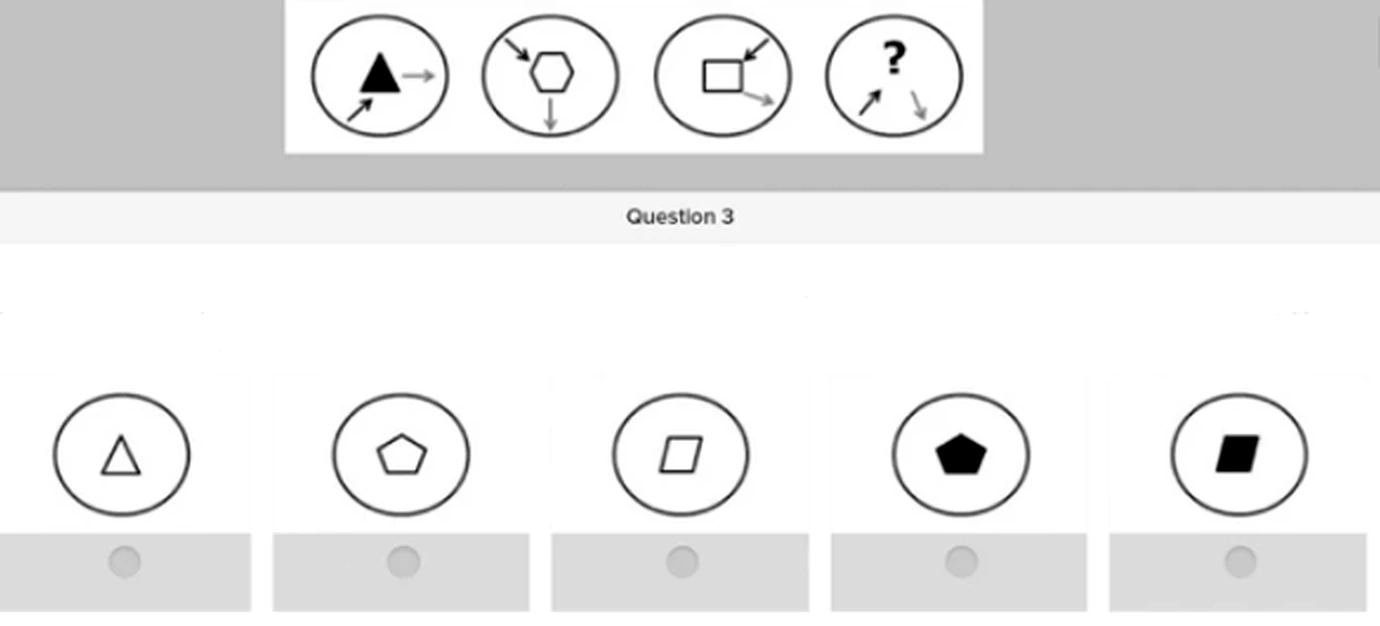
Which shape replaces the question mark?
Question Review and Worked Solution
Correct answer: D — filled pentagon.
Read the grey arrow as a clock hand: it points to 3, 6 and 4 in the completed panels, matching the triangle, hexagon and quadrilateral. In the missing panel it points to 5, so the shape must be a pentagon. Check the black arrow separately. It points upwards in the filled example and downwards in the two outline examples. In the missing panel it points upwards, so the pentagon must be filled. The answer is D.
Why B fails: B has five sides but is an outline shape; it fails the fill rule indicated by the black arrow.
Visual challenge score: 0 / 5.
Continue with Easy Five Additional Practice Questions
Apply the same method to five further questions covering alphanumeric sequences, movement, geometry, alternation and multi-rule reasoning.
1. Complete the sequence: B3 → D6 → F12 → H24 → ?
Question Review and Worked Solution
Question: Complete the sequence: B3 → D6 → F12 → H24 → ?
Skills assessed: alphabet, numeric
Correct answer: B. J48
Worked explanation: Letters advance by two positions and numbers double. The answer is J48.
Why the strongest distractor fails: I48 follows the number rule but advances the letter by only one position.
2. Which panel comes next?
Question Review and Worked Solution
Question: Which panel comes next?
Skills assessed: rotation, fill
Correct answer: D. ← ○
Worked explanation: The arrow rotates 90 degrees clockwise while the circle alternates filled and outline. The next panel is ← ○.
Why the strongest distractor fails: ← ● follows the rotation rule but breaks the fill alternation.
3. Where should the dot appear next?
Question Review and Worked Solution
Question: Where should the dot appear next?
Skills assessed: position
Correct answer: D. Bottom-left
Worked explanation: The dot moves clockwise through the four corners. The missing position is bottom-left.
Why the strongest distractor fails: Top-left would restart the cycle one step too early.
4. Which shape comes next?
Question Review and Worked Solution
Question: Which shape comes next?
Skills assessed: count, fill
Correct answer: A. Filled hexagon
Worked explanation: The number of sides increases by one and the fill alternates outline, filled, outline, filled. The next item is a filled hexagon.
Why the strongest distractor fails: An outline hexagon follows the side-count rule but breaks the fill alternation.
5. Complete the sequence: 1, 10, 3, 8, 5, ?
Question Review and Worked Solution
Question: Complete the sequence: 1, 10, 3, 8, 5, ?
Skills assessed: alternation, numeric
Correct answer: C. 6
Worked explanation: Odd positions are 1, 3, 5 and even positions are 10, 8, 6. The answer is 6.
Why the strongest distractor fails: A single continuous sequence does not explain all six positions.
Score: 0 / 5. Complete each question to receive a strict weakness analysis.
Weakness analyser
Complete at least one question to generate a rule-by-rule diagnostic.
Finish with the Entry Level Adaptive Reasoning Drill
This drill adapts between difficulty levels 3 and 5 and combines visual, matrix, movement, numerical and alphanumeric reasoning.
Each Fixed Exercise Includes a Complete Written Review
Each fixed visual or interactive exercise combines the attempt with a written question, answer choices, the correct response and a detailed explanation. The entry level adaptive drill remains an interactive practice tool with instant feedback.
Focused preparation instead of generic puzzle collections
Enough structured repetition to revisit recurring patterns instead of seeing each rule only once.
The objective is to understand the complete rule and recognise why an attractive answer is still wrong.
Progress from easy foundations to extreme questions with several interacting transformations.
Prepare for inductive, numerical, verbal and deductive reasoning in one online programme.
Repeat difficult categories, review explanations and return to the programme without a study deadline.
Use rule-specific diagnostics to identify whether the problem is observation, validation, timing or elimination.
The aim is not to collect more questions. It is to build a repeatable process that remains reliable when the test becomes unfamiliar or time-pressured.
Start SHL Preparation — €99Six habits that improve performance before the timer starts
Strong candidates do not rely on inspiration. They reduce each question to a sequence of observable checks and use the same process even when the diagram looks unfamiliar.
The TRACE method for unfamiliar pattern questions
Sequence, code, grid, completion or learned behaviour?
What changes and what stays fixed?
Track one attribute at a time.
Does the rule explain all available evidence?
Reject answers that violate confirmed rules.
TRACE converts visual overload into a sequence of small decisions. It also gives you a useful error log. A wrong answer can be traced to incorrect task classification, a missed attribute, premature acceptance of a rule, weak validation or poor elimination.
Interactive Pattern Rule Finder
Select the changes you can observe. The tool suggests the first rule families to test. It does not solve the question automatically.
12 pattern families worth learning
A clear route from registration to structured practice
Open the package page
Review the preparation details, complete the registration process and follow the access instructions.
Enter the English-language programme
Begin with the recommended level and use the interactive exercises as a structured learning sequence.
Practise, analyse and repeat
Use unlimited access to revisit difficult rules, study every explanation and strengthen weak categories.
Ready to move beyond the free examples?
The full €99 package is built for candidates who want clear structure, harder questions, better feedback and a faster route to exam readiness across all four reasoning categories.
Start SHL Preparation — €99How to use the complete package effectively
Begin with a diagnostic
Identify whether your main weakness is visual observation, rule validation, speed or elimination.
Practise by rule family
Work through counting, movement, rotation, fill, alternation, matrices and coded relationships.
Increase difficulty gradually
Do not jump straight to extreme questions before your accuracy on the intermediate level is dependable.
Review every wrong answer
Record the exact cause of the error and repeat that rule family until the mistake stops recurring.
About the ReasoningCampus editorial team
Frequently asked questions
What is the SHL inductive reasoning test?
It is a timed assessment that asks candidates to infer rules from unfamiliar visual or alphanumeric information and apply those rules to a new item.
What is the current SHL inductive reasoning format?
SHL retired older Verify Inductive Reasoning versions during 2024 and identified Verify Interactive Inductive Reasoning as the replacement. Your invitation and official tutorial determine the exact interface you receive.
How long is the interactive inductive assessment?
The current official product factsheet describes an 18-minute assessment with a maximum of 15 questions. Always follow the timer and instructions in your own invitation.
Does the test contain only geometric shapes?
No. Official product information states that the interactive assessment can use shapes and alphanumeric sequences.
Is there a universal SHL pass mark?
No. Employers can use different thresholds, norm groups, score bands and combined selection criteria.
Can I return to a previous question?
Do not assume that back-navigation is available. Read the tutorial before the timer begins because navigation can depend on the assessment interface.
What should I practise first?
Begin with counting, position, rotation, reflection and fill. Then move to alternation, overlays, alphanumeric sequences, conditional rules and multi-rule questions.
What is the TRACE method?
TRACE is the ReasoningCampus framework: Type, Record, Analyse, Check and Eliminate.
Does the practice score predict my official percentile?
No. The tools on this page provide an educational readiness estimate only. A genuine percentile requires the correct assessment, scoring model and norm group.
Are the free practice questions the same difficulty as the full package?
No. The first free exercises are introductory and designed to teach the method. The complete €99 package includes much harder multi-rule questions, complex matrices, misleading distractors and timed advanced practice.
How many inductive reasoning exercises are included?
The package includes 150 targeted interactive inductive-reasoning exercises with detailed worked solutions.
What difficulty levels are included?
The inductive-reasoning exercises are organised across easy, intermediate, advanced and extreme difficulty levels.
Is access limited by time?
The package provides unlimited online access, allowing candidates to repeat difficult categories and review solutions.
What language is the preparation material in?
The preparation material and worked explanations are provided in English.
Does the package include other reasoning categories?
Yes. The complete programme covers inductive, numerical, verbal and deductive reasoning.
What makes this preparation different from a generic question bank?
The programme combines 150 targeted inductive exercises, graded difficulty, detailed worked solutions, interactive feedback, weakness analysis and preparation across inductive, numerical, verbal and deductive reasoning.
Can I see the teaching method before purchasing?
Yes. This page includes free visual challenges, worked explanations, strict weakness feedback and an advanced adaptive drill so candidates can evaluate the approach before purchasing.
Official SHL sources used
Turn pattern recognition into a repeatable method
Use the free challenges to assess the teaching approach. Continue with the complete programme when you are ready for 150 targeted exercises, four difficulty levels, full worked solutions and unlimited English-language access.
Start SHL Preparation — €99Contact: info@reasoningcampus.com
