ReasoningCampus · Global candidate guide · Updated 20 August 2026
Choose the practice that matches your assessment
SHL tests are not one single exam. Your invitation may point to numerical, verbal, inductive or deductive reasoning, a G+ general-ability assessment, OPQ/OPQ32, a situational-judgement assessment, or another job-specific test. The fastest way to prepare well is to identify the exact assessment first and then practise the skills that assessment actually measures.
This candidate hub combines current official SHL guidance with a simple invitation decoder, a study planner and an original 8-question diagnostic. It is designed to help you move from “I have SHL tests coming up” to a clear next step without forcing you through a 12,000-word question library before you know what you need.
Quick answer: SHL tests are pre-employment assessments used to measure abilities, work-related behaviour, skills or job fit. Cognitive SHL tests commonly involve numerical, verbal, inductive and deductive reasoning. Other SHL tests can include OPQ personality questionnaires, situational judgement, technical skills or simulations. Your own invitation and on-screen instructions are the final authority for the exact format you will take.
Which SHL Tests Am I Taking? Use the Invitation Decoder
Paste the assessment name or a short, non-sensitive phrase from the invitation. This decoder processes the assessment wording locally in your browser. Do not paste login links, passwords, candidate IDs, personal data or confidential employer information.
What this tool is: a preparation router based on the wording you provide. It is not an AI analysis of your employer’s confidential setup and it cannot know settings that are not stated in the invitation.
SHL Tests Explained: The Main Test Types Candidates Encounter
Many pages treat all SHL tests as if they were variations of the same aptitude quiz. That can send candidates into the wrong preparation. A better first step is to identify the assessment family and then match your practice to the skill being measured.
SHL Tests for Cognitive Ability
NumericalVerbalInductiveDeductiveG+
These assessments use problems with objectively better or correct answers. Practice should build both reasoning accuracy and the ability to work efficiently under the stated time limit.
Personality & Behavioural SHL Tests
OPQOPQ32BehaviourSJT
These require a different mindset. OPQ-style questionnaires explore work preferences; situational assessments ask how you would respond in job-related scenarios. Treating them like numerical tests is a category error.
Skills & Simulation SHL Tests
Technical skillsJob tasksSimulations
Some SHL tests are role-specific rather than general reasoning tests. Use the exact title and employer instructions to decide whether a specialist practice route is needed.
Assessment wording
What it usually measures
Where to practise
Numerical Reasoning
Charts, tables, percentages, ratios and quantitative decisions.
Mixed cognitive ability. Confirm the exact product named in your invitation.
Combine numerical + deductive + inductive practice when that matches the current G+ description.
OPQ / OPQ32
Work-related preferences and behavioural style.
Use role reflection and answer consistently and authentically.
Situational Judgement
Workplace decision-making in scenarios.
Focus on priorities, evidence, stakeholders, risk and the stated role context.
Already know which SHL tests you have?
Skip the broad guide and go straight to practice. The dedicated free page contains the full 28-question Practice Mode / Test Mode library with worked solutions.
SHL Tests and Verify G+: What the Current Fact Sheet Says
For candidates searching specifically for G+, the current SHL Verify G+ fact sheet is more useful than old blog posts. It describes the G+ test as a computer-adaptive cognitive assessment measuring Numerical, Deductive and Inductive Reasoning. The fact sheet lists 30 questions in total, 10 for each ability, an average testing time of 32–36 minutes and an allowed time of 36 minutes.
That does not mean every historical article about interactive SHL tests is suddenly “wrong”; it means product names and formats can change over time. When your invitation says G+, compare the wording with current official material and follow the tutorial attached to your own assessment.
SHL Tests Candidate Journey: From Invitation to Test Day
A strong SHL tests guide should reduce uncertainty. Use this sequence instead of opening random practice pages and hoping they match your assessment.
1Read the exact assessment name
2Identify the assessment family
3Open the official familiarisation material
4Take a diagnostic
5Train the error types that repeat
6Practise under time pressure
7Follow your live instructions exactly
SHL Candidate Support also distinguishes the practice website from an employer’s actual assessment. Practice-site results are separate, while the real assessment is accessed using the original link supplied for the recruitment process.
7 SHL Tests Facts Candidates Often Get Wrong
These points matter because they can change how you practise and how you behave during the assessment. The wording below is deliberately careful: specific platforms and products can differ, so the instructions shown in your own SHL tests remain the final authority.
1. Do SHL tests have one universal pass mark?
No. SHL Candidate Support says SHL does not set passing scores. The recruiter or organisation decides how results are used.
2. Do incorrect answers always reduce SHL tests scores?
In the candidate-support flow cited here, SHL states that incorrect responses do not decrease the test score and candidates are expected to answer all delivered questions. Follow the instructions for your specific assessment.
3. Can you always return to previous SHL tests questions?
No. SHL explains that in adaptive assessments you may be unable to return after submitting because later difficulty is determined by earlier responses.
No universal rule should be assumed. SHL Candidate Support says a calculator may be used for a numerical or calculation test unless the instructions say otherwise. Some assessment flows can use different calculator rules.
5. Are free official SHL tests available for every assessment and language?
No. SHL says free practice is available for a selection of assessments, not every assessment or language, and the main purpose is familiarisation with how the assessments work.
6. Do full-length official SHL tests practice sessions show every answer?
SHL says answers to its full-length timed practice tests are not available. Short example questions can provide immediate right/wrong feedback, the correct answer and a brief explanation.
7. Is the practice website the same as your employer’s live SHL tests?
No. SHL Candidate Support says candidates should use the original employer assessment link for the real tests; results from the practice website are not shared with the employer.
SHL Tests Scores, Percentiles & “What Is a Good Score?”
A practice accuracy score is not the same thing as an official SHL percentile. Official reports can compare performance with a relevant comparison group, and the hiring organisation decides what result is sufficient for its process. That is why this page does not convert “6/8” or “19/24” into a fake official percentile.
The diagnostic below reports only what it can measure honestly: accuracy by reasoning category, the skill families behind your wrong answers, and a recommended next practice route. That gives you actionable feedback without pretending to know your recruiter’s benchmark.
Chart / commission errors
Multi-step operation order
Main-idea errors
Context vocabulary
Rotation / fill rules
Multi-feature patterns
Rule chaining
Multi-condition inference
SHL Tests Study Planner: 1 Day, 3 Days, 7 Days or 14 Days
More time does not automatically mean better preparation. Choose the time you genuinely have and use it to cycle between diagnosis, targeted practice and timed retesting.
What Better SHL Tests Preparation Should Do Beyond Giving You More Questions
A large question bank can help, but quantity alone does not tell you why the same type of mistake keeps returning. Better SHL tests preparation should create a feedback loop: identify the assessment → diagnose the error → learn the rule → practise the weak skill → retest under time pressure.
That is also why the broad SHL tests page should not duplicate the entire free question library. This page gives you a short diagnostic and then sends you to the dedicated practice page when you need the full 28-question environment.
Two questions from each reasoning category give you a quick directional check. This is not an official SHL score. It is a practice diagnostic designed to identify which type of error deserves your next study session.
Mode: PracticeAnswered: 0/8Correct: 0Accuracy: —
Practice Mode shows feedback after each answer. Test Mode keeps correctness and solutions hidden until you submit.
Numerical SHL Tests: Charts, Percentages & Multi-Step Data
Look for the shortest valid calculation path. The main trap is often not arithmetic itself but choosing the wrong base, sequence or condition.
Numerical ReasoningLevel 2 · Easy–Medium
Numerical Practice 2: Bar Chart Commission and Total Earnings
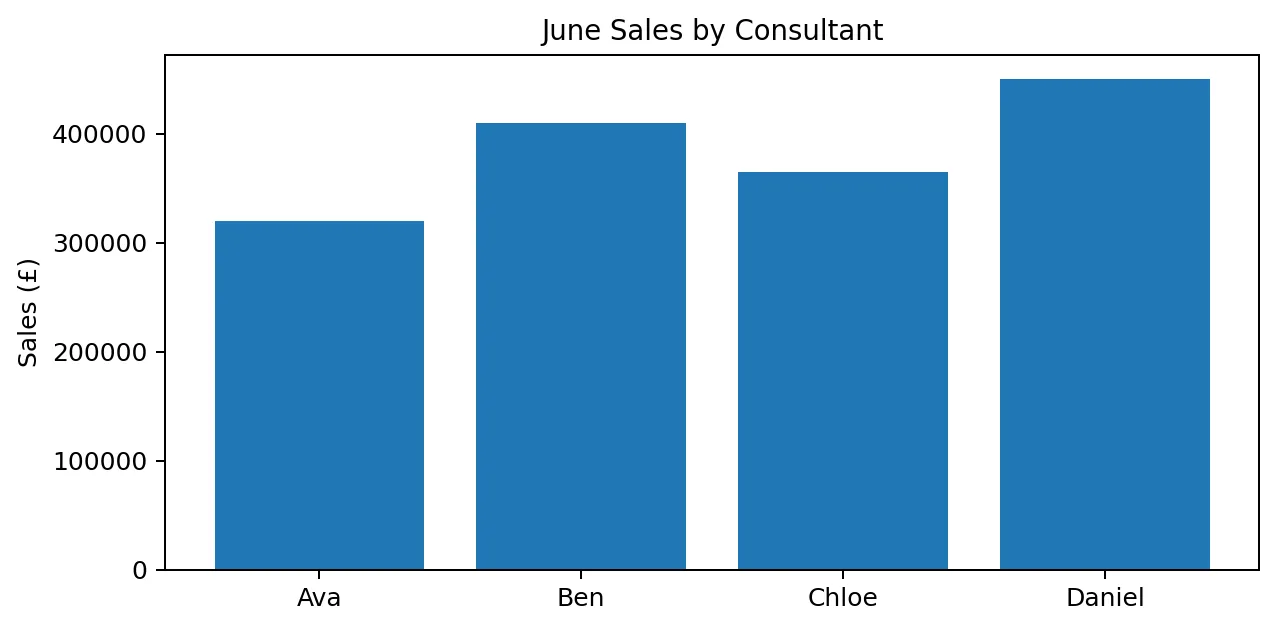
June sales by consultant. Use Chloe’s bar with the pay rules in the question.
Rules / Notes: Base salary = £2,400 per month. Commission = 2.8% of sales.
Question: What were Chloe’s total earnings for June?
Machine-readable chart value: Chloe’s June sales = £365,000.
View answer & full teaching solution
Correct answer: C — £12,620
The chart gives the sales base; the question then requires two stages: calculate commission from sales, and add the fixed base salary.
Formula or rule to use
Total earnings = Base salary + (Sales × Commission rate)
Work it out step by step
Convert 2.8% to decimal form: 2.8% = 0.028.
Commission = £365,000 × 0.028 = £10,220.
Total earnings = base salary + commission = £2,400 + £10,220 = £12,620.
Why this is the right answer
£12,620 includes both components of pay. Stopping at £10,220 would calculate commission only, not total earnings.
Why the other options do not work
Option A (£10,220) is the commission but omits the base salary.
Other options reflect arithmetic or base-salary errors rather than the stated pay plan.
What to remember: Before calculating, classify every number as a base, rate, adjustment or fixed addition. Then build the answer from those components in order.
Numerical ReasoningLevel 7 · Very Hard / Combined Trap
Numerical Practice 7: Returns, Commission, Threshold Bonus and Base Salary
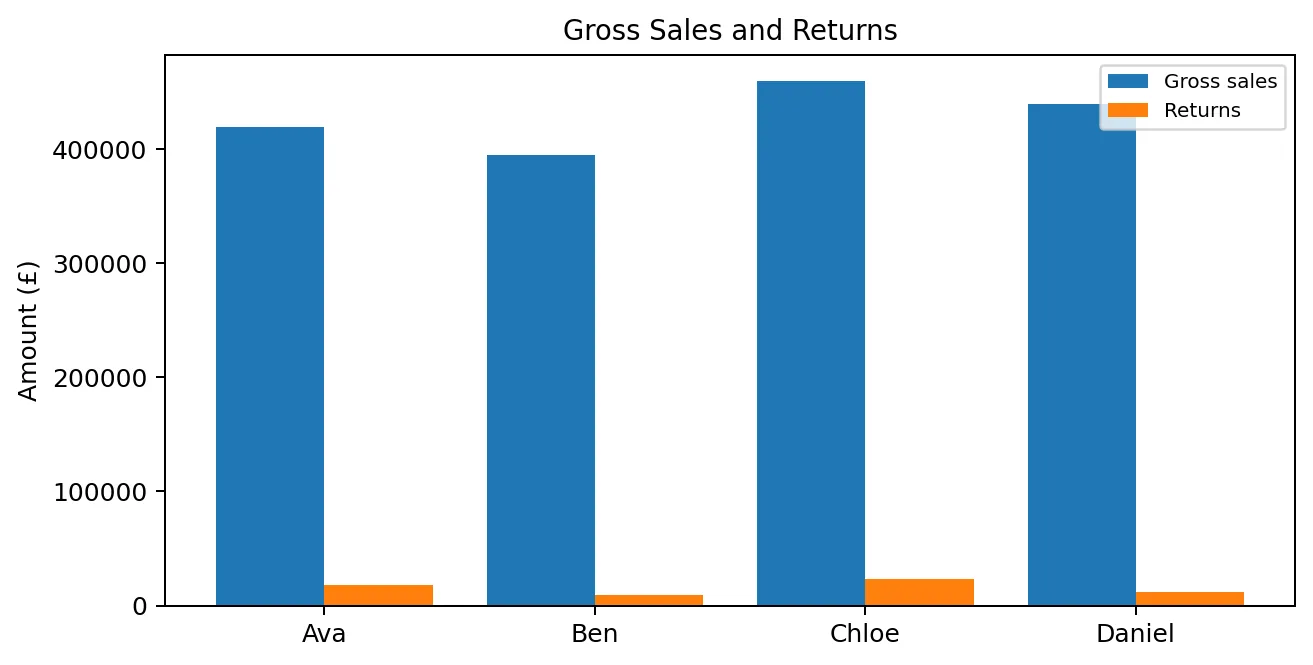
Gross sales and returns. The commission base is net sales, not the gross bar.
Rules / Notes: Base salary £2,400; commission 2.7% of net sales; bonus £700 if net sales exceed £430,000.
The difficulty is procedural: every adjustment has a specific place in the calculation. Commission is based on net sales, the bonus depends on the net-sales threshold, and base salary is added at the end.
Formula or rule to use
Net = Gross − Returns; Earnings = Base + (Net × rate) + qualifying bonus
Threshold test: £437,000 > £430,000, so the £700 bonus applies.
Total earnings = £2,400 + £11,799 + £700 = £14,899.
Sanity check: the answer must be greater than commission alone and must include exactly one base salary and one qualifying bonus.
Why this is the right answer
£14,899 follows the stated order of operations and uses net rather than gross sales as the commission base.
Why the other options do not work
Calculating commission on £460,000 overstates earnings because returns must be removed first.
Omitting the bonus ignores the threshold; adding the bonus before testing net sales risks using the wrong base.
A very large answer usually signals that a percentage has been treated as a whole number or a fixed component has been duplicated.
What to remember: In multi-rule numerical items, write the calculation as a pipeline: gross → adjustment → net → rate → cap/threshold → fixed additions.
Need more Numerical SHL tests practice?Continue with chart, table, percentage and worked numerical examples before you move to a longer mixed test.
Verbal SHL Tests: Evidence, Meaning & Reading Control
Stay inside the passage. Strong distractors often sound reasonable while adding one assumption the text never actually supports.
Verbal ReasoningLevel 2 · Summary Selection
Verbal Practice 2: Identify the Passage’s Central Pivot
Passage: Several municipalities experimented with hybrid service centres in which routine requests remained fully digital while more complex cases were handled through booked in-person appointments. The initial assumption was that this model would simply reduce queues. In practice, the more interesting result was that front-line staff began to separate requests that needed judgment from requests that mainly needed routing. Once that distinction became explicit, training improved, referral errors dropped, and citizens with genuinely complex cases reached the right specialist faster. The model did not eliminate pressure on staff, nor did it solve every access problem, but it made the service more deliberate in the way it triaged complexity.
Question: Which option is the best summary of the passage?
View answer & full teaching solution
Correct answer: B
A strong summary captures the passage’s movement, not merely the opening premise. Here, the text begins with queue reduction but pivots to the deeper effect: clearer triage of complexity.
Work it out step by step
Identify the opening expectation: reduce queues.
Locate the contrast marker: “In practice, the more interesting result…”
Track the mechanism: staff distinguish judgment-heavy cases from routing-heavy cases.
Track the consequences: training improves, referral errors fall, complex cases reach specialists faster.
Preserve the limitation: the model did not solve every access problem.
Why this is the right answer
Option B captures the central mechanism and its service-quality effect without overstating the outcome.
Why the other options do not work
A is too narrow because it repeats the initial assumption rather than the passage’s final emphasis.
C makes a universal claim the passage never argues.
D promotes one consequence—training—into the main purpose.
What to remember: In summary questions, look for the paragraph’s pivot: “however,” “in practice,” “more importantly,” or a final qualifying sentence often reveals the true centre of gravity.
Verbal ReasoningLevel 6 · Contextual Meaning
Verbal Practice 6: Vocabulary in Context, Not Dictionary Reflex
Passage: The chair described the oversight framework as “robust but not inflexible”. By this she meant that the framework set firm minimum requirements for approval, documentation, and review, while still allowing departments to adopt stricter internal controls where their risk profile justified it. She added that the framework should not be interpreted as a ceiling on good practice.
Question: In the passage, the word “robust” most nearly means:
View answer & full teaching solution
Correct answer: B — well-founded and durable
Contextual vocabulary is solved from sentence function, tone and neighbouring clauses. “Robust” is paired with minimum requirements and flexible strengthening, so it describes strength and reliability, not aggression or punishment.
Work it out step by step
Read the local contrast: “robust but not inflexible.” The second half rules out rigidity as the intended meaning.
Observe what the framework does: it sets firm minimum requirements and withstands stricter controls.
Choose a meaning compatible with institutional strength and durability.
“Well-founded and durable” fits both the governance context and the contrast.
Why this is the right answer
B preserves the formal tone and the framework’s functional strength.
Why the other options do not work
Aggressive and punitive import a hostile tone not present in the passage.
Bureaucratically heavy confuses strength with administrative burden.
What to remember: When vocabulary is tested in context, replace the target word with each option and ask which one preserves both meaning and tone of the whole sentence.
Need more Verbal SHL tests practice?Move to the dedicated verbal hub for evidence, inference, reading accuracy and verbal reasoning preparation.
Separate count, position, rotation, fill and dependencies. Do not accept a rule just because it works for one transition.
Inductive ReasoningLevel 1 · Easy
Inductive Practice 1: Rotation + Alternating Fill
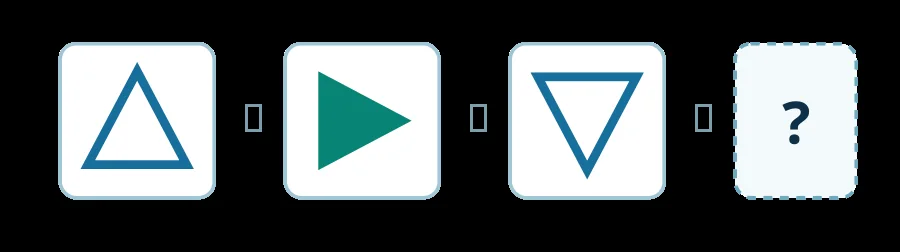
Sequence description: outline triangle points up → filled triangle points right → outline triangle points down → ?
Question: Which figure comes next in the sequence?
Visual described in words: Sequence description: outline triangle points up → filled triangle points right → outline triangle points down → ?
View answer & full teaching solution
Correct answer: D — Filled triangle pointing left
Solve the visual by separating features before choosing an option. The detailed reasoning below turns the diagram into explicit rules so you can reuse the method on unfamiliar figures.
Work it out step by step
Track orientation separately: up → right → down → left is a 90° clockwise rotation each step.
Track fill separately: outline → filled → outline → filled.
The next panel must satisfy both rules simultaneously: left-pointing and filled.
Why this is the right answer
The correct option is the only one that satisfies every confirmed feature simultaneously.
Why the other options do not work
Option A follows the rotation rule but violates the alternating-fill rule. B and C each break at least one of the two confirmed rules.
What to remember: When two visual features change independently, solve them as separate mini-sequences and intersect the results.
Inductive ReasoningLevel 6 · Hard
Inductive Practice 6: Quadrant Symbol Order
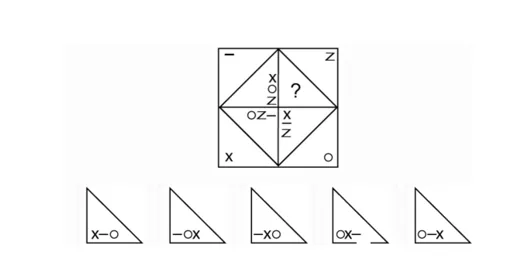
Visual description: a square is divided into triangular sectors containing the symbols dash, Z, X and O; one sector is missing.
Question: Which triangular response completes the diagram?
Visual described in words: Visual description: a square is divided into triangular sectors containing the symbols dash, Z, X and O; one sector is missing.
View answer & full teaching solution
Correct answer: E — O–X arrangement
Solve the visual by separating features before choosing an option. The detailed reasoning below turns the diagram into explicit rules so you can reuse the method on unfamiliar figures.
Work it out step by step
Treat each triangular sector as an ordered symbolic output, not merely a set of symbols.
Compare the three completed quadrants to identify how corner information is transferred into internal order.
The missing sector must begin with O, place the dash in the middle, and end with X.
Only O–X preserves the established order.
Why this is the right answer
The correct option is the only one that satisfies every confirmed feature simultaneously.
Why the other options do not work
Option D is especially tempting because it contains the same symbols and starts with O, but order is part of the rule: moving the dash to the end breaks the pattern.
What to remember: In symbol-order items, “same elements” is not enough. Position and sequence are themselves encoded information.
Want more Inductive SHL tests?Start with the inductive hub or use the structured learning path below for diagnostic practice, rules, harder patterns and complete guides.
Translate the wording into constraints. A conclusion must follow from the rules; being merely possible is not enough.
Deductive ReasoningLevel 2 · Chained Implication
Deductive Practice 2: Connect Two Rules into One Chain
Maria, and everyone who works in Room A, wears a red hat. Ioanna works in Room A. Despoina does not wear a red hat. Anyone who wears a red hat also wears grey trousers.
Question: Which statement must be true?
View answer & full teaching solution
Correct answer: B — Ioanna wears grey trousers
This question is a chain. Once Ioanna is placed in Room A, two consequences follow automatically.
Formula or rule to use
A → B; B → C ⇒ A → C
Work it out step by step
Room A → red hat.
Ioanna is in Room A, therefore Ioanna wears a red hat.
Red hat → grey trousers.
Therefore Ioanna wears grey trousers.
The chain can be compressed to Room A → red hat → grey trousers.
Why this is the right answer
B is forced by two linked rules and a direct membership fact.
Why the other options do not work
A conflicts with Despoina’s lack of a red hat because everyone in Room A must wear one.
C is false because Maria is explicitly included among red-hat wearers, and red hat implies grey trousers.
E is unsupported because grey trousers do not imply red hat; the second rule is one-directional.
What to remember: Whenever two rules share a middle term, connect them before looking at the options. Chaining often turns a paragraph into a one-line pathway.
Deductive Practice 7: Ability, Membership and Action
Anyone who is not a member of the Access Committee cannot give approvals for entry to the Archive. All members of the Access Committee can give approvals for entry to the Archive. Eleni has given approvals in the past. Kostas is a member of the Committee, but he has never given an approval. No one who has given an approval ignores the access rules.
Question: Which statement must be true?
View answer & full teaching solution
Correct answer: B — Kostas can give approval, but has not done so
This item tests the difference between ability, membership and observed action. Those are related but not interchangeable.
Work it out step by step
Rule 1: non-member → cannot approve.
Rule 2: member → can approve.
Fact: Kostas is a member → Kostas can approve.
Fact: Kostas has never given an approval → he has not exercised that ability.
Therefore B combines two directly supported statements.
Cross-check: Eleni has approved, so she cannot be a non-member under Rule 1; and anyone who has approved does not ignore the rules.
Why this is the right answer
B is fully supported without reversing or strengthening any rule.
Why the other options do not work
A contradicts the rule about people who have given approval.
C conflicts with Eleni’s approval history plus the non-member rule.
D invents a relationship between non-membership and ignoring rules.
E directly contradicts the fact that Kostas is a member.
What to remember: Separate modal concepts: “can do” (ability), “is” (status), and “has done” (action). Many hard deductive distractors deliberately blur these categories.
Need more Deductive SHL tests practice?Continue with rule chains, constraints, ordering and multi-condition deductive reasoning in the dedicated hub.
Continue to the dedicated free practice guide for 28 original Numerical, Verbal, Inductive and Deductive questions, Practice Mode, Test Mode and detailed worked solutions.
More SHL Tests Practice: Choose the Right ReasoningCampus Learning Path
You do not need to open every SHL article on the site. Choose the route that matches your assessment and your current weakness. These internal links are organised as a hub-and-spoke learning path: the broad SHL tests page helps you choose a topic, then the specialist pages go deeper.
Full Free SHL Tests Practice
Use the full 28-question candidate guide when you want more exercises across Numerical, Verbal, Inductive and Deductive Reasoning.
Inductive Reasoning Learning Path: From First Diagnostic to Hard Patterns
The ReasoningCampus inductive library is now large enough that a simple list of links would be confusing. This order gives each page a distinct job and helps candidates move from orientation to advanced practice.
Return to the full guide when you need a broader review of format, strategy, practice and preparation in one place.
SHL Tests Candidate Questions: Clear Answers Before Test Day
Are SHL tests difficult?
They can feel difficult because the assessment combines unfamiliar question formats with time pressure and, in some adaptive formats, no ability to revisit a submitted answer. Difficulty also depends on the role, assessment family and your familiarity with the reasoning skill. A better question is: which part is costing you accuracy or time? Use the diagnostic above to find that first.
How do I prepare for SHL tests?
Start with the exact assessment name. Use official familiarisation material, then practise the matching reasoning category. Keep an error log, increase difficulty gradually and finish with timed mixed practice. Avoid spending most of your study time on a test family that is not in your invitation.
How do I pass SHL tests?
There is no universal SHL pass mark. Your goal is to maximise accurate performance under the rules of your own assessment and the hiring organisation decides how the result is used. Preparation should improve method, speed and consistency; no preparation website can honestly guarantee a recruiter’s outcome.
Can I practise SHL tests for free?
Yes. SHL provides a selection of official free practice tests and example questions, although its Candidate Support says coverage does not exist for every assessment and language. ReasoningCampus also provides a separate 28-question free practice page with worked solutions.
What should I do if my invitation only says “SHL assessment”?
Look for the assessment title on the invitation, assessment home page or tutorial. If the wording remains unclear, ask the recruiter which assessment you will take rather than assuming that every SHL assessment is G+ or numerical reasoning.
Are OPQ and cognitive SHL tests prepared for in the same way?
No. Cognitive tests contain reasoning tasks with performance-based answers. OPQ-style questionnaires examine work-related preferences and should not be approached as if there were a single “correct personality”. Read carefully, think about your genuine work behaviour and answer consistently.
Should I memorise questions from SHL tests practice sites?
No. The useful skill is transfer: recognising the structure of an unfamiliar problem. Memorising one percentage question or one shape sequence is much less valuable than understanding why the formula, evidence rule or visual dependency works.
Sources & Methodology for This SHL Tests Guide
Current factual claims about SHL products, candidate rules and official practice resources are checked against primary SHL sources. The practice questions are original ReasoningCampus educational exercises designed to train transferable reasoning methods rather than reproduce confidential live assessment content.
Numerical questions are checked by recomputing the stated arithmetic and conditions. Verbal answers are checked against the evidence strength of the passage. Inductive answers are checked against the complete visual rule rather than one matching feature. Deductive answers are checked against the stated rules without adding assumptions. Each question is also assigned a skill label so the diagnostic can recommend a more specific next step when an answer is wrong.
Who Created and Reviewed This SHL Tests Guide?
The people responsible for the educational content and review are identified below. Only roles and areas of expertise already used in ReasoningCampus materials are included here; no unverified degrees, employer claims or external profiles have been added.
Ioannis Triantafylliou
Author · Public Administration and Legislation Instructor
Contributes rule interpretation, institutional reasoning and structured analysis used in the written explanations and deductive-style material.
Sofia Karamezidou
Contributing Author · Management, Leadership and Human Resource Management Instructor
Contributes management, HR and organisational context used in candidate guidance and work-related assessment explanations.
Dimitris Karagiannidis
Reviewer · Psychometric Tests and Analytical Assessment Instructor
Reviews numerical, verbal, inductive and deductive reasoning logic and the consistency of the assessment-preparation methodology.
Last substantive review: 20 August 2026.
SHL Tests: Know What You Have, Then Practise What Matters
If you arrived here because an employer sent you SHL tests, your next step should now be clearer: identify the assessment, check the official instructions, diagnose your weak skill and practise that skill deliberately.
For a deeper free diagnostic, continue to the 28-question practice page. For a structured programme across the main reasoning categories, use the complete ReasoningCampus preparation route.
Understand SHL assessment data requests, the employer contact route and the difference between feedback, access and deletion enquiries.
Published by ReasoningCampus Editorial Team
ReasoningCampus publishes independent preparation guides and original practice resources for SHL assessments and EPSO competitions. This shared editorial account represents the organisation, rather than a single named author. Individual contributions and reviews are identified where documented. Meet the educational team. Browse our SHL guides, EPSO resources and Greek competition guides.