
ReasoningCampus · SHL Study Skills
SHL distractor analysis turns a tempting wrong answer into a traceable mistake. Reconstruct the calculation or assumption that would produce it, then compare that step with the question. This lesson shows how the same method works for numerical and verbal reasoning. ReasoningCampus teaches candidates to explain distractors, including a wrong denominator, as part of reviewing original practice questions.
Independent learning resource · English · Content revised 16 October 2026
View full preparationSHL distractor analysis: reconstruct the wrong step
At ReasoningCampus, we use solve first, diagnose alternatives, transfer the lesson. The options can help you recognise a possible error, but they should not replace the reasoning. After solving, identify the exact operation or assumption that produces each distractor, then test the corrected method on new data.
Wrong denominator: three numerical answers, three operations
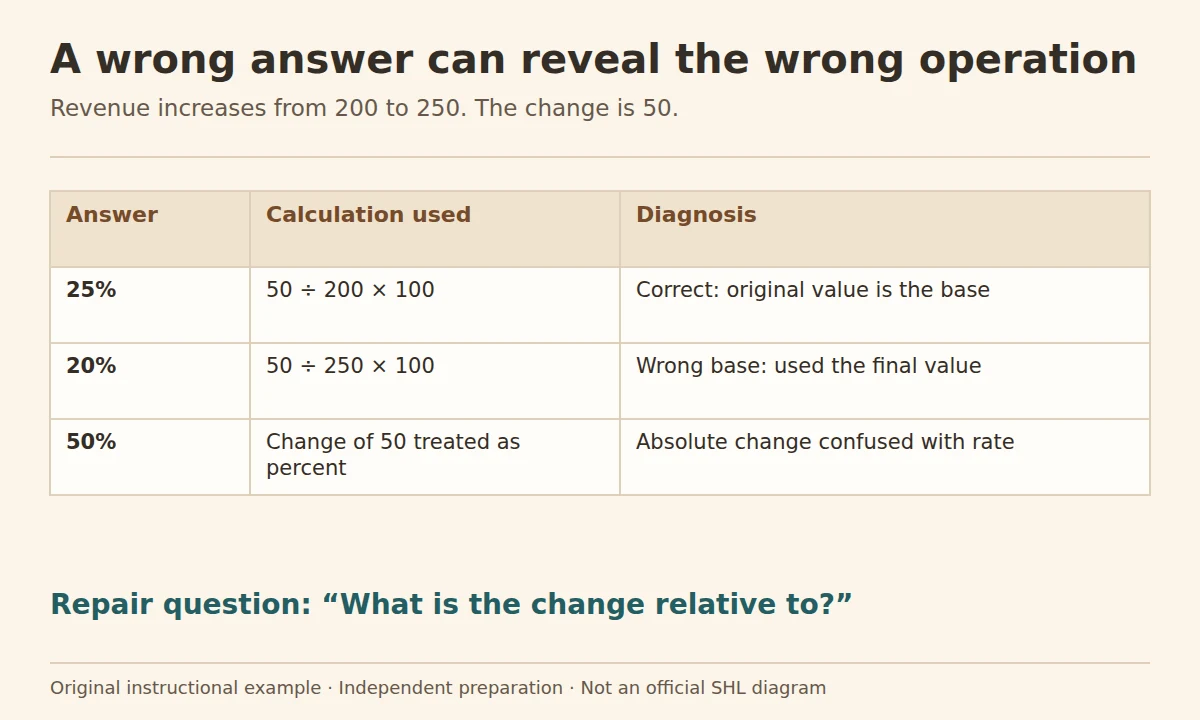
Revenue grows from 200 to 250. The options are 20%, 25% and 50%. The increase is 50, and growth from the original value is 50 ÷ 200 × 100 = 25%. The 20% option divides by the new value, 250. The 50% option treats the absolute difference as a percentage. Each wrong answer is plausible because it uses a real number from the task, but only one uses the requested relationship.
Now change the data to 300 and 360. Correct growth is 60 ÷ 300 = 20%. If you simply remembered “25%” from the first example, the changed data exposes the lack of transfer.
Deductive example: reverse the arrow and the answer changes
Every approved document has a stamp. Document M has a stamp. “M is approved” is a tempting conclusion, but the rule does not exclude stamped documents that are not approved. A valid counterexample is a stamped draft awaiting approval. “M is definitely unapproved” is also unsupported. The evidence leaves approval undetermined.
| Distractor pattern | What went wrong | Repair question |
|---|---|---|
| Wrong denominator | A real value was used as the wrong base | What is the quantity relative to? |
| Reversed implication | A → B became B → A | Can B occur without A? |
| Scope expansion | Some or one group became all | Did the population or quantity change? |
| Extra transformation | One feature changed without evidence | Which shown transition supports it? |
Verbal example: a different population
A passage reports that 12 surveyed managers preferred a new dashboard. A statement says all employees preferred it. The population has changed from surveyed managers to all employees, and a limited count has become a universal claim. Without further evidence, the stronger statement is not established. Do not call it false solely because the passage is narrower; it could be true or false outside the reported evidence.
Review distractors with an error note you can reuse
“Careless” is rarely enough. Write “divided by final value instead of initial value” or “treated a necessary condition as sufficient”. Add a one-sentence repair and a fresh check question. If you cannot explain why an alternative is wrong, review whether the item is ambiguous before treating its answer key as authoritative.
A rate distractor that reverses the relationship
Original question: an identical job takes 12 hours at the original constant rate. The rate increases by 50%, with no setup overhead. How long does the same job take now? The new rate is 1.5 times the old rate, so time becomes 12 ÷ 1.5 = 8 hours.
A tempting answer of 6 hours treats a 50% increase in rate as a 50% reduction in time. Another answer, 18 hours, multiplies time by the rate factor instead of dividing. Verify the result using work = rate × time: 1.5 × 8 equals the original 12 rate-hours.
Record “inverse relationship” as the error type. Recording only “arithmetic mistake” would send you to the wrong repair exercise.
Check your understanding: original practice
Solve the question first, then trace each tempting alternative to a specific wrong step. Use the explanation to choose what to practise next.
Looking for a structured course alongside these free questions? View full preparation.
Questions about SHL distractor analysis
Should I read the options before the question?
There is no universal order. Understand the question and use options carefully; do not let an attractive number dictate the operation.
Are all official distractors designed around these errors?
This guide makes no claim about every official item. The examples illustrate common reasoning mistakes in original practice.
Can analysing distractors replace solving?
No. It can support elimination and review, but a final answer still needs to satisfy the actual task.
Sources and scope
- SHL Verify Numerical Ability factsheet (2018)
- SHL Candidate Support: available practice tests and familiarisation
The linked assessment resources provide the wider context. The distractor analysis is demonstrated on original exercises so that the arithmetic or logical error behind an option can be inspected.
Where to go next
Return to the numerical formula or verbal scope lesson behind the mistake. The four-step method then connects the correction to fresh practice.
