
SHL Inductive Reasoning Test 2026: Format, Pattern Rules, Practice Questions & Worked Solutions
The SHL inductive reasoning test measures how accurately you can infer rules from unfamiliar shapes or alphanumeric information and apply them under time pressure. This guide explains the current interactive format, teaches the TRACE method, provides five visual practice questions with complete solutions and shows what is included in the €99 ReasoningCampus preparation package.
Prepared and reviewed by the ReasoningCampus Assessment Editorial Team.
Scope: primary-source checking, pattern-rule verification, distractor analysis, timing guidance and worked-solution review. See the editorial method below.
23 July 2026
ReasoningCampus is independent and is not affiliated with or endorsed by SHL. Official facts are linked directly to SHL sources.
What Is the SHL Inductive Reasoning Test?
The central skill is disciplined rule induction. Candidates must separate a complex image into observable variables—such as number, position, orientation, fill, order and relationship—then confirm which transformation explains every required step. A visually attractive answer is not enough: the correct option must satisfy all active rules simultaneously.
Observe
Translate the diagram into measurable features rather than relying on overall appearance.
Infer
Form the simplest rule that explains the complete sequence or matrix.
Validate
Reject every answer that violates even one confirmed condition.
Current SHL Inductive Reasoning Format: What Official Sources Confirm
SHL’s support documentation states that the older Verify Inductive Reasoning versions were retired during 2024 and identifies Verify Interactive – Inductive Reasoning as the replacement. The official product factsheet describes the standalone assessment as interactive, activity-based, adaptive and designed with mobile-first technology.
| Feature | Current published information | Candidate action |
|---|---|---|
| Standalone assessment | Verify Interactive – Inductive Reasoning | Check that this exact name appears in your invitation. |
| Time | 18 minutes | Practise under a realistic total timer rather than using unlimited time. |
| Maximum questions | 15 | Do not assume every employer configuration will look identical. |
| Question style | Interactive, activity-based and adaptive | Complete the official tutorial and practise the input method. |
| Information used | Shapes and alphanumeric sequences | Train both visual rules and letter-number relationships. |
Before using independent preparation, inspect the official SHL inductive reasoning example questions and the official SHL practice-test area. These sources help you confirm the interface and instruction style you may encounter.
The TRACE Method for Unfamiliar Pattern Questions
TRACE is the ReasoningCampus framework for converting visual overload into five controlled decisions. It is an independent learning method, not an official SHL procedure.
T — Type
Classify the structure before solving. A linear sequence requires transition checking; a matrix may require both row and column logic; a coded task may contain separate letter and number rules.
R — Record
List the candidate variables: count, position, rotation, reflection, fill, shape, line style, inside/outside state, overlap, order and odd/even position.
A — Analyse
Follow one distinctive component at a time. A dot can move while the frame rotates and the fill alternates. Treat those as independent short sequences.
C — Check
A valid rule must explain the complete required pattern. In a sequence, confirm it over more than one transition. In a matrix, test every row or column governed by the same operation.
E — Eliminate
Reject answers in layers: wrong count first, then wrong position, orientation, fill and secondary relationships. This is faster than reconstructing every option mentally.
For a deeper taxonomy of rule families, distractors and recovery methods, continue to the internal guide on advanced SHL inductive test rules, error patterns and faster solving strategy.
Eight Core Pattern Families to Check
Counting
Objects, sides, lines, intersections or filled regions increase, decrease, alternate or follow arithmetic progressions.
Position and movement
Elements travel through corners, edges, rows, columns, checkpoints or inside/outside layers.
Rotation
A shape turns by a fixed or changing angle. Use asymmetric anchor points to measure direction accurately.
Reflection
The figure mirrors across a vertical, horizontal or diagonal axis, reversing handedness rather than simply turning.
Fill and colour
Outline, solid and shaded states change independently or only when another trigger occurs.
Alternating subsequences
Odd and even positions may form two separate patterns. Split them whenever adjacent items appear unrelated.
Overlay and cancellation
Figures combine through addition, intersection, subtraction or exclusive-OR behaviour.
Coded relationships
Letters, numbers, arrows or markers describe another feature rather than changing for their own sake.
One €99 Package for Inductive, Numerical and Verbal Reasoning
The complete ReasoningCampus package is designed for candidates who need structured practice rather than disconnected question banks. It combines approximately 1,430 exercises with detailed worked explanations and a progression from foundation skills to more demanding multi-rule questions.
Inductive and abstract reasoning
Rotation, movement, counting, matrices, fill changes, alternating sequences, alphanumeric relationships, overlays, conditional rules and multi-rule distractors.
Numerical reasoning
Percentages, ratios, rates, averages, growth, comparisons, tables, charts and multi-stage data interpretation, with the calculations and logic shown step by step.
Verbal reasoning
True, False and Cannot Say logic, evidence control, inference, assumptions, scope, wording precision and the distinction between possibility and certainty.
The material is reviewed against current official candidate information and is designed to cover the major skill families and subtopics candidates need for SHL-style reasoning preparation. It does not claim to reproduce confidential live questions.
Five Visual Inductive Reasoning Practice Questions
Answer the five visual examples below in order. Each image has descriptive alternative text, and every complete solution is also present as readable HTML so candidates, search engines and accessibility tools can follow the reasoning rather than seeing only a JavaScript score. They are presented as independent practice examples, not as confidential live questions or official SHL test items.
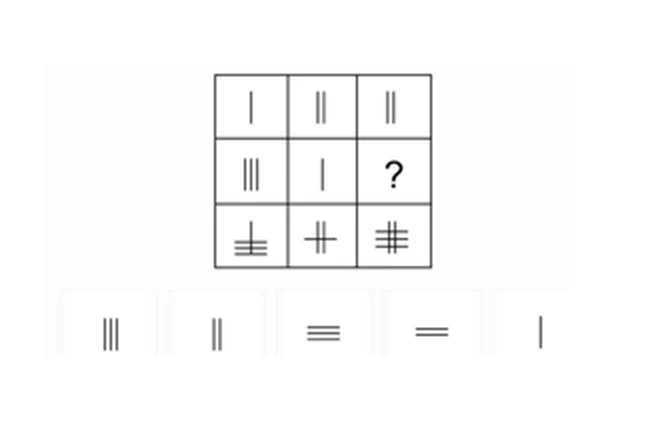
Which symbol completes the matrix?
Read the complete worked solution
- Read each column from top to bottom.
- The top cell supplies the number of vertical lines in the result cell.
- The middle cell supplies the number of lines that become horizontal after a 90-degree rotation.
- In column three, the bottom result contains two vertical and three horizontal lines.
- The top-right cell already supplies the two vertical lines, so the missing middle-right cell must supply three lines before rotation.
Therefore the missing symbol is three vertical lines: option A. Option C has the correct count but ignores the required rotation of the middle-row input.
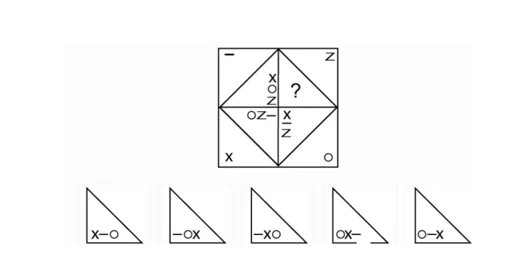
Which triangular response completes the upper-right section?
Read the complete worked solution
- The four outside corners contain the complete symbol set: dash, Z, X and O.
- Each inner triangle contains the other three symbols, excluding the symbol in its corresponding outside corner.
- Normalise the reading direction: read each inner list from the outside midpoint toward the centre.
- The visible lists then progress cyclically: XOZ → OZ− → Z−X → −XO.
- For the missing upper-right triangle, the outside-to-centre direction runs from right to left. Therefore the required order −XO appears visually from left to right as OX−.
Option D is the only response that preserves both the cyclic order and the required spatial reading direction.
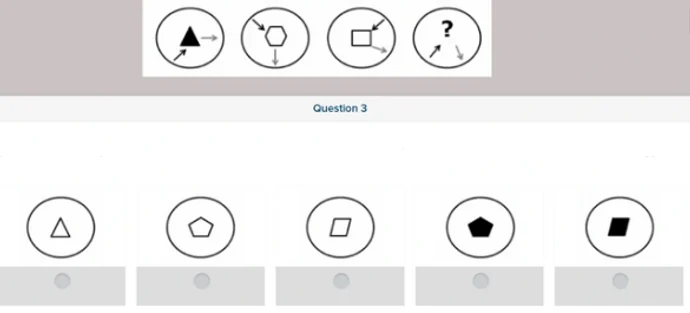
Which shape replaces the question mark?
Read the complete worked solution
Correct answer: D — filled pentagon.
Read the grey arrow as a clock hand: it points to 3, 6 and 4 in the completed panels, matching the triangle, hexagon and quadrilateral. In the missing panel it points to 5, so the shape must be a pentagon. Check the black arrow separately. It points upwards in the filled example and downwards in the two outline examples. In the missing panel it points upwards, so the pentagon must be filled. The answer is D.
Why B fails: B has five sides but is an outline shape; it fails the fill rule indicated by the black arrow.
Which panel completes the arrow-and-dot sequence?
Read the complete worked solution
Correct answer: E — upward arrow with five dots.
Track two independent rules across all four panels. The arrow turns 90 degrees clockwise: up, right, down, left, so it must point up next. The number of black dots increases by one: 1, 2, 3, 4, so the next panel must contain 5. Only E combines an upward arrow with five dots.
Check every option: A has the correct arrow but only four dots. B and D have five dots but the wrong arrow direction. C has the correct arrow but only three dots.
Which upper panel matches the fifth coded position?
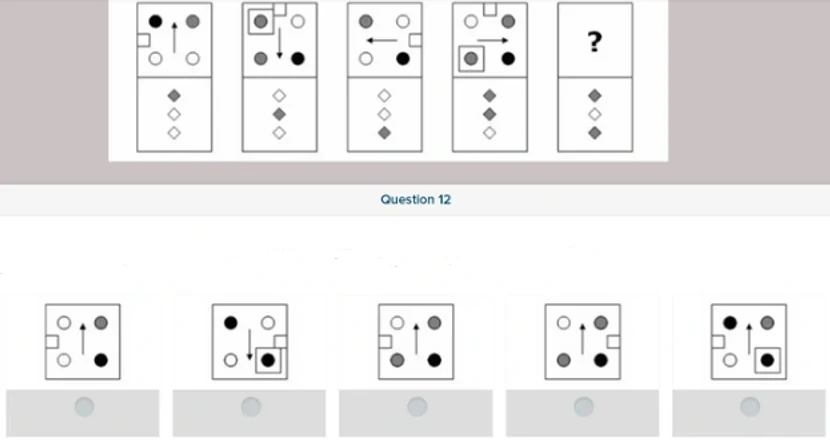
Read the complete worked solution
Correct answer: A.
Use two directly repeatable features. The large box highlighting a circle is absent, present, absent, present, so it must be absent in panel 5. The number of grey circles is 1, 2, 1, 2, so the next panel must contain one grey circle. B and E have a highlight box; C and D have two grey circles. Only A satisfies both rules. These two checks are sufficient: the side marker and arrow do not need an additional assumed rule.
Elimination: B and E break the box alternation. C and D break the one-grey-circle requirement.
Scoring, Incorrect Answers and Pass Marks
No universal pass mark
SHL Candidate Support states that SHL does not set passing scores. The employer decides how the result contributes to selection.
No score deduction for an incorrect answer
SHL Candidate Support states that incorrect responses do not decrease the test score and candidates are expected to answer all questions delivered.
No reliable public conversion table
A third-party raw-score table cannot predict an official result without the exact assessment, adaptive model, comparison group and employer decision rule.
Window Switching, Screenshots and Assessment Security
SHL Support documents that some assessments may display an “Illegal window switch detected” warning and prohibit opening another browser, switching away from the test, minimising the window or taking screenshots. Repeated prohibited actions can result in the assessment being locked.
This does not mean that every SHL configuration uses identical controls. Read the privacy notice, technical check and instructions displayed for your own invitation. Do not rely on generic internet claims about hidden AI detection, webcam recording or response-pattern analysis unless the specific assessment documentation confirms them.
How This Guide Was Prepared and Reviewed
ReasoningCampus is the disclosed organisational author. This page avoids unverified personal qualifications and describes the checks actually applied to the guide.
Primary-source review
Current format, timing, question maximum, adaptive delivery, scoring and security statements are tied to the official SHL sources listed below. Employer-specific details are clearly separated from general product information.
Rule and answer verification
Each displayed question is decomposed into observable variables. The selected response must satisfy every stated rule, and each distractor is checked against the missing condition.
Candidate-first review
Worked solutions remain readable without JavaScript, uncertainty is stated explicitly, and the page does not claim a universal pass mark, confidential live questions or guaranteed assessment results.
Substantive review date: 23 July 2026.
Frequently Asked Questions
What is the SHL inductive reasoning test?
It is a timed cognitive assessment that asks candidates to infer rules from unfamiliar shapes or alphanumeric information and apply those rules to predict the next or missing result.
What is the current SHL inductive reasoning format?
SHL retired its older Verify Inductive Reasoning versions during 2024 and identified Verify Interactive – Inductive Reasoning as the replacement. The exact assessment name and tutorial in your invitation remain the final authority.
How long is Verify Interactive – Inductive Reasoning?
SHL product material describes the standalone interactive assessment as 18 minutes, with a maximum of 15 questions, interactive activity-based delivery and adaptive scoring. Employer configurations and combined assessments can differ.
Is Verify Interactive – Inductive Reasoning adaptive?
Yes. SHL product information describes the standalone interactive version as adaptive. This means candidates may not receive an identical sequence of items.
Is there a universal SHL pass mark?
No. SHL Candidate Support states that SHL does not set passing scores. The recruiting organisation decides how results are used.
Do incorrect answers reduce the SHL score?
SHL Candidate Support states that incorrect responses do not decrease the test score and that candidates are expected to answer all questions delivered.
Can an SHL assessment detect window switching or screenshots?
SHL Support documents that some assessments can display an illegal-window-switch warning and can prohibit switching windows, minimising the test or taking screenshots. Controls can vary, so candidates must follow the rules shown for their own assessment.
Where can I find official SHL inductive reasoning examples?
SHL provides a dedicated inductive-reasoning example page and an official practice-test area. Use those resources to confirm the current interaction style before using independent preparation material for additional practice.
What does the ReasoningCampus €99 package include?
It includes 150 inductive or abstract reasoning exercises, approximately 1,100 numerical reasoning exercises and approximately 180 verbal reasoning exercises, with detailed worked explanations and structured online practice.
Are these five visual examples official SHL test questions?
No. They are presented as independent visual practice examples and not as official or confidential live SHL items. SHL’s own examples and practice area are linked below for comparison with the current official interface.
Is ReasoningCampus affiliated with SHL?
No. ReasoningCampus is an independent preparation provider and is not affiliated with or endorsed by SHL. SHL and related product names belong to their respective owner.
Official SHL Sources Used
- SHL Verify Interactive – Inductive Reasoning product factsheet
- Official SHL inductive reasoning example questions
- Official SHL practice tests
- SHL Support: retirement of legacy Verify Inductive Reasoning products
- SHL Candidate Support: pass marks
- SHL Candidate Support: effect of incorrect answers
- SHL Support: illegal window switching and screenshots
Official product information can change. Review this page whenever SHL updates its product catalogue, candidate examples or support documentation.
Move from random practice to a complete reasoning system
Prepare with 150 inductive exercises, approximately 1,100 numerical exercises and approximately 180 verbal exercises, supported by detailed worked explanations and structured online practice.
Independent preparation material. Not affiliated with or endorsed by SHL.
