

SHL General Ability Test (Verify G+) 2026: Practice & Guide
The SHL General Ability Test (Verify G+) combines numerical, deductive and inductive reasoning. The challenge is not just solving each type correctly; it is switching cleanly between different reasoning modes under time pressure.
Use this page in the order that suits you: practise immediately with the 12-question diagnostic, or first check the official format and the solving methods. Every answer includes a simple typology, a step-by-step method, the common trap and a transferable lesson you can reuse on new questions.
Start Here: Choose the Fastest Route for Your Goal
You do not need to read every section before practising. Use the route below to move directly to what you need.
12-Question G+ Practice Diagnostic
This mixed diagnostic is designed to reveal how you reason, not to imitate SHL’s proprietary interface. It contains 4 Numerical, 4 Deductive and 4 Inductive questions. Answer first, then open the explanations and label the reason for every error.
The numerical and visual inductive exercises below reuse original ReasoningCampus practice visuals from earlier ReasoningCampus materials. The deductive exercises and the final visual rule exercise are independent ReasoningCampus items. None are live or confidential SHL questions.
Question 1: Recover the Whole Budget from One Pie Slice
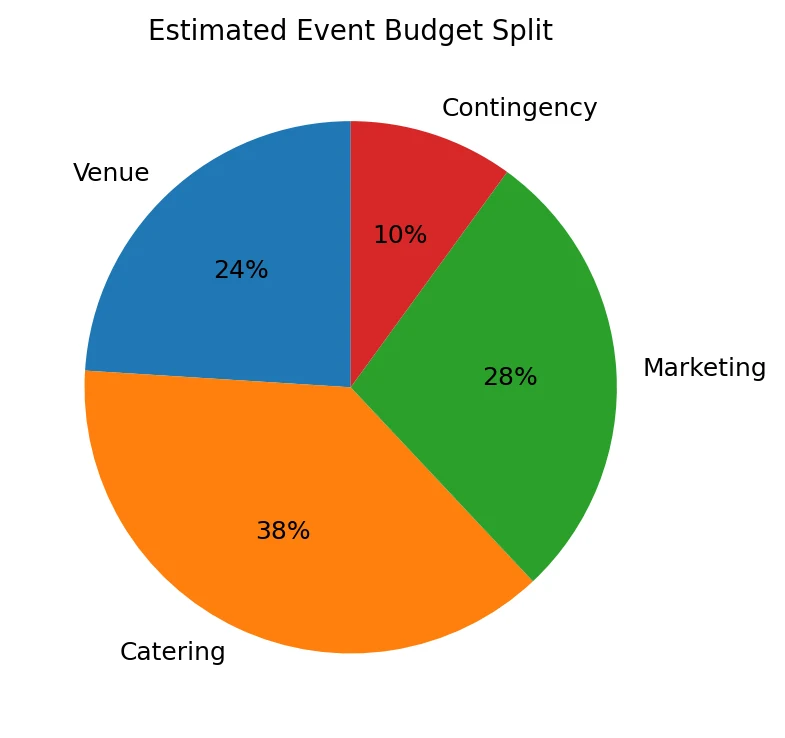
Figure: event-budget pie chart used for reverse-percentage practice.
Question. If the Venue slice equals £4,800, what is the total event budget?
View the step-by-step solution and question typology
- Read the share first. The pie chart shows that Venue is 24% of the complete budget.
- Convert 24% to a decimal. 24% = 0.24.
- Translate the information. £4,800 is not the whole budget; it is only 0.24 of the whole.
- Work backwards. Total budget = £4,800 ÷ 0.24.
- Calculate. £4,800 ÷ 0.24 = £20,000.
- Quick check. 24% of £20,000 = £4,800, so the result fits the chart exactly.
Question 2: Launch Approval
Rule 2: No project that requires legal review may launch before legal sign-off.
Fact: Orion is a Vega project.
Fact: Orion has not received legal sign-off.
Which conclusion must be true?
View the step-by-step solution and question typology
- Apply Rule 1. Orion is a Vega project, therefore Orion requires legal review.
- Apply Rule 2. Anything requiring legal review cannot launch before legal sign-off.
- Use the fact. Orion has not received sign-off yet.
- Necessary conclusion. Orion cannot launch yet.
Question 3: Three Count Rules Change at the Same Time
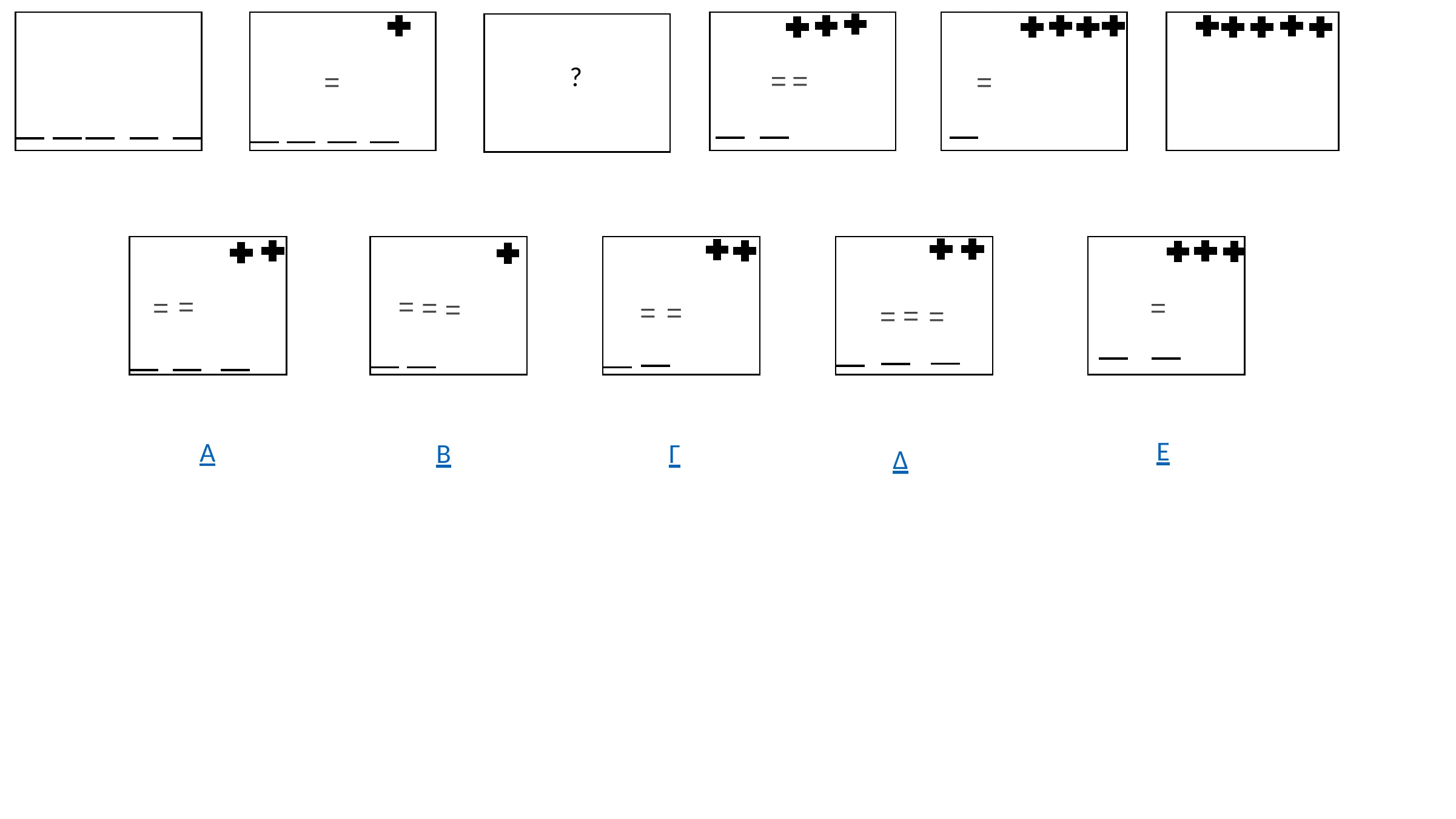
Answer choices are labelled A–E below the visual.
Which option correctly fills the missing frame?
View the step-by-step solution and question typology
- Ignore the answer options first. Count each symbol family in the given sequence.
- Crosses: 0, 1, ?, 3, 4, 5. The simplest complete rule is +1 each frame, so the missing frame needs 2 crosses.
- Bottom dashes: 5, 4, ?, 2, 1, 0. They decrease by 1, so the missing frame needs 3 bottom dashes.
- Equals signs: 0, 1, ?, 2, 1, 0. The complete symmetric count pattern is 0, 1, 2, 2, 1, 0, so the missing frame needs 2 equals signs.
- Combine all three requirements. We need 2 crosses + 2 equals signs + 3 lower dashes.
- Compare the options only now. Option A is the only option satisfying all three counts together.
Question 4: Reverse the Pie Slice, Then Apply Fee and VAT
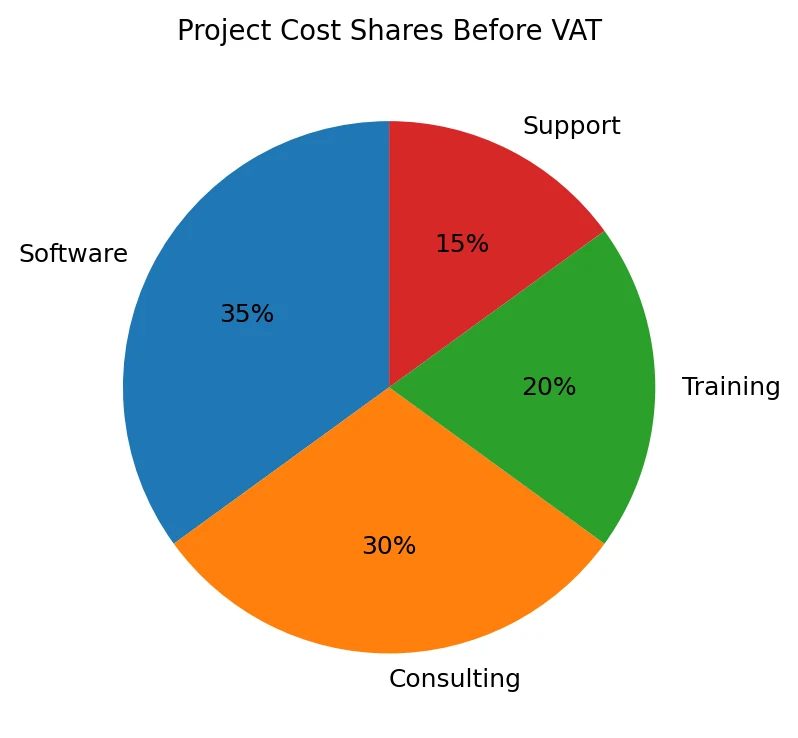
Figure: project-cost pie chart used for a reverse-percentage, fee and VAT calculation.
VAT: 20% added after the administration fee.
Question. If the Training slice equals £7,600, what is the final gross project cost?
View the step-by-step solution and question typology
- Recover the pre-VAT project total. Training is 20% of the pie and equals £7,600.
- 20% = 0.20, so pre-VAT total = £7,600 ÷ 0.20 = £38,000.
- Add the administration fee. 4% of £38,000 = £1,520.
- Subtotal after the fee = £38,000 + £1,520 = £39,520.
- Add VAT last. VAT = 20% of £39,520 = £7,904.
- Final gross cost = £39,520 + £7,904 = £47,424.
Question 5: Project Sequence
C must occur before B.
B must occur after D.
Which statement must be true?
View the step-by-step solution and question typology
- Write the first two rules as one chain: A → C → B.
- If A is before C and C is before B, then A must also be before B.
- The third rule tells us D is before B, but it does not tell us whether D is before or after A or C.
- The word immediately never appears in the rules, so option E adds an unsupported condition.
Question 6: Track the Corner, Then Track the Arrow Flow
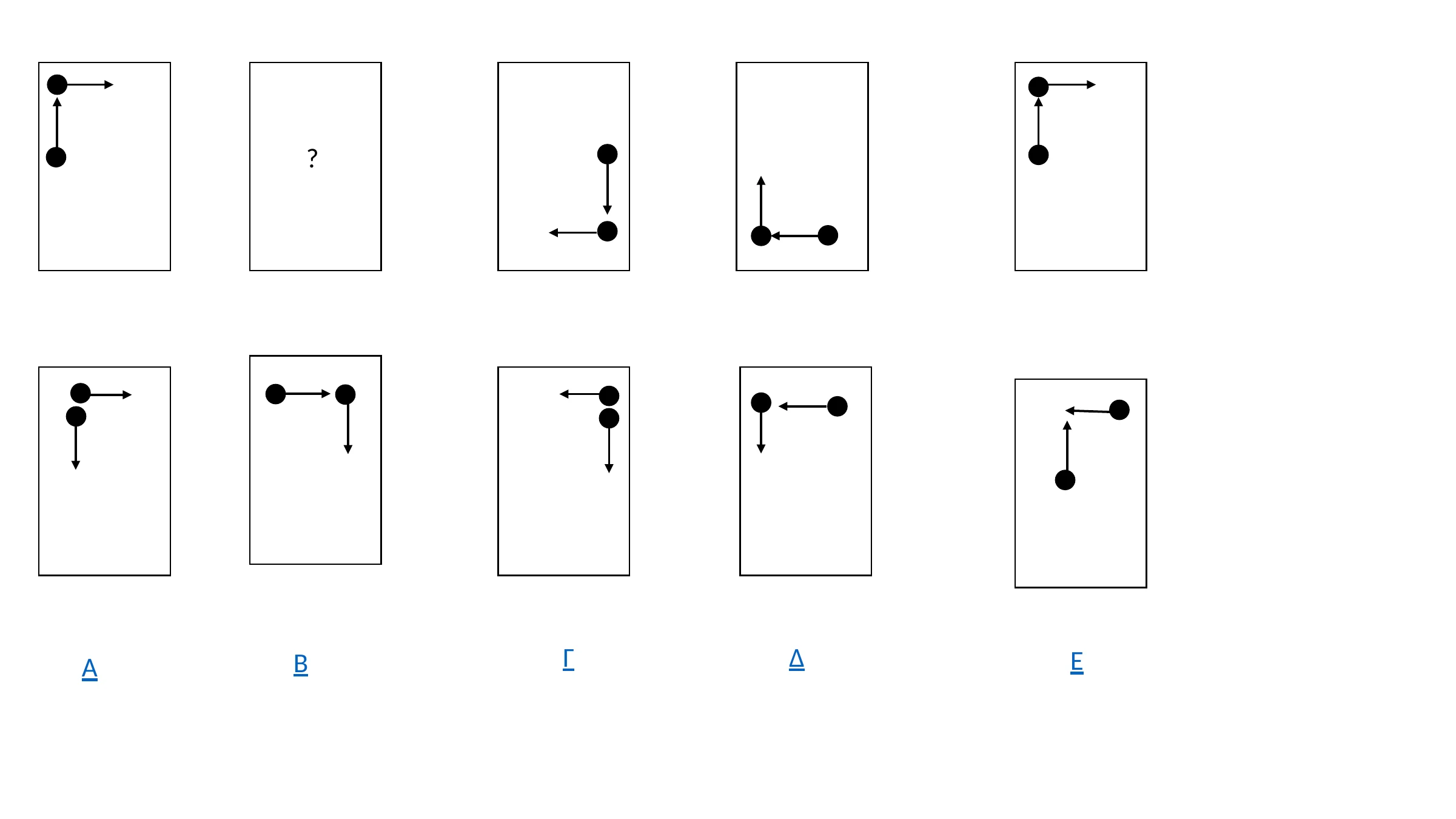
Answer choices are labelled A–E below the visual.
Which option correctly fills the missing second frame?
View the step-by-step solution and question typology
- Find the corner position first. The visible corner states move around the rectangle: top-left → missing → bottom-right → bottom-left → top-left.
- To complete a clockwise four-corner cycle, the missing state must therefore be top-right.
- Now inspect the arrows. At each corner, one arrow arrives along one side and the second arrow leaves along the next side of the corner.
- At the missing top-right corner, the horizontal arrow must travel rightwards into the corner, and the vertical arrow must then travel downwards.
- Compare the answer options. Option B shows exactly that top-right corner relationship.
Question 7: Largest Proportional Over-Performance
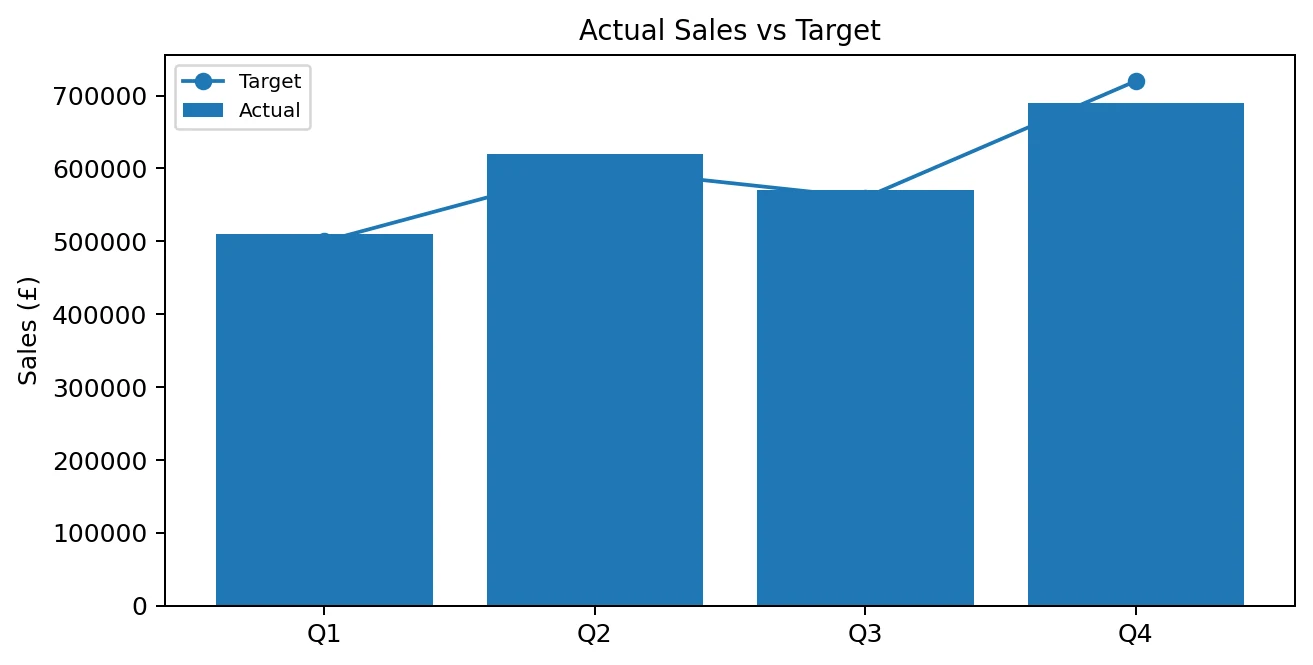
Figure: actual-versus-target sales chart used for proportional comparison.
Question. In which quarter did actual sales exceed target by the largest proportion?
View the step-by-step solution and question typology
- Q1: (£510,000 − £500,000) ÷ £500,000 = 2.0%.
- Q2: (£620,000 − £600,000) ÷ £600,000 ≈ 3.33%.
- Q3: (£570,000 − £560,000) ÷ £560,000 ≈ 1.79%.
- Q4: (£690,000 − £720,000) ÷ £720,000 ≈ −4.17%, so actual sales were below target.
- The largest positive proportion is Q2 at about 3.33%.
Question 8: Selection Rules
N and M cannot both be selected.
N is selected.
What must be true?
View the step-by-step solution and question typology
- N is definitely selected.
- N and M cannot both be selected, so M cannot be selected.
- Now test L. The first rule says that if L is selected, M must also be selected.
- But M cannot be selected because N is already selected.
- Therefore selecting L would create a contradiction. So L cannot be selected.
Question 9: Separate Two Symbol Cycles Before Choosing
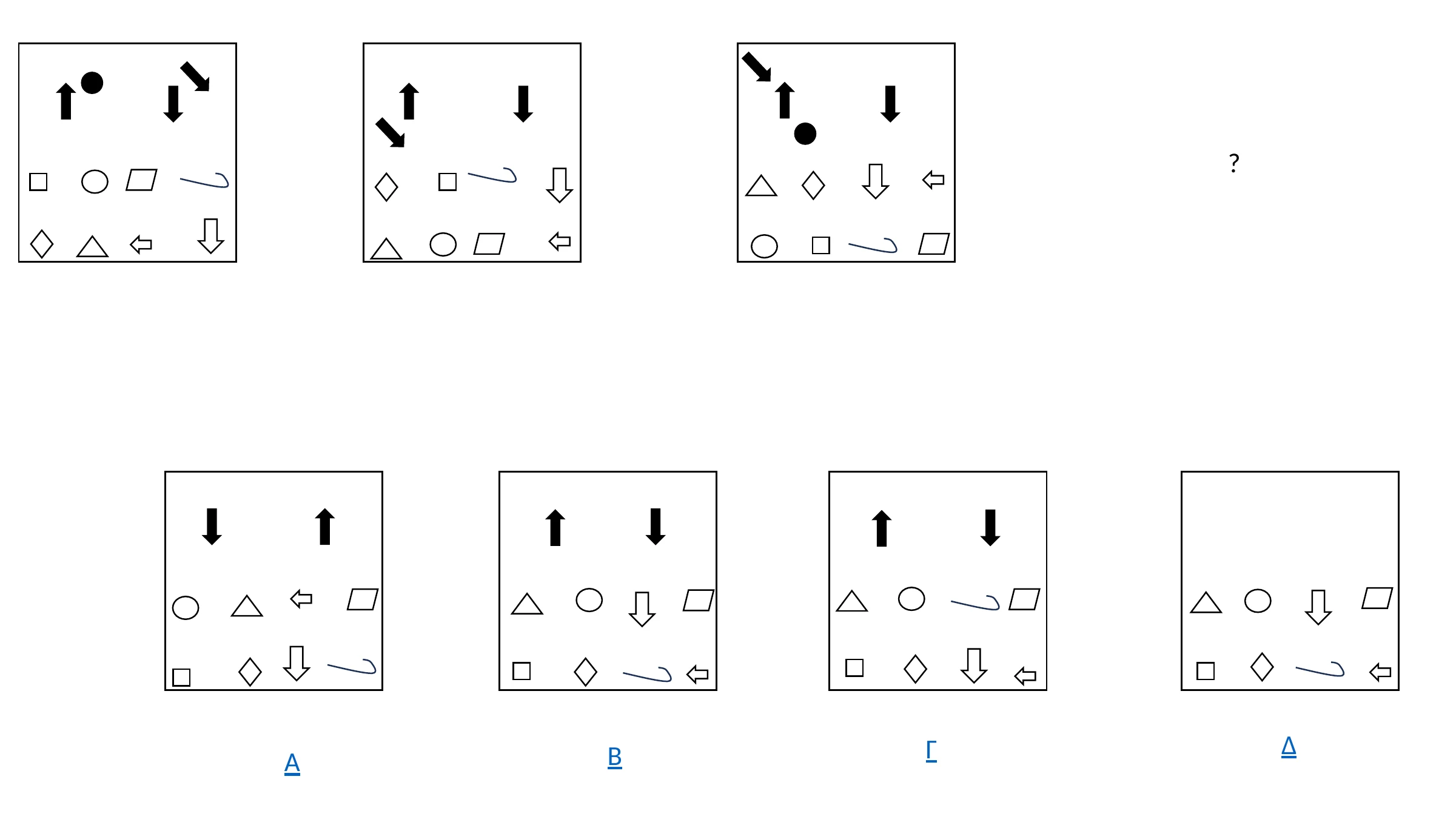
Answer choices are labelled A–D below the visual.
Which option correctly completes the sequence?
View the step-by-step solution and question typology
- Do not start with the large black symbols at the top. The stable, testable rule is in the lower 2×4 arrangement.
- Separate the left group of four shapes: square, circle, diamond and triangle occupy four positions and rotate through those positions from frame to frame.
- Following the first three frames, the next left-side arrangement must place circle + triangle on the upper row and square + diamond on the lower row.
- Now separate the right group: parallelogram, hook, left arrow and down arrow also rotate through their own four positions.
- The next right-side arrangement must be left arrow + parallelogram on the upper row and down arrow + hook on the lower row.
- Combine the two predicted halves. Only option A contains both complete next states at once.
Question 10: Apply the Same 110% Threshold to Every Team
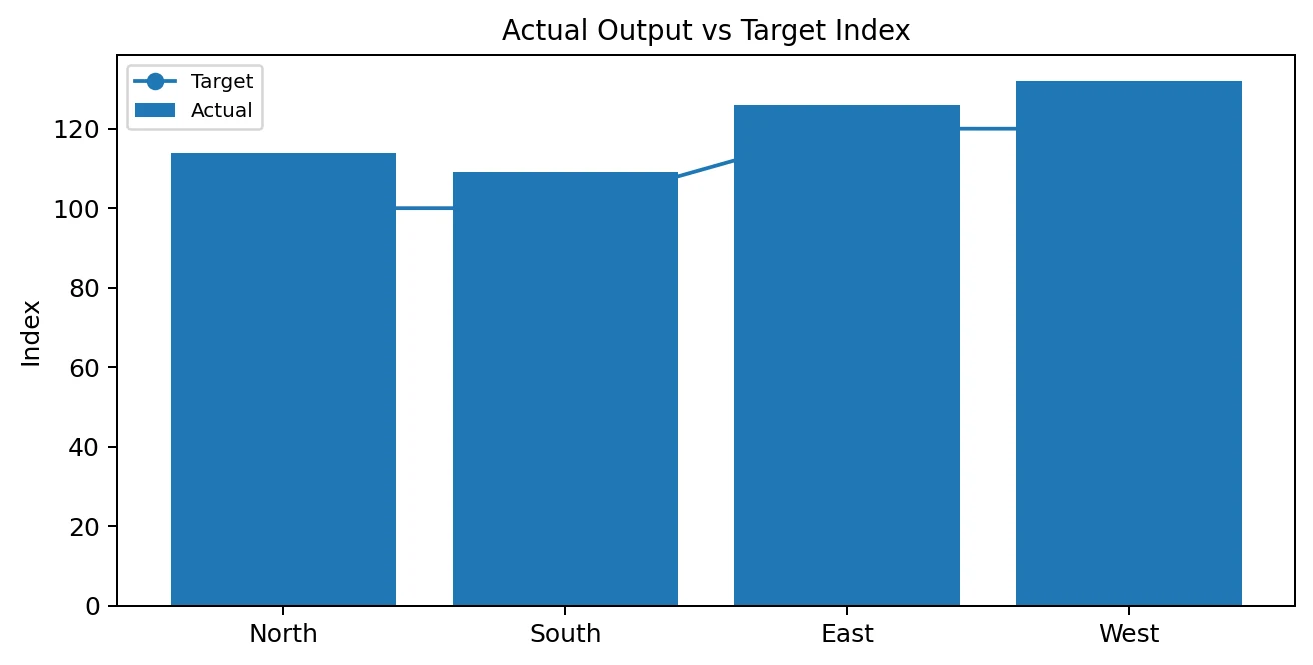
Figure: target and actual output chart used for the 110% threshold calculation.
Question. What is the total bonus pool?
View the step-by-step solution and question typology
- North: target 100 → threshold 110. Actual 114, so North qualifies.
- South: target 100 → threshold 110. Actual 109, so South does not qualify.
- East: target 120 → threshold 132. Actual 126, so East does not qualify.
- West: target 120 → threshold 132. Actual 132, so West qualifies because at least 110% includes equality.
- Two teams qualify.
- Total bonus pool = 2 × £750 = £1,500.
Question 11: Analysts and Remote Work
Some trained employees work remotely.
Which conclusion follows necessarily?
View the step-by-step solution and question typology
- “All analysts are trained employees” places the analyst group inside the trained-employee group.
- “Some trained employees work remotely” tells us that at least one trained employee belongs to the remote group.
- But it never tells us that the remote trained employee is an analyst.
- So we cannot conclude that some analysts are remote, all analysts are remote, or no analysts are remote.
- We also cannot reverse the relationship and say all remote employees are analysts.
Question 12: Solve Two Independent Rules
Which option comes next?
View the step-by-step solution and question typology
- Direction rule: the arrow rotates 90° clockwise: ↑ → → → ↓ → ← → therefore the next direction returns to ↑.
- Count rule: the number of dots increases by one: 1, 2, 3, 4 → therefore next is 5 dots.
- Combine the two rules: upward arrow + five dots.
Your ReasoningCampus G+ Diagnostic
ReasoningCampus practice classification — not an SHL benchmark.
This diagnostic is an educational practice tool. It is not normed against an SHL comparison group and does not predict an official SHL score or employer outcome.
Continue with structured SHL practice after reviewing your weakest category.
What G+ Measures
The SHL General Ability Test is designed to measure broad cognitive ability through three distinct reasoning domains: numerical reasoning, deductive reasoning and inductive reasoning. In practical terms, you may need to move from interpreting business data, to applying a set of logical rules, to discovering a visual or abstract pattern.
That mixture is what makes preparation different from practising one reasoning test in isolation. A candidate can be strong at percentages but lose time when switching into a rule-based deductive problem. Another candidate can recognise visual patterns quickly but make avoidable numerical mistakes because they select the wrong data base. Good preparation therefore needs both domain skill and switching discipline.
What the test is trying to measure
Numerical ability
Working with numerical data, selecting appropriate calculations, and making sound decisions or inferences from tables, charts and statistical information.
Deductive reasoning
Applying information and explicit constraints to draw logically valid conclusions without adding assumptions that were never stated.
Inductive reasoning
Detecting regularities, patterns and general rules from incomplete or unfamiliar information and applying those rules consistently.
Format: Interactive vs Multiple-Choice
Two official SHL fact sheets are especially useful for candidates because they show why generic statements such as “the SHL G+ always has X questions” can be misleading. The older Verify G+ fact sheet describes a multiple-choice adaptive assessment with a maximum of 30 questions. The Verify Interactive G+ fact sheet describes an activity-based adaptive assessment with a maximum of 24 questions. Both list a 36-minute allowed time.
| Feature | Verify Interactive G+ | Traditional multiple-choice Verify G+ |
|---|---|---|
| Abilities measured | Numerical, Deductive, Inductive | Numerical, Deductive, Inductive |
| Allowed time | 36 minutes | 36 minutes |
| Maximum questions | 24 | 30 |
| Question format | Interactive / activity-based | Multiple choice |
| Adaptive | Yes | Yes |
| Designed for unsupervised use | Yes | Yes |
The key preparation lesson is simple: train the skill first, then train the interface and pacing that match your invitation. A percentage problem still requires correct percentage reasoning, but the way you enter or manipulate an answer can differ between versions.
Question Typologies: What to Recognise Before You Solve
Numerical solving map
Core habit: identify what the percentage, ratio or threshold is based on before calculating.
Deductive solving map
Core habit: choose only what must be true from the stated rules.
Inductive solving map
Core habit: solve count, position, direction, fill and dependency separately before combining them.
One of the fastest ways to improve is to classify the question before you calculate or choose an answer. The label tells you which method to retrieve from memory. The diagnostic below therefore gives every question a typology, a short method, and a transferable lesson.
Numerical typologies
Reverse percentage, sequential percentage changes, proportional comparison, threshold rules, chart reading and part-to-whole reasoning.
Deductive typologies
Conditional implication, ordering chains, mutually exclusive rules, contradiction testing and quantifier traps.
Inductive typologies
Count interaction, rotation and direction, position cycles, independent feature rules and multi-cell dependencies.
Numerical formula bank used in the worked solutions
| Question type | Core formula / decision rule | Common trap |
|---|---|---|
| Reverse percentage | Whole = known part ÷ decimal share | Multiplying by the percentage instead of dividing by it. |
| Percentage increase/decrease | New value = original × (1 ± rate) | Using the wrong starting value as the percentage base. |
| Proportional over-performance | (Actual − Target) ÷ Target × 100 | Choosing the largest raw difference instead of the largest percentage difference. |
| Threshold | Required level = base × threshold multiplier | Treating “at least” as “greater than” and wrongly excluding an exact match. |
Inductive feature checklist
Before selecting an option, scan the visual in the same order every time: count → position → direction → rotation → fill/colour → dependency. A candidate rule is not valid until it explains every relevant feature across the sequence.
Deductive rule checklist
Translate the wording into a small rule system. Ask: What is definitely stated? What follows necessarily? What would create a contradiction? What am I merely assuming? The correct answer must be forced by the information, not simply plausible in real life.
How Adaptive Testing Changes Your Strategy
Both SHL G+ fact sheets referenced in this guide describe adaptive testing. In an adaptive assessment, the testing system uses your responses to determine the level of challenge presented during the assessment. The exact scoring model is proprietary, so candidates should avoid trying to reverse-engineer their score from how difficult one question felt.
What adaptive testing should change in your behaviour
- Do not panic after a difficult item. Difficulty is not a reliable live score indicator.
- Protect accuracy. Random speed is not a strategy; solve with a repeatable method.
- Switch cleanly between domains. Finish the logic of the current question before carrying a method into the next category.
- Use your invitation instructions. Navigation, review options and interaction rules can differ by assessment.
The ReasoningCampus reset routine
Identify
Reset
Solve
Check
Move
Identify: decide whether the item is numerical, deductive or inductive. Reset: clear the previous question’s method from your working memory. Solve: use the shortest valid approach. Check: verify the critical condition, not every detail. Move: commit and transition without mentally replaying the previous question.
Scores, Percentiles and Pass Marks
Score interpretation is one of the most frequently misunderstood parts of SHL preparation. The safest starting point is the official position: SHL does not set a universal passing score. The recruiting organisation decides how assessment results are used in its selection process.
What a percentile means
Official SHL sample reports describe percentile scores relative to a comparison group. A percentile of 50 means that the candidate performed better than 50% of the people in the comparison group used for that report. The comparison group matters: a percentile is not simply “percentage correct”.
What the Interactive G+ report can include
SHL’s Interactive G+ fact sheet states that candidates receive a score for each of the three specific abilities as well as a general ability score. A sample SHL report shows separate General Ability, Inductive Reasoning, Numerical Reasoning and Deductive Reasoning percentile results.
How to Prepare Efficiently
The strongest preparation plan is diagnostic rather than repetitive. Instead of solving hundreds of mixed questions without learning why you miss them, classify every error and then practise the underlying decision skill.
Step 1: Identify the version in your invitation
Record the exact assessment name, time limit, platform instructions and whether the experience is interactive or multiple-choice. Do this before buying or choosing any preparation resource.
Step 2: Establish a baseline in all three abilities
Take a short mixed diagnostic. The important output is not only your total. Compare your numerical, deductive and inductive accuracy. If one category is significantly weaker, it should receive extra focused practice before you return to mixed sets.
Step 3: Build a repeatable method for each domain
- Numerical: question → data → calculation → unit check.
- Deductive: rules → implications → eliminate violations → conclude only what is forced.
- Inductive: separate features → test candidate rules → verify across every transition.
Step 4: Add task switching deliberately
Do not spend your entire preparation period solving numerical questions in one block, then inductive questions in another. Once your methods are stable, mix the categories so your brain practises the transition itself.
Step 5: Add time pressure last
Timing a broken method only teaches you to make the same mistake faster. First reach stable accuracy untimed. Then reduce the time window while preserving your error-control routine.
Step 6: Review the cause, not only the answer
Every error should receive a label. Examples: wrong percentage base, missed constraint, converse error, pattern guessed from one step, unit mismatch, over-calculation, or failure to reset after a different question type. Your error log becomes your personal curriculum.
7-Day Preparation Plan
| Day | Primary task | Goal |
|---|---|---|
| 1 | Identify exact assessment + take mixed baseline | Know your version and weakest ability. |
| 2 | Numerical fundamentals | Remove base, ratio, percentage and data-selection errors. |
| 3 | Deductive rules and constraints | Stop adding assumptions; track conditions systematically. |
| 4 | Inductive feature analysis | Separate movement, count, direction, fill and alternation. |
| 5 | Mixed untimed set | Train clean switching while protecting accuracy. |
| 6 | Timed mixed practice | Reduce hesitation without abandoning method. |
| 7 | Light review + error log | Consolidate rules; avoid exhausting yourself with new material. |
If you have longer than a week, repeat the cycle with progressively harder questions rather than simply increasing volume. Your aim is fewer repeated error types, not a larger count of questions completed.
Common Preparation Mistakes
Preparing for the wrong version
A generic “SHL test” search can lead you to the wrong interface or even the wrong assessment family. Start with the invitation.
Memorising answer banks
Adaptive cognitive testing rewards transferable reasoning. Memorised surface patterns are fragile when values, rules or presentation change.
Chasing a mythical pass mark
SHL does not set one universal pass score. Concentrate on accurate reasoning and the employer’s actual process.
Practising only your favourite domain
A strong numerical score cannot compensate for never diagnosing your deductive or inductive weaknesses.
Timing too early
Speed work before method stability often reinforces shortcuts and repeated errors.
Reading difficulty as a live score
An adaptive item that feels hard is not a reliable indicator of your final percentile. Stay on the current task.
When to Use a Specialist Practice Page
The General Ability page should be your hub when the invitation names G+ or when you need mixed training across the three reasoning domains. If the invitation names a standalone assessment, specialist practice is more efficient.
Numerical only
Deductive only
Inductive only
Candidate FAQ
How do I know whether I have Interactive G+ or the multiple-choice version?
Use the exact assessment name and instructions in your invitation. The official fact sheets differ in question format and maximum question count, so do not infer your version from the words “SHL” or “TalentCentral” alone.
Is this 12-question diagnostic a simulation of the Interactive G+ interface?
No. It is an original ReasoningCampus learning diagnostic for Numerical, Deductive and Inductive reasoning. It uses accessible answer controls and does not reproduce SHL’s proprietary activity-based interface.
How many questions are in G+?
The official Verify Interactive G+ fact sheet lists up to 24 activity-based questions in 36 minutes. The traditional multiple-choice Verify G+ fact sheet lists up to 30 questions in 36 minutes. Confirm your own invitation because assessment configurations can change.
What is a good score or pass mark?
SHL does not set one universal passing score. Employers decide how results are used, and percentile interpretation depends on the comparison group. Do not treat a practice percentage as an official SHL pass mark.
Should I practise each ability separately or use mixed sets?
Do both. First isolate a weak area until the method is stable. Then return to mixed Numerical, Deductive and Inductive sets so you practise switching between reasoning modes.
What should I do after this diagnostic?
Label each mistake by cause, practise the weakest category with a specialist guide, then return to mixed timed work. For full preparation, use the Start Practicing button on this page.
Official Sources, Review Method and Editorial Transparency
Use the test name in your invitation to check whether this guide matches your assessment. The factual format and scoring statements are separated from ReasoningCampus teaching recommendations.
Official SHL sources checked
- SHL Verify Interactive – G+ Assessment Fact Sheet — abilities measured, 36-minute limit, maximum 24 questions, activity-based adaptive format.
- SHL Verify G+ Test Fact Sheet — Numerical/Deductive/Inductive structure, 36-minute limit, maximum 30 questions, multiple-choice adaptive format.
- SHL Candidate Support: What is the pass mark for my test? — SHL states that it does not set passing scores.
- SHL Verify Interactive G+ Sample Ability Report — percentile and comparison-group interpretation.
How this guide was produced
The editorial process used official SHL documentation for product facts and then reviewed the diagnostic question set item by item. The numerical exercises reuse original ReasoningCampus charts from earlier ReasoningCampus materials; their calculations were recomputed before publication. The complex inductive visuals were checked against the visible sequence itself rather than relying only on older short answer notes, and the explanations were rewritten into explicit feature-by-feature reasoning. The deductive questions and teaching methods are independent ReasoningCampus educational content. No competitor question text or proprietary SHL item content has been copied into the practice set.
Editorial responsibility
Trademark note: SHL and associated product names are trademarks of their respective owner. References are descriptive and used to identify the assessment candidates may be preparing for.
Use full ReasoningCampus preparation to continue with focused and mixed SHL practice.
