
ReasoningCampus · SHL Inductive and Spatial Reasoning
SHL inductive matrix practice becomes easier to explain when each occupied cell is treated separately. OR, AND and XOR give different answers where two shapes overlap. These original grids show the distinction and then ask you to infer an operation from completed examples. In this ReasoningCampus preparation lesson, an XOR rule keeps a cell only when it is filled in exactly one input; the diagrams let you test that rule yourself.
Independent learning resource · English · Content revised 16 October 2026
View full preparationSHL inductive matrix practice: distinguish the cell operations
At ReasoningCampus, we teach a cell-by-cell comparison. For each position, ask whether it appears in the first pattern, the second or both. Then apply one proposed operation consistently. Check the operation on a complete row before using it to fill a missing cell elsewhere in the matrix.
OR, AND and the XOR rule: three different cell operations
| First pattern | Second pattern | Union / OR | Intersection / AND | Exclusive OR / XOR |
|---|---|---|---|---|
| Empty | Empty | Empty | Empty | Empty |
| Filled | Empty | Filled | Empty | Filled |
| Empty | Filled | Filled | Empty | Filled |
| Filled | Filled | Filled | Filled | Empty |
OR keeps a cell if either pattern contains it. AND keeps it only if both contain it. XOR keeps it if exactly one contains it. The final row is the decisive difference between OR and XOR: a shared cell remains under OR but disappears under XOR.
Worked example with named positions
Use four positions: top-left (TL), top-right (TR), bottom-left (BL) and bottom-right (BR). Pattern A fills TL and BR. Pattern B fills TR and BR. Under XOR, TL remains because only A has it, TR remains because only B has it, and BR disappears because both have it. BL stays empty because neither has it. The result is the top row, TL and TR.
| Operation | Resulting filled positions |
|---|---|
| A OR B | TL, TR, BR |
| A AND B | BR |
| A XOR B | TL, TR |
A result containing BR alone is not “nearly XOR”; it follows a different operation, AND. Naming the operation is more precise than saying the shapes “cancel somehow”.
A complete 3 × 3 matrix example
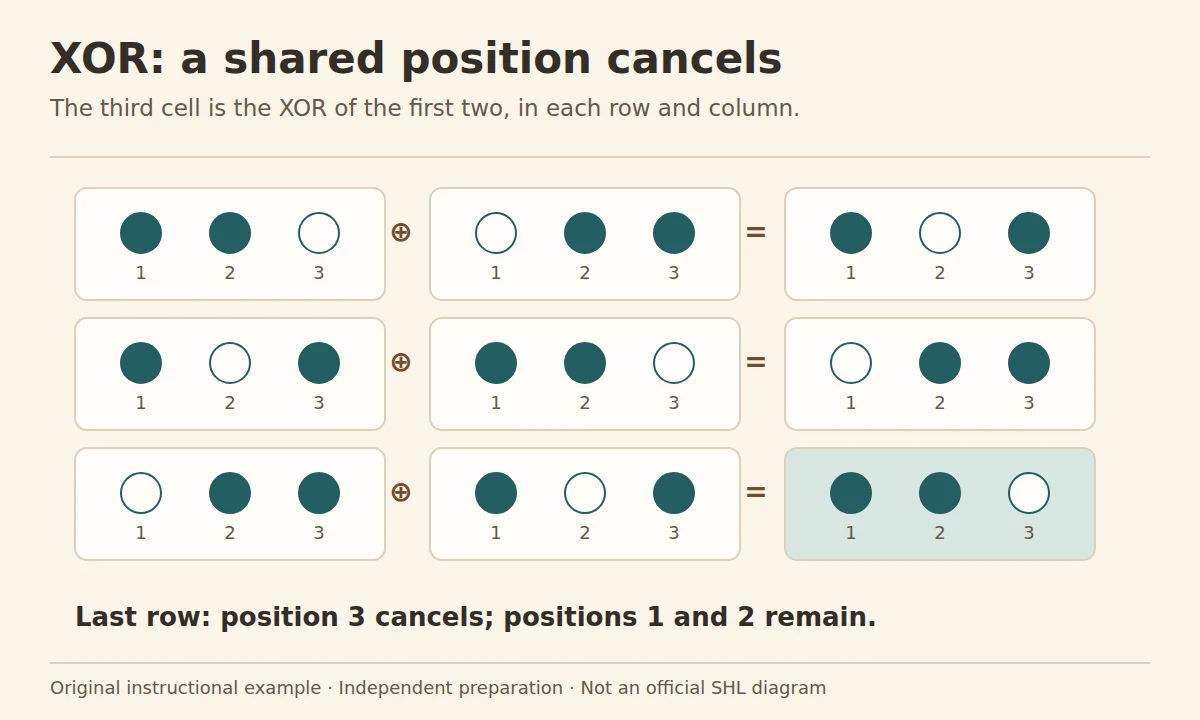
Each cell below lists the filled positions on the same three-position strip. The third cell in each row is the XOR of the first two. Use the two complete rows to test the rule before solving the missing cell.
| First pattern | Second pattern | Result |
|---|---|---|
| Positions 1 and 2 | Positions 2 and 3 | Positions 1 and 3 |
| Positions 1 and 3 | Positions 1 and 2 | Positions 2 and 3 |
| Positions 2 and 3 | Positions 1 and 3 | ? |
In the last row, position 3 appears in both inputs and cancels. Position 2 appears only in the first input; position 1 appears only in the second. The missing cell therefore fills positions 1 and 2. The same relationship also works down each column, providing an additional consistency check.
How to identify an operation in a matrix
- Choose a fully specified row or column.
- List the occupied positions in the first two cells.
- Test OR, AND or XOR against the third cell.
- Check the same relationship on another complete row or column.
- Apply the supported operation to the missing result.
If rows support one relationship but columns do not, check the task structure before assuming both must use identical rules. The evidence, rather than the square layout alone, determines what you can infer.
Avoid forcing every visual feature into a binary model
These examples treat occupancy as binary. If a task distinguishes several colours, layered objects or orientation, you must preserve those distinctions. Converting everything into filled versus empty too early can discard the very feature that carries the rule.
Infer the operation before completing the last row
| Input A | Input B | Observed output |
|---|---|---|
| {1, 4} | {2, 4} | {1, 2} |
| {2, 3} | {1, 3} | {1, 2} |
| {1, 2, 4} | {2, 3, 4} | ? |
Which operation fits, and what is missing?
In each completed row, the shared position disappears and the unshared positions remain. Among OR, AND and XOR, only XOR fits. In the final row, 2 and 4 cancel, leaving {1, 3}. OR would retain all four positions; AND would retain {2, 4}.
Check your understanding: original practice
Work one position at a time and distinguish union, intersection and XOR. The explanations show exactly which positions remain and why.
Looking for a structured course alongside these free questions? View full preparation.
Questions about SHL inductive matrix practice
Does XOR mean overlapping shapes always disappear?
In the binary occupied-cell examples here, yes: shared occupied positions become empty. Do not extend that rule to every visual task unless the given examples support it.
Can I count shapes instead of checking positions?
Counts can suggest a rule but may hide where overlap occurs. Two patterns with the same count can produce different outputs depending on their positions.
How many rows should I check?
Use all available evidence needed to distinguish the rule. A single row may fit more than one operation, especially when the inputs have no overlap.
Sources and scope
The official product information below gives assessment context. These matrices are original teaching examples of set operations, not a claim that every assigned inductive assessment uses XOR.
Where to go next
Return to rule discovery if more than one operation fits. Feature tracking and operator practice introduce different kinds of relationships.
