
ReasoningCampus · SHL Inductive and Spatial Reasoning
SHL visual pattern practice on this page focuses on tracking several features at once. The position cycle and dot-count cycle need not have the same length. Use the feature ledger and visual frames to predict the combined state without restarting every feature too early. ReasoningCampus teaches feature tracking through original examples in its independent SHL preparation.
Independent learning resource · English · Content revised 16 October 2026
View full preparationSHL visual pattern practice: follow one feature at a time
The ReasoningCampus method uses a small feature ledger: position, direction, fill and count. Track one feature across the frames before moving to the next. Nothing is labelled a “decoy” until the evidence supports treating it as constant or irrelevant. A central shape may carry the rule just as easily as a corner marker.
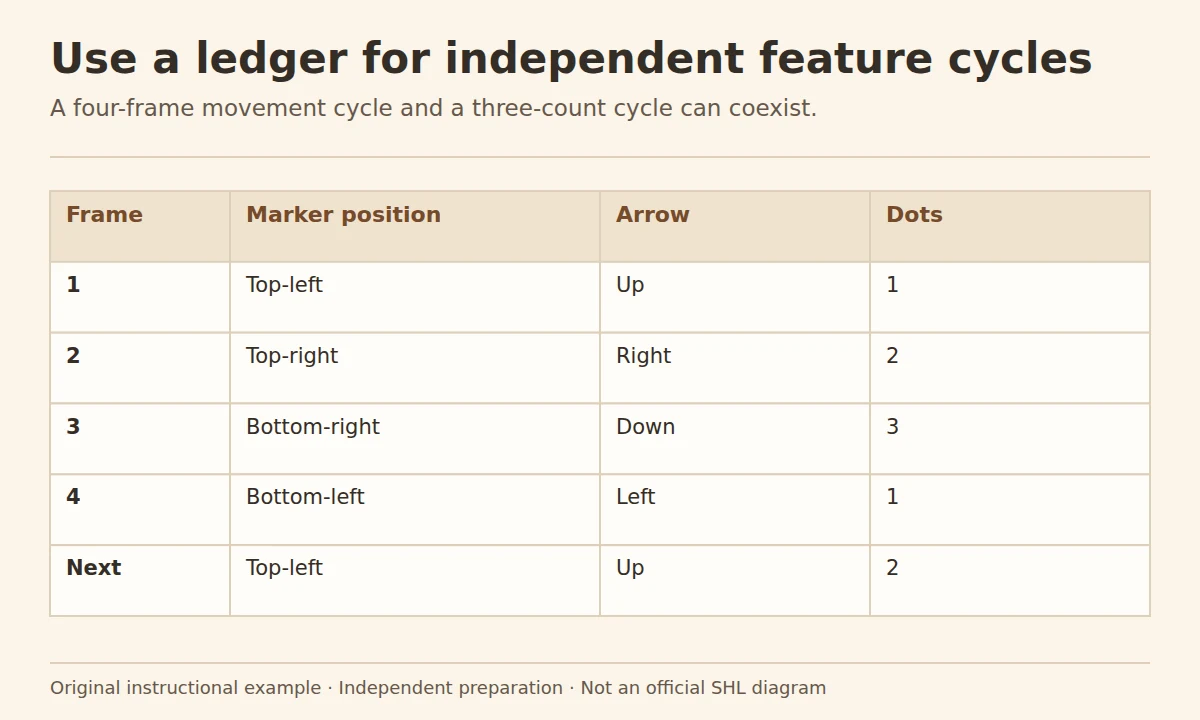
Feature ledger: a worked example
| Frame | Marker position | Arrow direction | Dots |
|---|---|---|---|
| 1 | Top-left | Up | 1 |
| 2 | Top-right | Right | 2 |
| 3 | Bottom-right | Down | 3 |
| 4 | Bottom-left | Left | 1 |
| Next | Top-left | Up | 2 |
The marker cycles clockwise through four corners. The arrow also rotates clockwise by 90 degrees. The dot count cycles through 1, 2, 3. After frame 4, the next frame combines top-left, up and two dots. The dot count does not become zero and does not keep increasing to four; the fourth frame returning to one is consistent with the intended repeating cycle 1, 2, 3.
Notice that the cycles have different lengths: four for position and direction, three for count. Treating the whole picture as a single four-frame cycle would incorrectly return the dots to one.
Separate observation from prediction
In your notes, distinguish “frame 3 has three dots” from “dots increase forever”. The first is an observation; the second is a proposed rule. A later frame can reject the rule without changing the observation. This small distinction prevents you from defending an early guess after the evidence has contradicted it.
Use elimination after the feature analysis
- Reject answers with the wrong marker position.
- Among the survivors, reject the wrong arrow direction.
- Use the count cycle to distinguish any remaining options.
- Check the chosen answer against all three rules.
This does not mean the first feature is always the most important. Choose a feature that separates the available answers efficiently while still checking the complete result.
Practise memory economically
Use short labels such as TL, TR, BR and BL only if you can read them reliably. If paper is permitted, a tiny grid may make the relationships clearer than several sentences. In untimed study, explain the rule fully; in a later practice set, compress only the representation, not the reasoning check. There is no need to force a 40-second limit while the method is still unclear.
Dot count and position: a sequence with two cycle lengths
Compare the feature predictions
The four-step direction cycle gives right; the two-step dot cycle gives two dots. The intended continuation is a right-pointing arrow with two dots. Restarting both features merely because the arrow points up in frame 5 would lose the independent dot cycle.
After solving, close the explanation and predict frame 8. The direction is left and the dot count is two. Use your ledger to check each prediction separately before combining them.
Check your understanding: original practice
Track direction and count separately before combining them. After answering, test your rule against every frame rather than only the final transition.
Looking for a structured course alongside these free questions? View full preparation.
Questions about tracking visual features
Should I ignore the centre of a pattern?
No. Examine whether it changes and whether that change helps explain the sequence. The centre is not automatically a distraction.
Does this train working memory?
The ledger helps you organise the information instead of holding every feature in mind at once. It is a practical reasoning aid; these exercises have not been used to measure a change in working-memory capacity.
What if two features move together?
Check whether they genuinely share a rule across all frames. Tracking them separately first can reveal a later divergence.
Sources and scope
The official sources identify the assessment context. The feature ledger is a practical way to organise these original visual exercises; it has not been presented as a validated working-memory intervention.
Strengthen the feature that caused the mistake
Use rule discovery to test a proposed cycle, matrices for overlap and spatial practice when the difficulty concerns folding rather than sequence movement.
