
ReasoningCampus · SHL Deductive and Verbal Reasoning
SHL deductive ranking separates what can happen from what has to happen. One valid order proves possibility, not necessity. Build the order from the stated constraints and use a counterexample to test claims such as “A must be first”. ReasoningCampus uses this distinction to teach constraint-based reasoning through original SHL preparation exercises.
Independent learning resource · English · Content revised 16 October 2026
View full preparationSHL deductive ranking: test necessity, not just plausibility
At ReasoningCampus, we use a partial order before a complete order. Write the relationships that are certain, identify what is still free and only then test full arrangements. This avoids treating the first valid arrangement you find as the only one.
Worked example: four ranked proposals
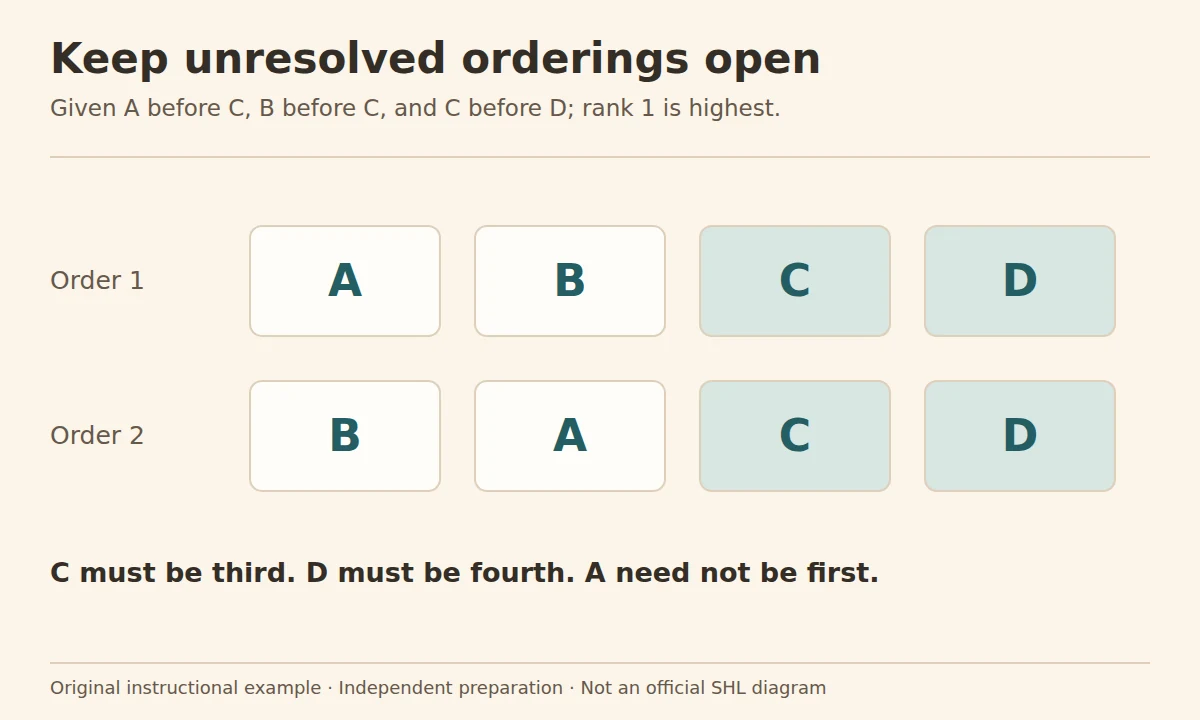
Four proposals A, B, C and D occupy ranks 1–4, with rank 1 highest. A ranks above C. B ranks above C. D ranks below C. What must be true?
A < C < D and B < C < D, where a smaller rank number means a higher position.
Both A and B must precede C, so C cannot be rank 1 or 2. D must follow C, so C cannot be rank 4. C is therefore rank 3 and D rank 4. A and B occupy the first two ranks in either order. The valid orders are A–B–C–D and B–A–C–D. “A is first” is possible, but it is not necessary.
| Claim | Status | Reason |
|---|---|---|
| C is third | Must be true | Two predecessors and one successor |
| A is first | Could be true | One of two valid orders |
| D is second | Cannot be true | D must follow C |
Linear seating: preserve left and right
In a row viewed from the same stated direction, “L is to the left of M” need not mean they are adjacent. If the task says “immediately left”, they form a consecutive block. Circular seating is a different structure: it needs a defined orientation and does not have an ordinary first seat. Do not reuse a linear ranking shortcut without checking the geometry.
A constraint method you can reuse
- Define what position 1 means.
- Translate only the stated relations into short symbols or a diagram.
- Count required predecessors and successors where useful.
- Keep unresolved pairs open.
- Test the wording of the question against all valid possibilities required.
Counting predecessors can be powerful, but count distinct items. If A is before B and B before C, A and B are two predecessors of C; do not count the path A–B–C as an extra third item.
Must be true: use a counterexample to test the answer
To disprove a “must be true” claim, one valid counterexample is enough. To establish a “could be true” claim, one valid example is enough. To establish “cannot be true”, show that the claim conflicts with the constraints. This reduces unnecessary enumeration while keeping the logic explicit.
Add a free item and test the conclusion again
Now change the rules: A and B are still before C, but D can be anywhere. C has two required predecessors, so it cannot be first or second. It can be third in A–B–C–D or fourth in D–A–B–C. The earlier conclusion “C must be third” no longer holds because D is no longer required to follow C.
Keep the distinction explicit: one valid arrangement proves “could”; a single valid counterexample disproves “must”. To prove “must”, reason from the constraints or examine the complete set of valid arrangements.
Check your understanding: original practice
Write the fixed ordering relationships first. Use a valid counterexample to reject any answer that claims more than the rules require.
Looking for a structured course alongside these free questions? View full preparation.
Questions about SHL deductive ranking
Can I solve every arrangement mentally?
No single method suits every problem. Short chains may be manageable mentally; several exclusions or positions may benefit from permitted scratch work.
Does “before” mean immediately before?
Only when the task explicitly says so. Otherwise other items may lie between the two.
What if my first arrangement fits?
It proves that arrangement is possible. It does not prove that every feature of it is necessary.
Sources and scope
The official deductive information gives assessment context. The ranking examples use explicit original constraints, allowing you to check necessary positions against every valid arrangement.
Where to go next
Calendars add fixed slots, arguments add implication chains and mixed G+ practice tests whether you can change method cleanly.
