
ReasoningCampus · SHL Deductive and Verbal Reasoning
SHL verbal practice for non-native speakers should separate language uncertainty from reasoning uncertainty. This lesson concentrates on context, reference words and misleading paraphrases. You do not need to know every possible meaning of a word to identify its role in a particular passage. ReasoningCampus offers independent SHL preparation that explains both the English wording and the reasoning behind each example.
Independent learning resource · English · Content revised 16 October 2026
View full preparationSHL verbal practice for non-native speakers: read for meaning
At ReasoningCampus, we teach a two-pass reading method. On the first pass, identify who, what and when. On the second, underline words that limit the claim: only, unless, before, subsequent, all and some. Translate the relationship into plain language, then return to the exact wording before deciding the answer.
Reference words: small words with a large logical role
| Word or phrase | Plain-language meaning | Check |
|---|---|---|
| Preceding | Coming before | Which event is the reference point? |
| Subsequent | Coming after | Does the text say immediately after? |
| Only if | A necessary condition | Do not reverse the implication |
| At least | A minimum, including the stated value | Do not replace it with exactly |
| No more than | A maximum, including the stated value | Do not read it as strictly less than |
| Inferred | Concluded from evidence | An inference still needs support |
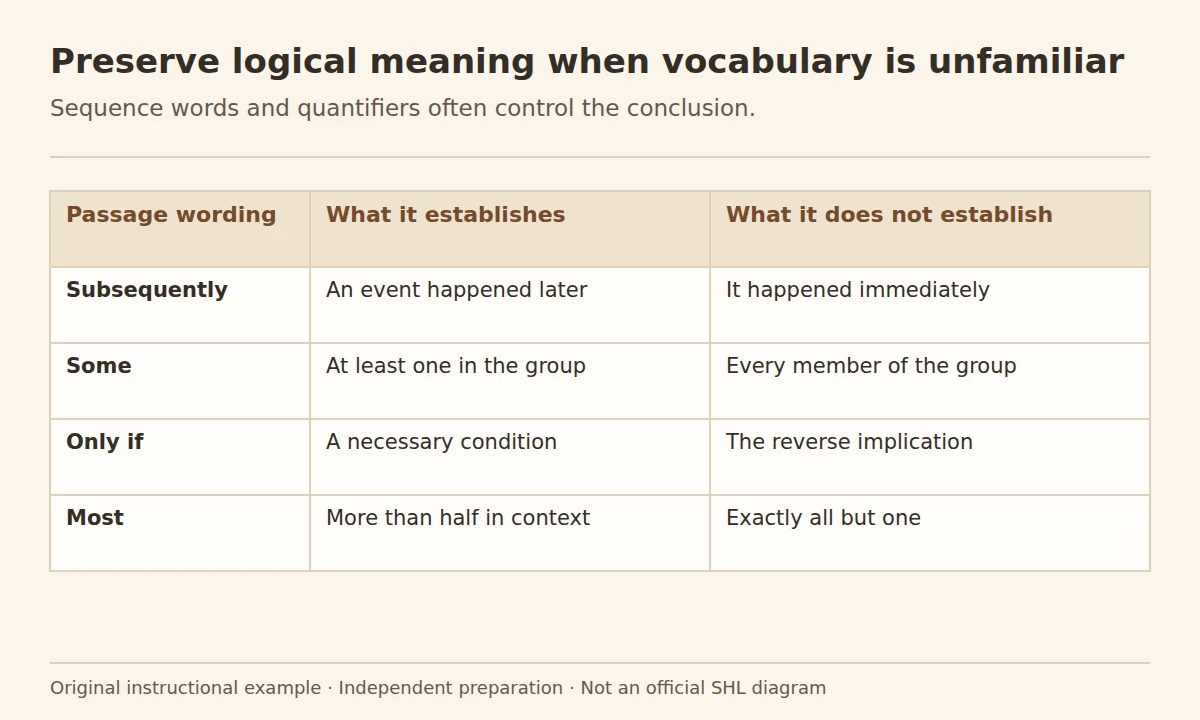
Worked passage: subsequent does not mean immediate
“The review took place after the pilot. A meeting subsequent to the review considered changes to the process.” A statement that the meeting occurred after the review is supported by the ordinary sequence described. A statement that it occurred the very next day is not established. “Subsequent” gives an order, not a date or a one-day interval.
When you rewrite the passage for yourself, preserve the uncertainty: “pilot, then review, then a later meeting”. Do not improve the story by adding a timetable.
Use context when a noun is unfamiliar
Suppose you do not recognise the name of a specialised device: “Every Luma unit requires inspection before dispatch.” You can still reason with “every unit of this type needs inspection before being sent”. If a statement says one such unit was dispatched without inspection, it conflicts with the stated requirement if the passage describes compliance with it. However, a rule alone does not prove that everyone obeyed it. Distinguish a policy from a report of what happened.
Prepare in the actual assessment language
Check the language offered and any arrangements with the organiser. Mandarin and Cantonese are language varieties, while simplified and traditional Chinese refer to writing systems; do not assume a one-to-one match or a specific product option from those labels. This English lesson does not claim to reproduce translated SHL items. If you practise with translations, have the logical equivalence checked rather than trusting a literal word substitution.
Three language traps to isolate from the logic
| Wording in a practice passage | What it establishes | What it does not establish |
|---|---|---|
| The issue was eventually resolved | Resolution happened in the end | That it happened immediately |
| The manager was sympathetic to the concern | The concern received an understanding response | That the requested action was approved |
| Only the revised files were sent | Any file sent was revised | That every revised file was sent |
Original passage: “The supplier acknowledged the delay but did not commit to delivery by Friday.” The statement “The supplier promised delivery by Friday” is false: the passage expressly denies that commitment. Knowing a positive-sounding word such as acknowledged is not enough; the clause after but determines the conclusion.
Check your understanding: original practice
Read each passage for its precise claim and time frame. Then compare your answer with the explanation of the language that settles it.
Looking for a structured course alongside these free questions? View full preparation.
Questions about SHL verbal practice for non-native speakers
Should I translate the whole passage into my first language?
During practice, translation can help understanding, but preserve condition and quantity words carefully. In a live assessment, use only permitted resources and the available time.
Can I ignore a technical word?
Sometimes you can treat it as a label if its detailed meaning is not needed. Do not ignore it when the question depends on that meaning.
Does “required” prove that something happened?
No. A requirement describes what should happen under a rule. Evidence that a particular person or process complied is a separate fact.
Sources and scope
The linked verbal information concerns the named product. The original passages here teach careful reading in English; they do not set an employer’s language requirement or an assessment accommodation policy.
Where to go next
Use the quantifier lesson for logical scope. The interview guide develops your own clear explanations, while the AI prompt guide helps create checkable study variations.
