
ReasoningCampus · SHL Study Skills
The ReasoningCampus SHL preparation method uses four observable steps: recognise the task, represent the information, reason through the answer and review the cause of an error. The worked example shows what those steps change in practice, beyond simply checking an answer letter.
Independent learning resource · English · Content revised 16 October 2026
View full preparationReasoningCampus SHL preparation method: four observable steps
The cycle is recognise → represent → reason → review. Recognise the skill and requested output. Represent the evidence in a useful form. Reason through the calculation or rule. Review the answer and the alternatives, then use new data to check that the learning transfers. Each stage should leave something the candidate can explain.
Four steps with visible teaching evidence
| Stage | What the candidate does | Example |
|---|---|---|
| Recognise | Names the requested result | Percentage increase from the original value |
| Represent | Organises the decisive information | Old = 120, new = 150, change = 30 |
| Reason | Uses an appropriate relationship | 30 ÷ 120 × 100 = 25% |
| Review | Explains alternatives and tries a variation | 20% used the wrong denominator |
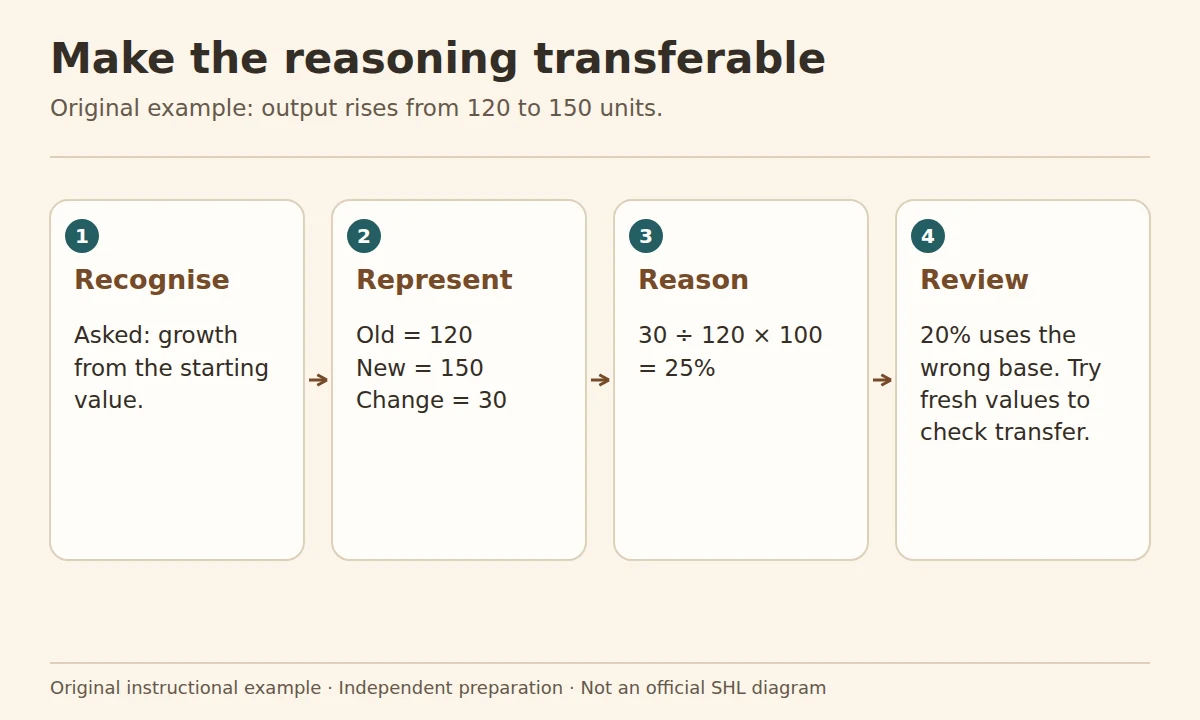
A complete teaching example
A department’s output rises from 120 to 150 units. First recognise that the question asks for growth from the starting value. Represent the data with labels, not just numbers. Calculate the change, 30, and divide by 120 to obtain 25%. Review the tempting 20% option: it divides by 150 and answers how the change compares with the final output.
For transfer, change the values to 200 and 260. The change is 60, and growth is 60 ÷ 200 = 30%. The numbers are different but the denominator decision is the same. That is what a transferable explanation should make possible.
The method changes representation across reasoning types
For inductive reasoning, represent position, orientation and fill separately before combining the rules. For deductive reasoning, write constraints and distinguish necessary from possible conclusions. For verbal reasoning, preserve the population, time and strength of the passage. For workplace reflection, use genuine examples rather than a memorised profile. The shared principle is disciplined evidence use, not one formula for every task.
What this preparation does and does not claim
The worked examples and practice calculations in this resource are original educational material. They are not official SHL items, a calibrated adaptive test or a verified percentile prediction. The paid preparation page describes the offer available to candidates; check its current scope and terms rather than assuming that every topic in a free learning collection is a separate paid course.
How to review your own learning
- Can I explain why the method applies?
- Can I identify the first wrong step in a distractor?
- Can I solve a fresh variation without viewing the answer?
- Can I repeat the method under the relevant practice conditions?
A “yes” on a memorised item is a starting point, not proof of general mastery. Keep an error log and revisit the specific step that remains uncertain.
A transfer check makes the review stage observable
A department has 200 employees. Exactly 120 attended training, and 30 of those attendees are managers. Two questions use the same data but require different denominators.
| Question | Calculation | Answer |
|---|---|---|
| What proportion of all employees attended? | 120 ÷ 200 × 100 | 60% |
| What proportion of attendees are managers? | 30 ÷ 120 × 100 | 25% |
Recognise: each question asks for a part of a specified group. Represent: label that group before choosing the denominator. Reason: divide the requested part by that group. Review: explain why 30 ÷ 200 = 15% answers a different question: the proportion of all employees who are both managers and attendees.
Cover the table and explain which denominator each question needs. Then change the numbers and try again. You are checking whether you can choose the method yourself, rather than remember the previous answer.
Questions about ReasoningCampus SHL preparation method
Is ReasoningCampus affiliated with SHL?
This resource presents ReasoningCampus as an independent preparation provider. It does not claim endorsement, partnership or access to confidential assessment material.
Does the method copy the official adaptive algorithm?
No such claim is made. The exercises demonstrate learning methods and transparent practice calculations.
Where can I see the preparation offer?
Use the “View full preparation” link. Check the current page for the actual scope and terms of the offer.
Sources and scope
The official assessment resources provide context for the skills being practised. The recognise–represent–reason–review cycle and transfer examples are the ReasoningCampus teaching method illustrated in this lesson.
Where to go next
Use the buying checklist to evaluate explanations and the study plan to organise them. Distractor analysis makes the review stage more precise.
