
ReasoningCampus · SHL Numerical Reasoning
SHL numerical formulas are useful when you know which relationship the question needs. This reference works through percentages, weighted averages, rates and conversions, with particular attention to the denominator and units. Use the examples to understand the choice of formula rather than memorising symbols alone. ReasoningCampus teaches this choice of relationship before calculation in its independent SHL preparation.
Independent learning resource · English · Content revised 16 October 2026
View full preparationSHL numerical formulas: choose the relationship first
In this ReasoningCampus lesson, we use name the quantity → choose the base → calculate → check the unit. Before substituting values, say what the answer should mean. “Profit as a share of revenue” and “profit as a share of cost” sound similar but lead to different calculations. That distinction is part of the method, not an optional final check.
A formula sheet with the meaning attached
| Quantity | Formula | Check |
|---|---|---|
| Percentage change | (new − old) ÷ old × 100 | Use the starting value as the base |
| Original value after an increase | final ÷ (1 + rate) | Write 20% as 0.20 |
| Original value after a reduction | final ÷ (1 − rate) | A 20% reduction leaves 0.80 of the original; the rate must be below 1 |
| Compound growth | initial × (1 + rate)periods | Use the same growth rate for each equal-length period |
| Weighted average | sum of (value × weight) ÷ sum of weights | Use quantities or group sizes as the weights, as specified |
| A share in the ratio a:b | total × a ÷ (a + b) | The two shares must add back to the total |
| Rate per unit of time | quantity ÷ time | Keep time units consistent; distinguish hours from staff-hours |
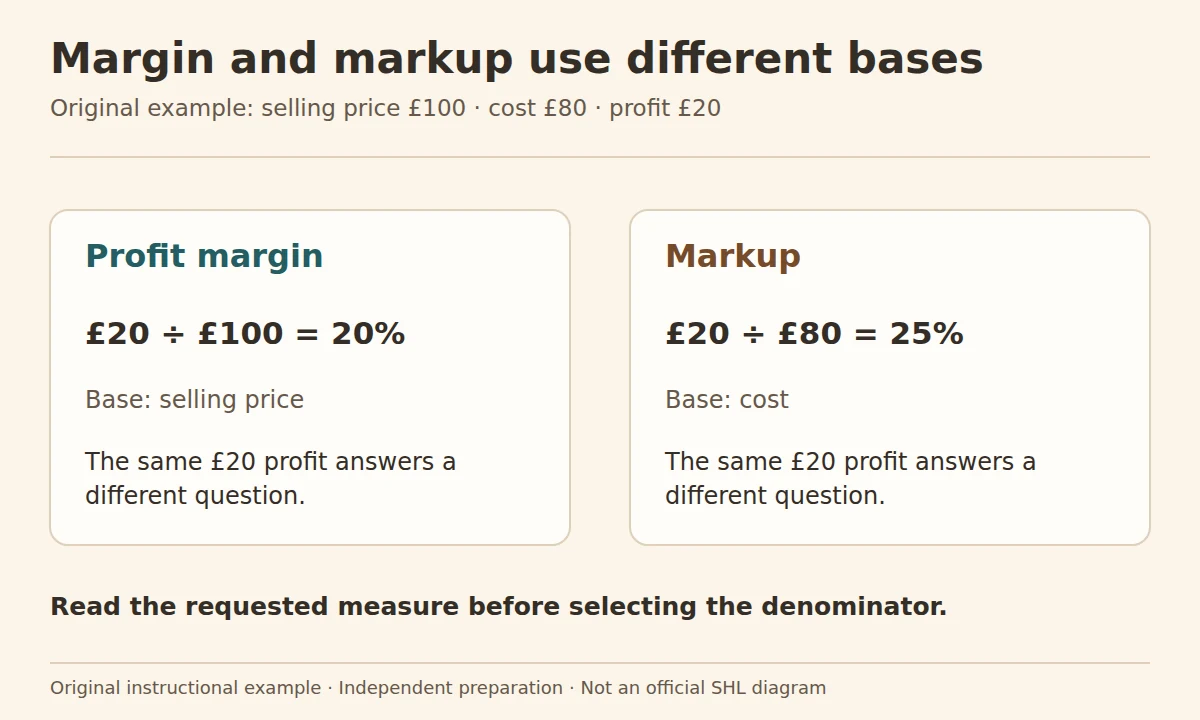
| Profit margin | (revenue − cost) ÷ revenue × 100 | Revenue is the denominator |
| Markup | (price − cost) ÷ cost × 100 | Cost is the denominator |
| Market share | part ÷ relevant total × 100 | Part and total need the same market definition |
| Currency conversion | amount × quoted target-units-per-source-unit | Read the direction of the rate |
Worked example: margin is not markup
A product costs £80 and sells for £100. Profit is £20. Margin is £20 ÷ £100 = 20%, because it asks how much of the selling price is profit. Markup is £20 ÷ £80 = 25%, because it asks how much was added relative to cost. If the question says “margin”, 25% is a plausible wrong answer with a recognisable cause.
To reverse the calculation, a 20% margin on revenue of £100 leaves £80 of cost. A 20% markup on £80 produces £96, not £100. Testing the answer backwards is a useful check.
Compound growth and currency direction: a worked example
If 1 euro equals 1.10 dollars, €200 converts to $220 by multiplication. Converting $220 back to euros requires division by 1.10. Writing the units beside the rate makes the direction visible. A value of 100 growing by 10% in each of two periods becomes 100 × 1.10 × 1.10 = 121. It does not become 120, because the second increase applies to 110.
If a task includes fees, inflation or another conversion, apply only the adjustments it actually requests and defines. Do not add financial assumptions from outside the question.
Read a dual-axis chart before calculating
A chart can put revenue on one axis and a percentage on another. Identify which series belongs to which axis, read its units and locate the correct period. The height of two plotted points does not make their numerical values directly comparable when the scales differ. Translate each required value into a labelled number before using a formula.
Weighted average: checks for ratios and unequal groups
If two teams share 90 tasks in the ratio 2:3, there are five equal parts. Each part is 90 ÷ 5 = 18 tasks, so the allocations are 36 and 54. Check that 36 + 54 = 90 and that 36:54 simplifies to 2:3.
For a weighted average, keep the amounts attached to their weights. Selling two units at £30 and eight at £10 gives revenue of £140 across ten units, so the average selling price is £14. Averaging £30 and £10 directly gives £20 and incorrectly treats the two sales volumes as equal.
Choose the denominator: part, change or original value
| Question asks for | Representation | Example |
|---|---|---|
| A part of a total | Total × proportion | 30% of 240 = 72 |
| The original before a reduction | Final ÷ remaining proportion | 192 after a 20% reduction → 192 ÷ 0.80 = 240 |
| The increase relative to the start | Change ÷ starting value | 240 to 300 → 60 ÷ 240 = 25% |
Underline what is given and circle what is missing. Then choose the relationship. The words “percentage question” are too broad to select a formula: forward percentage, reverse percentage and percentage change ask for different unknowns.
Check your understanding: original practice
Choose the relationship before substituting numbers. Write the denominator and unit beside your calculation, then use the explanation to check both.
Looking for a structured course alongside these free questions? View full preparation.
Questions about SHL numerical formulas
Do I need to memorise every formula?
Start by understanding the relationships you repeatedly use. Knowing why the denominator is revenue or cost is more reliable than recalling an unlabelled expression.
Can I round early?
Use the requested precision and keep enough intermediate precision to distinguish the options. Rounding early can change a close comparison.
What if the starting value is zero?
The usual percentage-change formula divides by the starting value, so it is undefined when that value is zero. Do not report an ordinary percentage increase using that formula.
Sources and scope
The numerical factsheet identifies the type of numerical ability being discussed. The formulas and worked examples are standard mathematical relationships applied in original ReasoningCampus teaching tasks.
Where to go next
Apply the formulas to multi-step tables and chart entry. Use distractor analysis when a familiar formula still produces a tempting wrong answer.
