
ReasoningCampus · SHL Study Skills
SHL last-minute preparation is a triage exercise, not an attempt to learn the whole library overnight. Choose one recurring error to repair, review familiar methods and confirm the practical details of your session. The aim is a clear next step rather than more unreviewed questions. ReasoningCampus uses this final-day plan to keep independent SHL preparation focused on familiar methods and manageable practice.
Independent learning resource · English · Content revised 16 October 2026
View full preparationSHL last-minute preparation: reduce the scope
The ReasoningCampus final-day approach is confirm, refresh, rehearse, stop. Confirm the session rules, refresh a few methods you have already learned, rehearse the permitted setup and leave time to arrive ready. A warm-up is optional familiarisation; it is not a scientifically guaranteed boost or a miniature official assessment.
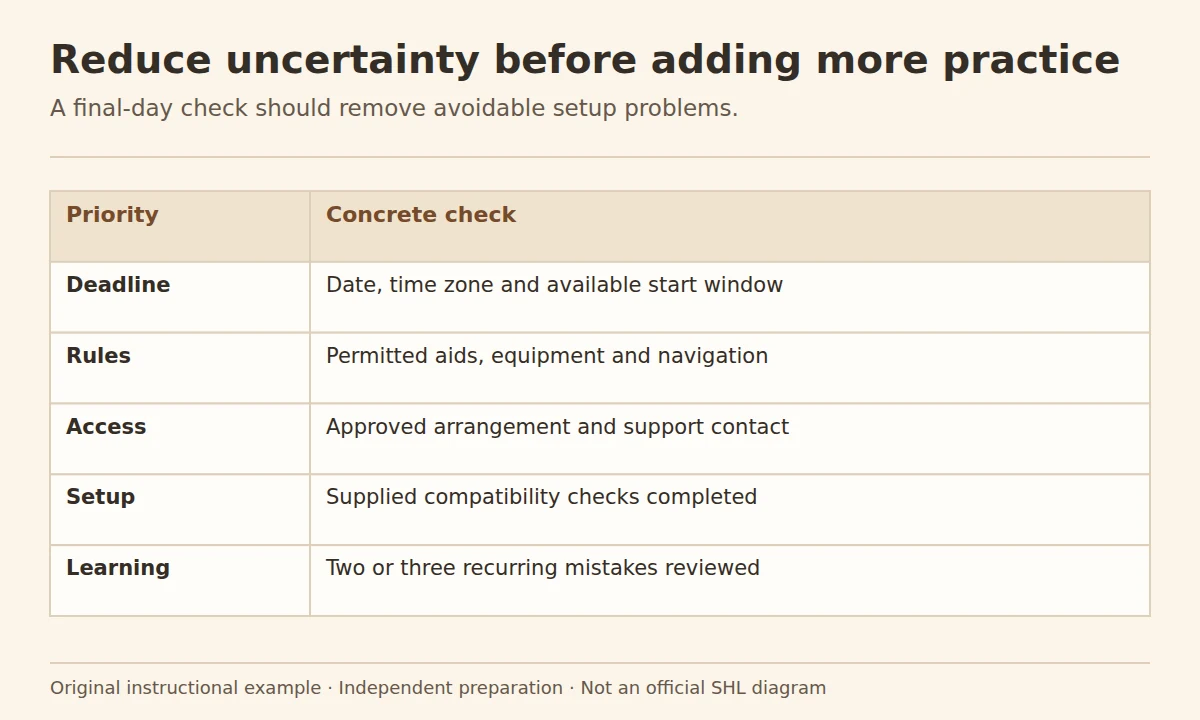
Your final-day plan: confirm the session rules
| Priority | Practical action |
|---|---|
| Deadline | Confirm the date, time zone and available start window |
| Rules | Check equipment, permitted aids and navigation instructions |
| Access | Confirm any agreed arrangement and support contact |
| Learning | Review two or three recurring mistakes |
| Setup | Complete the supplied compatibility checks before the session |
If the deadline or access arrangement is unclear, resolving that question is more urgent than squeezing in another timed set. If you discover a technical issue, contact the relevant support route early.
An optional 15-minute warm-up
- Spend a few minutes reading your own error notes.
- Solve one familiar type of calculation with fresh values.
- Try one logical or visual rule question relevant to your invitation.
- Explain the method aloud or in a short note.
- Stop the warm-up and follow the assessment starting instructions.
Use this as an adjustable routine, not a mandatory stopwatch prescription. Skip an exercise if it distracts you or does not match the assessment. The aim is to recall a method, not to prove your readiness through a last-minute score.
A small worked refresh
A value rises from 80 to 100. The increase is 20, and the base is the starting value, 80. Percentage growth is 20 ÷ 80 × 100 = 25%. A 20% answer divides by 100 and uses the wrong base. Now try 150 rising to 180: the increase is 30, so 30 ÷ 150 × 100 = 20%. The answer changes, but the method stays the same.
What to leave out of the final session
Do not experiment with an unfamiliar browser configuration, memorise a supposed employer personality profile or rely on a newly discovered “hidden scoring trick”. For a timed test, review the actual navigation instructions before deciding whether skipping or returning to questions is possible. For an interview, refresh a small number of truthful examples rather than scripting a whole performance word for word.
One final study block: stop adding new topics
| Order | Action | Stopping point |
|---|---|---|
| 1 | Review the invitation and unresolved practical questions | You know the start route and support contact |
| 2 | Repair one repeated mistake using a familiar explanation | You can explain the decisive step |
| 3 | Try a small fresh variation | You can apply the method without the old answer |
| 4 | Write a short reminder and close the study session | No growing list of new topics |
For example, when a reverse-percentage error keeps returning, work one complete example and one new variation. Do not immediately add unfamiliar cube nets merely because they appear elsewhere in the library. The invitation defines relevance; your practice record defines priority.
Questions about SHL last-minute preparation
Should I take a full mock immediately before the real test?
Only if it fits your situation and does not leave you rushed. This guide favours a small review and a ready setup; it does not prescribe a final mock for everyone.
What if I have only an hour?
Prioritise the invitation, access requirements and a brief review of your most common error. Do not attempt to cover every reasoning topic in one hour.
Is the warm-up a score predictor?
No. A few familiar exercises can help you recall a method, but they do not predict an official score or selection outcome.
Sources and scope
- SHL Candidate Support: Time Needed versus Time Limit
- SHL Candidate Support: device compatibility and system requirements
Use the official candidate guidance for the rules of your assigned session. The final-day sequence is a practical study plan, not an SHL requirement or a measured promise of improved results.
Where to go next
Return to the full study sequence when more time is available. For the final checks, keep scratch-paper layout and access instructions close at hand.
