

SHL Test Practice Free: 28 Best Questions & Answers (2026)
SHL test practice free should help you learn how to solve the questions — not just tell you which option is correct. Here you can work through 28 questions that get harder step by step: 7 numerical, 7 verbal, 7 inductive and 7 deductive. Every question comes with a clear worked solution, the formula or rule you need, and an explanation of why the other choices can look tempting.
Start with the easier questions and move upward in difficulty. This page works as a free SHL practice test in two ways: Practice Mode gives immediate teaching feedback, while Test Mode lets you complete the questions before seeing the solutions. The SHL practice questions are grouped into numerical, verbal, inductive and deductive reasoning so you can identify exactly where you need more work.
Use Practice Mode to study the worked explanation after each answer. Use Test Mode to attempt the set before reviewing your result. Compare these independent exercises with the official SHL familiarisation resources linked later in the guide to check the format you will encounter.
Free SHL Practice Test: Choose Practice Mode or Test Mode
Choose the way you want to practise. In Practice Mode, you see feedback and the full explanation after each answer. In Test Mode, the answers stay hidden until you finish, so you can focus on timing and accuracy first.
Learn question by question, or switch to Test Mode and check everything at the end.
Practice Mode: choose an answer to see immediate feedback and open the full teaching solution.
Your Test Mode Report
SHL Test Practice Free: What Candidates Should Know About SHL Tests in 2026
SHL tests are employment assessments used during recruitment to measure job-relevant abilities, behaviours and other characteristics. The exact assessment depends on the employer and the role, so the name shown in your invitation should always determine what you practise.
For cognitive-ability preparation, the most common reasoning areas candidates encounter include numerical, verbal, inductive and deductive reasoning. SHL also offers broader assessment families such as personality, motivation and situational-judgment tools, which are different from right-or-wrong cognitive reasoning tests.
| Assessment area | What it tests | What to practise here |
|---|---|---|
| Numerical Reasoning | Interpreting numerical information, tables, charts, percentages, ratios and business data. | 7 questions with charts, formulas, thresholds and multi-step calculations. |
| Verbal Reasoning | Reading accurately, locating evidence, controlling inference and distinguishing supported from unsupported claims. | 7 passage-based questions with detailed evidence analysis. |
| Inductive Reasoning | Inferring rules from visual information, sequences, matrices, movement, fill, rotation and dependencies. | 7 visual questions using original ReasoningCampus figures. |
| Deductive Reasoning | Applying explicit rules, constraints, ordering and logical consequences without adding assumptions. | 7 rule-based questions from foundation to multi-condition logic. |
| Verify Interactive G+ | A general cognitive ability assessment that includes Numerical, Deductive and Inductive Reasoning. | Use the numerical, inductive and deductive sections together as mixed preparation. |
Which SHL Assessment Are You Taking?
Use the exact assessment name in your invitation. Then jump directly to the most relevant free practice on this page.
SHL Tests Free: Official Practice Resources and How to Use Them
If you are searching for SHL tests free or a free SHL practice test, start by checking the official SHL candidate resources and then use additional practice to build depth. SHL currently provides a selection of free practice tests, but it states that practice is not available for every assessment or language and that not every practice test produces a report. SHL describes the main purpose of these practice tests as helping candidates become comfortable with how the assessments work.
SHL also provides short example questions. For those examples, candidates are told immediately whether their answer is right or wrong and are given the correct answer with a short explanation. By contrast, SHL says the answers to its full-length timed practice tests are not made available, although many provide a feedback report with the percentage answered correctly.
This ReasoningCampus page goes a step further: you get extra original questions, full worked solutions and clear explanations of the mistakes that commonly lead to a wrong answer. The goal is to help you improve from one question to the next, not simply complete a sample test once.
SHL Test Practice Free – Numerical Reasoning: 7 Questions from Easy to Very Hard
Start with straightforward calculations, then move into charts, percentages, commissions and multi-step business data. The aim is to help you recognise the calculation before you reach for the calculator.
Numerical Practice 1: Missing Quarter from an Annual Total
| Q1 | Q2 | Q3 | Q4 | Annual total |
|---|---|---|---|---|
| £540,000 | £610,000 | ? | £720,000 | £2,460,000 |
Rule: The annual total is exact.
Question: What were Q3 sales?
View answer & full teaching solution
Correct answer: C — £590,000
This is a missing-component problem. The total is fixed, so the unknown quarter is whatever remains after the known quarters are removed from the annual total.
Missing value = Total − Σ(known values)Work it out step by step
- Add the known quarters: £540,000 + £610,000 + £720,000 = £1,870,000.
- Subtract the known total from the annual total: £2,460,000 − £1,870,000 = £590,000.
- Check: £540,000 + £610,000 + £590,000 + £720,000 = £2,460,000, so the result reconciles exactly.
Why this is the right answer
The computed missing amount is £590,000 and it restores the stated annual total with no rounding or hidden adjustment.
Why the other answers are wrong
- £560,000, £580,000 and £600,000 all produce an annual total that does not reconcile.
- £610,000 is tempting because it repeats Q2, but no repetition rule is given; the annual-total constraint controls the answer.
Numerical Practice 2: Bar Chart Commission and Total Earnings
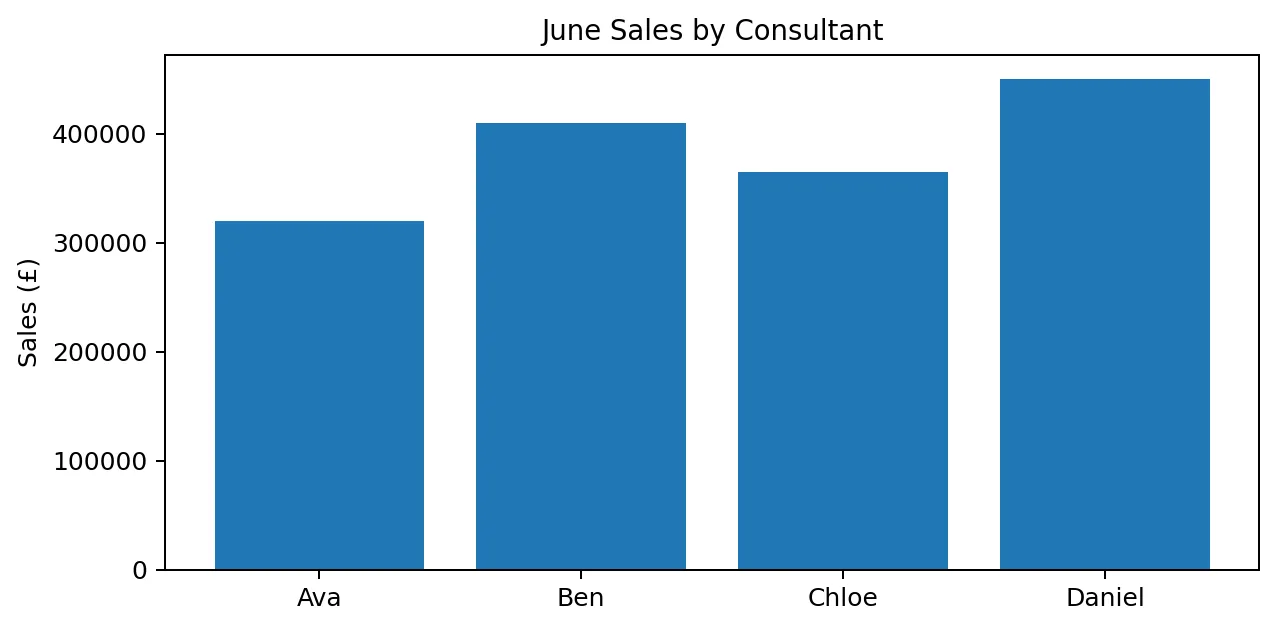
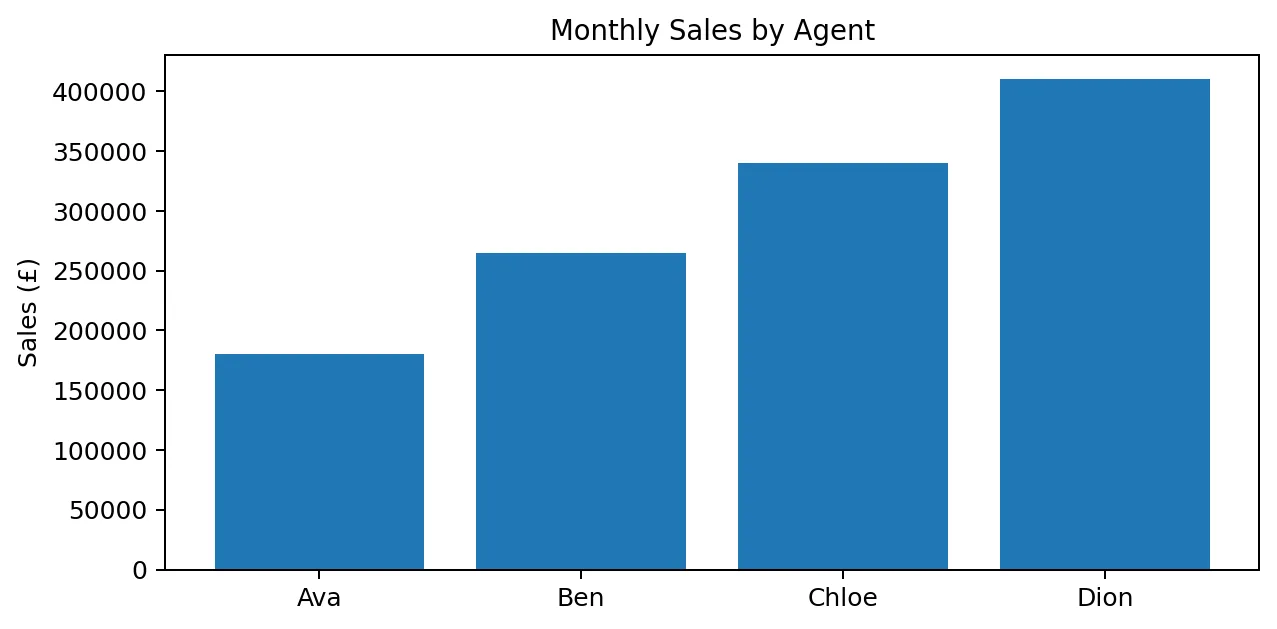
Rules / Notes: Base salary = £2,400 per month. Commission = 2.8% of sales.
Question: What were Chloe’s total earnings for June?
Machine-readable chart value: Chloe’s June sales = £365,000.
View answer & full teaching solution
Correct answer: C — £12,620
The chart gives the sales base; the question then requires two stages: calculate commission from sales, and add the fixed base salary.
Total earnings = Base salary + (Sales × Commission rate)Work it out step by step
- Convert 2.8% to decimal form: 2.8% = 0.028.
- Commission = £365,000 × 0.028 = £10,220.
- Total earnings = base salary + commission = £2,400 + £10,220 = £12,620.
Why this is the right answer
£12,620 includes both components of pay. Stopping at £10,220 would calculate commission only, not total earnings.
Why the other answers are wrong
- Option A (£10,220) is the commission but omits the base salary.
- Other options reflect arithmetic or base-salary errors rather than the stated pay plan.
Numerical Practice 3: Percentage Share of Total Compensation
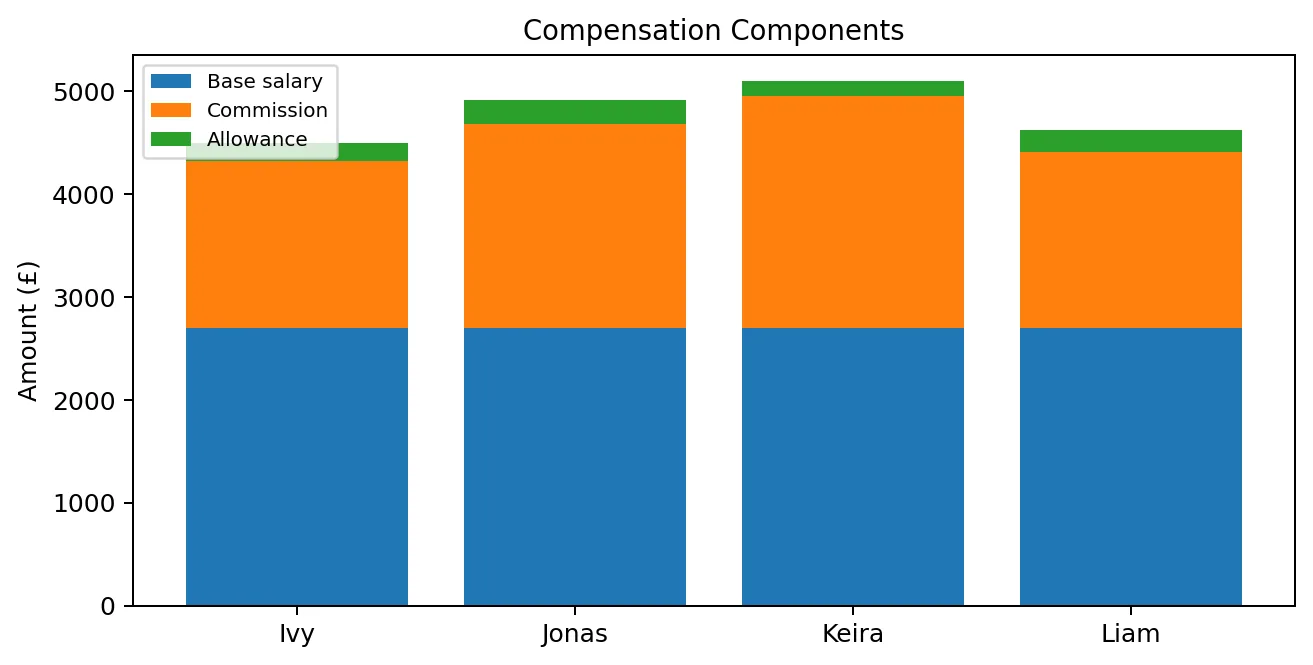
Question: What percentage of Keira’s total compensation came from commission?
Chart values used: base salary £2,700; commission £2,250; allowance £150.
View answer & full teaching solution
Correct answer: B — 44.1%
This is a part-to-whole percentage problem. Commission is the part; total compensation is the whole.
Percentage share = (Part ÷ Whole) × 100Work it out step by step
- Build the denominator first: £2,700 + £2,250 + £150 = £5,100.
- Divide the commission by the total: £2,250 ÷ £5,100 = 0.441176…
- Convert to a percentage: 0.441176… × 100 = 44.1176…%, which rounds to 44.1%.
Why this is the right answer
The correct denominator is all compensation components combined. Using salary alone, or salary plus commission only, changes the meaning of the percentage.
Why the other answers are wrong
- 49.1% and 47.1% are plausible-looking but come from an incorrect denominator or rounding path.
- 39.1% understates the commission share; 45.5% does not follow from the stated components.
Numerical Practice 4: Largest Percentage Increase on a Line Chart
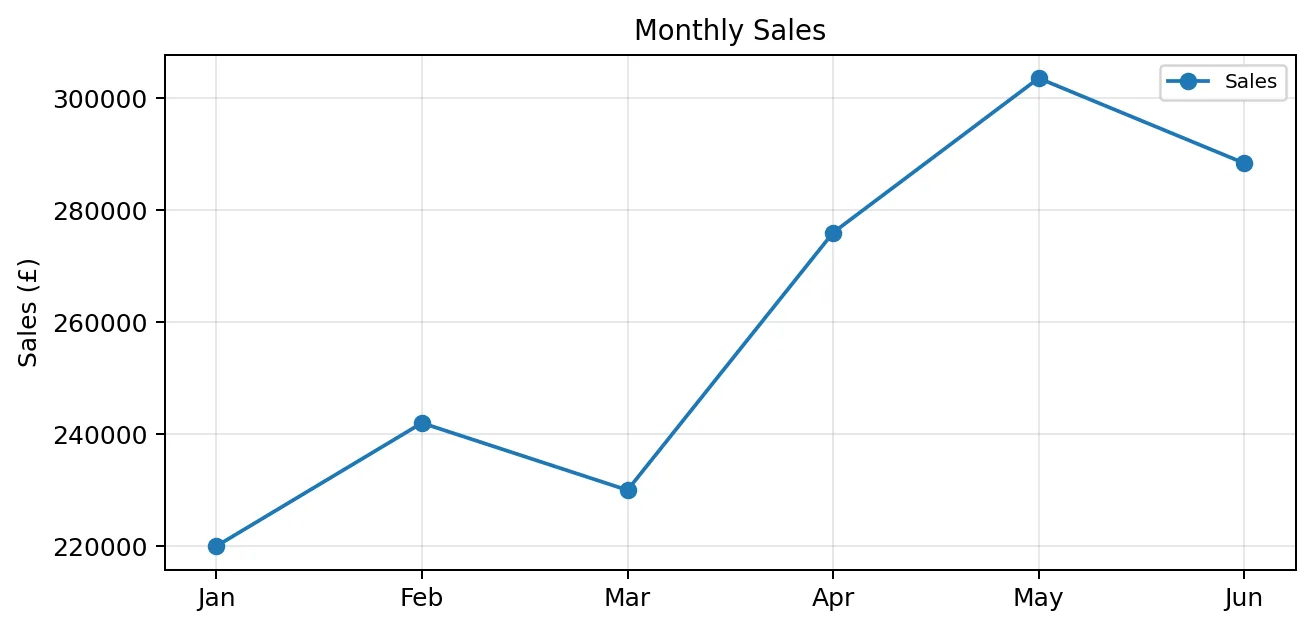
Question: Between which two consecutive months was the percentage increase in sales the largest?
| Month | Sales |
|---|---|
| Jan | £220,000 |
| Feb | £242,000 |
| Mar | £230,000 |
| Apr | £276,000 |
| May | £303,600 |
| Jun | £288,420 |
View answer & full teaching solution
Correct answer: C — Mar to Apr
The question asks for proportional growth, not the largest cash increase. Every interval must therefore be divided by its own starting month.
% change = (New − Old) ÷ Old × 100Work it out step by step
- Jan→Feb: (£242,000−£220,000) ÷ £220,000 = 10.0%.
- Feb→Mar: (£230,000−£242,000) ÷ £242,000 ≈ −5.0%.
- Mar→Apr: (£276,000−£230,000) ÷ £230,000 = 20.0%.
- Apr→May: (£303,600−£276,000) ÷ £276,000 = 10.0%.
- May→Jun: (£288,420−£303,600) ÷ £303,600 = −5.0%.
- The largest positive percentage change is 20.0%, from March to April.
Why this is the right answer
March to April has the greatest relative increase after each change is normalized by the earlier month.
Why the other answers are wrong
- Comparing only absolute £ changes is unsafe because each interval starts from a different base.
- Negative changes are not “smaller positive increases”; they are decreases.
Numerical Practice 5: Reverse a Percentage from a Pie Chart
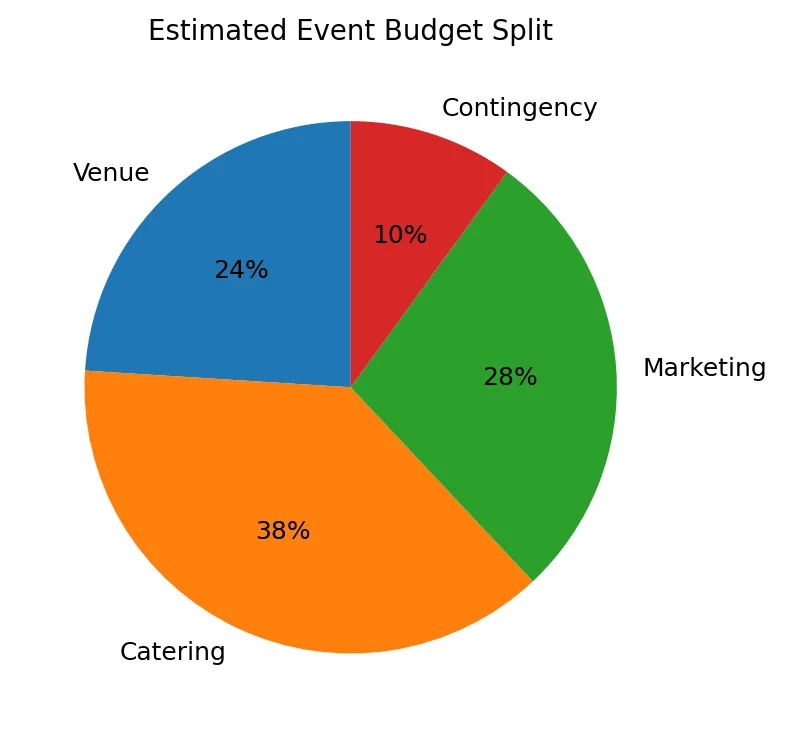
Question: If the Venue slice equals £4,800, what is the total event budget?
| Budget category | Share |
|---|---|
| Venue | 24% |
| Catering | 38% |
| Marketing | 28% |
| Contingency | 10% |
View answer & full teaching solution
Correct answer: A — £20,000
This is a reverse-percentage problem. You know the value of one slice and the proportion that slice represents; the unknown is the whole.
Whole = Part ÷ ProportionWork it out step by step
- Venue = 24% of the total.
- Write the relationship: 0.24 × Total = £4,800.
- Divide both sides by 0.24: Total = £4,800 ÷ 0.24 = £20,000.
- Check: 24% of £20,000 = £4,800.
Why this is the right answer
£20,000 is the only total that makes the 24% venue slice equal exactly £4,800.
Why the other answers are wrong
- Multiplying £4,800 by 24% would calculate 24% of the slice, not reconstruct the whole.
- Using 24 instead of 0.24 creates a scale error by a factor of 100.
Numerical Practice 6: Progressive Commission Bands
Commission plan: 2% on the first £200,000; 4% on the next £100,000; 6% on any sales above £300,000.
Question: What commission does Chloe earn?
Chart value: Chloe’s sales = £340,000.
View answer & full teaching solution
Correct answer: B — £10,400
Progressive bands must be treated separately. The highest rate does not apply retrospectively to all sales; it applies only to the amount inside that band.
Total = Σ(Band amount × Band rate)Work it out step by step
- First £200,000 at 2% = £4,000.
- Next £100,000 (from £200,000 to £300,000) at 4% = £4,000.
- Amount above £300,000 = £340,000 − £300,000 = £40,000.
- Top-band commission = £40,000 × 6% = £2,400.
- Total commission = £4,000 + £4,000 + £2,400 = £10,400.
Why this is the right answer
The band-by-band total is £10,400. Applying 6% to all £340,000 would violate the progressive structure.
Why the other answers are wrong
- A common trap is to multiply the entire sales figure by the top marginal rate.
- Another trap is to forget that the first two bands are fully used before the final £40,000 enters the 6% band.
Numerical Practice 7: Returns, Commission, Threshold Bonus and Base Salary
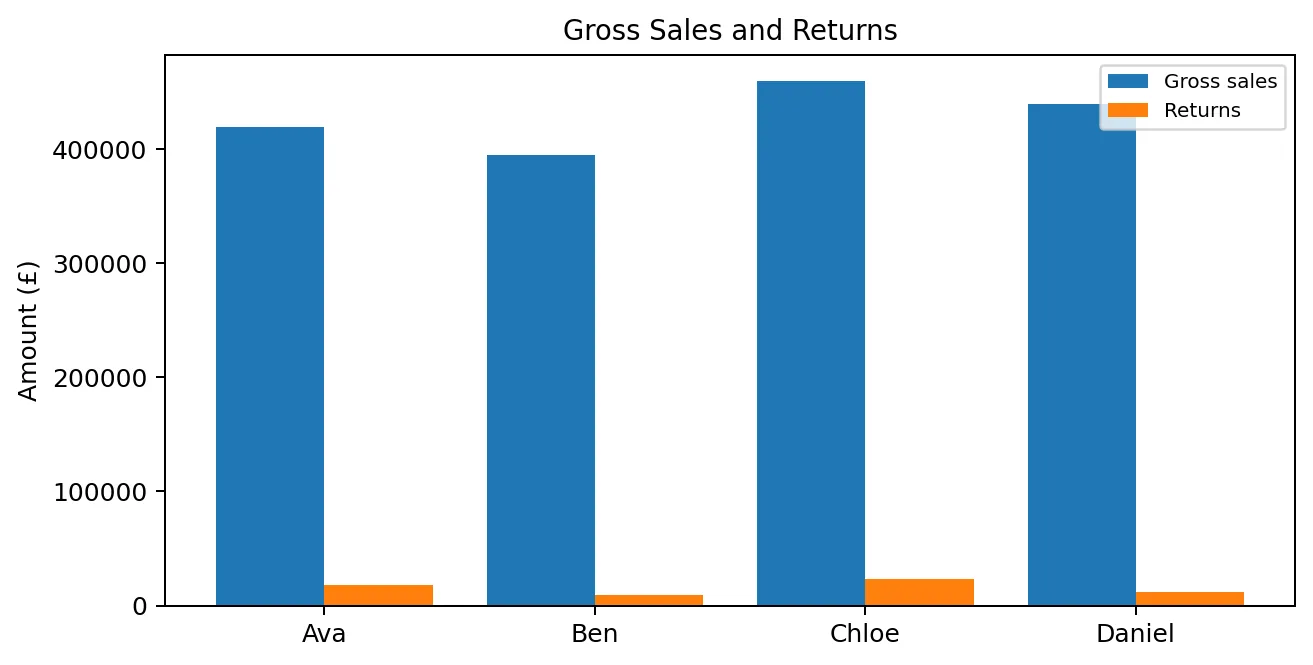
Rules / Notes: Base salary £2,400; commission 2.7% of net sales; bonus £700 if net sales exceed £430,000.
Question: What are Chloe’s total earnings?
Chart values: gross sales £460,000; returns £23,000.
View answer & full teaching solution
Correct answer: B — £14,899
The difficulty is procedural: every adjustment has a specific place in the calculation. Commission is based on net sales, the bonus depends on the net-sales threshold, and base salary is added at the end.
Net = Gross − Returns; Earnings = Base + (Net × rate) + qualifying bonusWork it out step by step
- Net sales = gross sales − returns = £460,000 − £23,000 = £437,000.
- Commission = £437,000 × 0.027 = £11,799.
- Threshold test: £437,000 > £430,000, so the £700 bonus applies.
- Total earnings = £2,400 + £11,799 + £700 = £14,899.
- Sanity check: the answer must be greater than commission alone and must include exactly one base salary and one qualifying bonus.
Why this is the right answer
£14,899 follows the stated order of operations and uses net rather than gross sales as the commission base.
Why the other answers are wrong
- Calculating commission on £460,000 overstates earnings because returns must be removed first.
- Omitting the bonus ignores the threshold; adding the bonus before testing net sales risks using the wrong base.
- A very large answer usually signals that a percentage has been treated as a whole number or a fixed component has been duplicated.
SHL Test Practice Free – Verbal Reasoning: 7 Questions with Deep Explanations
These questions train the skill that matters most in verbal reasoning: staying close to the evidence. You will practise finding details, choosing the best summary, making safe inferences and avoiding answers that sound plausible but go beyond the passage.
Verbal Practice 1: Find the Explicitly Missing Detail
Passage: In a review of hospital procurement, the audit team noted that emergency purchasing rose sharply during the winter surge period. Three categories accounted for most of the increase: temporary nursing support, oxygen equipment, and outsourced transport for discharged patients. The review also found that two of the region’s five hospitals had documented stock-monitoring failures in the month before the surge, although only one of those hospitals later exceeded its emergency purchasing threshold. A separate annex recorded that a central framework agreement for transport services had been available since July, but one hospital continued to rely on a local supplier because its contracting records had not been updated after an organisational merger.
Question: Which category was NOT identified as one of the three main drivers of increased emergency purchasing?
View answer & full teaching solution
Correct answer: D — Pharmaceutical research services
This is an explicit-information task. The safest technique is to map the passage’s list before evaluating the options.
Work it out step by step
- Extract the named drivers: temporary nursing support; oxygen equipment; outsourced transport for discharged patients.
- Compare each option against that list.
- Options A, B and C correspond to items explicitly named in the passage.
- Pharmaceutical research services never appears, so D is the required “NOT identified” answer.
Why this is the right answer
D is absent from the passage’s three-item list; the other three choices are present explicitly.
Why the other answers are wrong
- The main trap is familiarity: all four options sound plausible in a hospital procurement context.
- Do not replace textual evidence with real-world plausibility.
Verbal Practice 2: Identify the Passage’s Central Pivot
Passage: Several municipalities experimented with hybrid service centres in which routine requests remained fully digital while more complex cases were handled through booked in-person appointments. The initial assumption was that this model would simply reduce queues. In practice, the more interesting result was that front-line staff began to separate requests that needed judgment from requests that mainly needed routing. Once that distinction became explicit, training improved, referral errors dropped, and citizens with genuinely complex cases reached the right specialist faster. The model did not eliminate pressure on staff, nor did it solve every access problem, but it made the service more deliberate in the way it triaged complexity.
Question: Which option is the best summary of the passage?
View answer & full teaching solution
Correct answer: B
A strong summary captures the passage’s movement, not merely the opening premise. Here, the text begins with queue reduction but pivots to the deeper effect: clearer triage of complexity.
Work it out step by step
- Identify the opening expectation: reduce queues.
- Locate the contrast marker: “In practice, the more interesting result…”
- Track the mechanism: staff distinguish judgment-heavy cases from routing-heavy cases.
- Track the consequences: training improves, referral errors fall, complex cases reach specialists faster.
- Preserve the limitation: the model did not solve every access problem.
Why this is the right answer
Option B captures the central mechanism and its service-quality effect without overstating the outcome.
Why the other answers are wrong
- A is too narrow because it repeats the initial assumption rather than the passage’s final emphasis.
- C makes a universal claim the passage never argues.
- D promotes one consequence—training—into the main purpose.
Verbal Practice 3: Choose the Safest Supported Inference
Passage: A regulator required energy retailers to rewrite customer notices after a review found that many households misunderstood price-protection clauses. In the year after the change, complaint volumes about those clauses fell, but call-centre records showed that total call duration rose slightly. The regulator’s commentary noted that clearer notices often encourage consumers to ask more targeted questions rather than fewer questions. It also observed that firms with the shortest notices did not necessarily receive the fewest complaints, suggesting that brevity alone was not the decisive factor.
Question: Which inference is best supported by the passage?
View answer & full teaching solution
Correct answer: A
Inference requires a conclusion that goes beyond simple quotation but remains inside the evidence boundary. The best answer must account for both fewer complaints and slightly longer call duration.
Work it out step by step
- Evidence 1: complaints about the clauses fell.
- Evidence 2: total call duration rose slightly.
- Evidence 3: the regulator says clearer notices can generate more targeted questions rather than fewer questions.
- Evidence 4: shortest notice ≠ automatically fewest complaints.
- Option A reconciles these facts: understanding can improve without eliminating contact.
Why this is the right answer
A explains the combined evidence with the least unsupported extension.
Why the other answers are wrong
- B uses “always,” which the final sentence directly undermines.
- C invents a change to the clauses themselves; the passage says the notices were rewritten.
- D conflicts with the commentary that clearer notices may generate targeted questions.
Verbal Practice 4: Do Not Turn Timing into Causation
Passage: After the civil registry moved appointment booking online, average waiting-room occupancy fell during the following six weeks. At the same time, summer leave reduced walk-in demand in several districts, and one city office closed temporarily for renovation. The internal memo described the occupancy change as encouraging but stopped short of attributing it exclusively to the booking reform. It also noted that missed appointments rose in two districts, suggesting that channel change may have shifted rather than solved some coordination problems.
Question: Which option best respects the passage’s treatment of causation?
View answer & full teaching solution
Correct answer: B
The passage reports temporal association but also names competing explanations. That makes a single-cause conclusion too strong.
Work it out step by step
- Booking reform occurs before/during the occupancy decline.
- Two plausible confounders also occur: summer leave and a temporary office closure.
- The memo explicitly refuses exclusive attribution.
- Missed appointments rise in two districts, adding complexity to the outcome.
- Therefore the disciplined conclusion is possible influence without isolated causal proof.
Why this is the right answer
B preserves both the encouraging association and the evidential limitation.
Why the other answers are wrong
- A turns sequence into proof.
- C replaces one unsupported single cause with another.
- D overstates the side-effect evidence into an overall negative conclusion.
Verbal Practice 5: Is the Evidence Strong Enough for the Claim?
Passage: A labour-market note reported that apprenticeship completion rose in three regions after those regions introduced employer mentoring grants. The same note acknowledged that the regions also expanded travel subsidies for trainees during the same period. No comparable increase was observed in two neighbouring regions that did not introduce mentoring grants, although the note did not say whether those neighbouring regions changed their travel-support policies. The authors described the mentoring-grant result as promising, but called for a fuller comparative analysis before drawing firm conclusions about impact.
Question: Is the evidence sufficient to conclude that mentoring grants caused the rise in completion rates?
View answer & full teaching solution
Correct answer: C
Evidence sufficiency asks a different question from plausibility. The mentoring grants may have helped, but the study design described here cannot isolate that effect confidently.
Work it out step by step
- Outcome rises in the three grant regions—supportive evidence.
- Travel subsidies also expand in those same regions—a confounder.
- Two neighbouring regions provide some comparison, but their travel-support policy status is unknown—comparison remains incomplete.
- The authors themselves call for fuller comparative analysis.
- Therefore the evidence is promising but insufficient for a firm causal conclusion.
Why this is the right answer
C correctly identifies the unresolved confounder and incomplete comparison without claiming that no inference is possible at all.
Why the other answers are wrong
- A ignores the simultaneous policy change.
- B treats a partial comparison as if it controlled all relevant differences.
- D is too sceptical: regional evidence can contribute to causal inference; it is simply not conclusive here.
Verbal Practice 6: Vocabulary in Context, Not Dictionary Reflex
Passage: The chair described the oversight framework as “robust but not inflexible”. By this she meant that the framework set firm minimum requirements for approval, documentation, and review, while still allowing departments to adopt stricter internal controls where their risk profile justified it. She added that the framework should not be interpreted as a ceiling on good practice.
Question: In the passage, the word “robust” most nearly means:
View answer & full teaching solution
Correct answer: B — well-founded and durable
Contextual vocabulary is solved from sentence function, tone and neighbouring clauses. “Robust” is paired with minimum requirements and flexible strengthening, so it describes strength and reliability, not aggression or punishment.
Work it out step by step
- Read the local contrast: “robust but not inflexible.” The second half rules out rigidity as the intended meaning.
- Observe what the framework does: it sets firm minimum requirements and withstands stricter controls.
- Choose a meaning compatible with institutional strength and durability.
- “Well-founded and durable” fits both the governance context and the contrast.
Why this is the right answer
B preserves the formal tone and the framework’s functional strength.
Why the other answers are wrong
- Aggressive and punitive import a hostile tone not present in the passage.
- Bureaucratically heavy confuses strength with administrative burden.
Verbal Practice 7: Verbal Analogy by Functional Relationship
Question: Hypothesis : Testing :: Allegation :
View answer & full teaching solution
Correct answer: A — Verification
Analogy questions are not solved by finding words from the same topic. You must identify the relationship between the first pair and reproduce that relationship in the second pair.
Work it out step by step
- Convert the first pair into a sentence: a hypothesis is a claim that requires testing.
- Now apply the same functional template to “allegation”: an allegation is a claim that requires verification.
- Check the options for a process term rather than an object or related concept.
- Verification matches the relationship at the same level of specificity.
Why this is the right answer
A reproduces the “claim → disciplined examination” relationship.
Why the other answers are wrong
- Evidence is relevant to verification, but it is a noun describing support rather than the required process.
- Rumour is another kind of claim, not the examination process.
- Display has no matching functional relation.
SHL Test Practice Free – Inductive Reasoning: 7 Visual Questions with Shapes & Patterns
Work through the visual patterns one feature at a time. The set starts with simple movement and rotation, then builds toward matrices, dependencies and mixed rules. Each image also has a written description so the logic is clear even without relying on the graphic alone.
Inductive Practice 1: Rotation + Alternating Fill

Question: Which figure comes next in the sequence?
Visual described in words: Sequence description: outline triangle points up → filled triangle points right → outline triangle points down → ?
View answer & full teaching solution
Correct answer: D — Filled triangle pointing left
Solve the visual by separating features before choosing an option. The detailed reasoning below turns the diagram into explicit rules so you can reuse the method on unfamiliar figures.
Work it out step by step
- Track orientation separately: up → right → down → left is a 90° clockwise rotation each step.
- Track fill separately: outline → filled → outline → filled.
- The next panel must satisfy both rules simultaneously: left-pointing and filled.
Why this is the right answer
The correct option is the only one that satisfies every confirmed feature simultaneously.
Why the other answers are wrong
- Option A follows the rotation rule but violates the alternating-fill rule. B and C each break at least one of the two confirmed rules.
Inductive Practice 2: Clockwise Corner Movement

Question: Which panel completes the clockwise movement rule?
Visual described in words: Sequence description: marker moves top-left → top-right → bottom-right → ?
View answer & full teaching solution
Correct answer: B — Marker at bottom-left
Solve the visual by separating features before choosing an option. The detailed reasoning below turns the diagram into explicit rules so you can reuse the method on unfamiliar figures.
Work it out step by step
- List the four corners in clockwise order.
- The observed sequence visits three consecutive corners: top-left, top-right, bottom-right.
- The only unvisited next corner in that clockwise cycle is bottom-left.
Why this is the right answer
The correct option is the only one that satisfies every confirmed feature simultaneously.
Why the other answers are wrong
- Option D repeats the previous position rather than advancing. A moves backward in the cycle. C introduces a new location that the rule never uses.
Inductive Practice 3: Two-Dimensional Matrix Rule
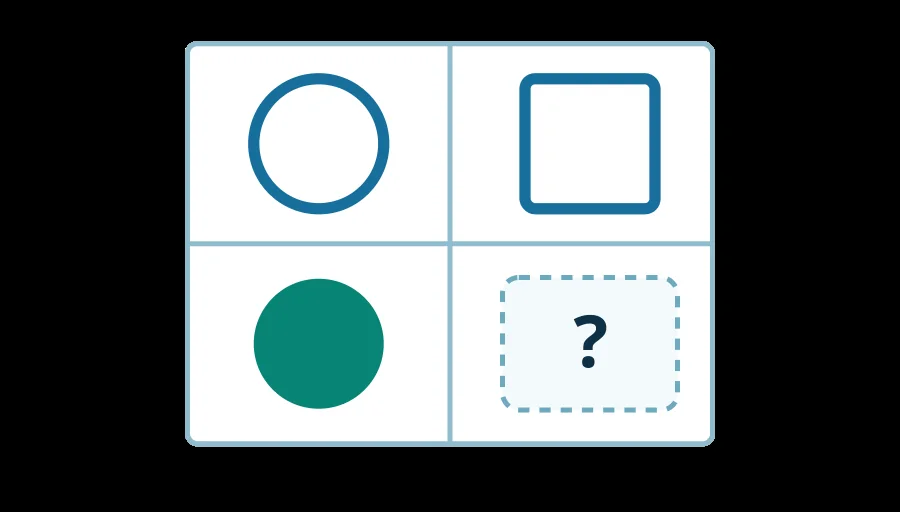
Question: Which figure completes the lower-right cell?
Visual described in words: Matrix description: top row = outline circle, outline square; bottom row = filled circle, ?
View answer & full teaching solution
Correct answer: C — Filled square
Solve the visual by separating features before choosing an option. The detailed reasoning below turns the diagram into explicit rules so you can reuse the method on unfamiliar figures.
Work it out step by step
- Read horizontally: circle becomes square while outline status stays the same.
- Read vertically: outline becomes filled while shape identity stays the same.
- The lower-right cell must satisfy both transformations: square from the row rule + filled from the column rule.
Why this is the right answer
The correct option is the only one that satisfies every confirmed feature simultaneously.
Why the other answers are wrong
- Option D satisfies only the horizontal shape rule. Option A satisfies neither final combination. Option B introduces a triangle, which has no support in either dimension.
Inductive Practice 4: Arrow-to-Polygon Coding
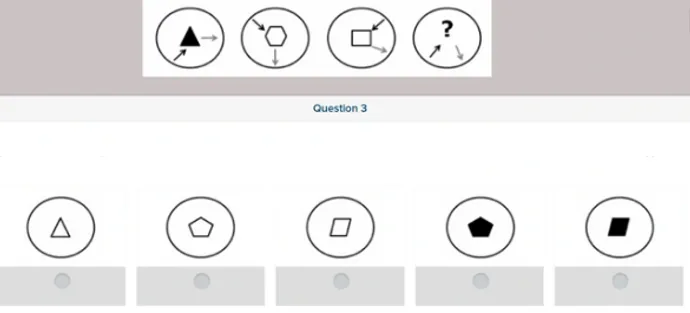
Question: Which shape replaces the question mark?
Visual described in words: Visual description: a grey arrow acts as a code for polygon side count; the black arrow independently indicates whether the polygon is filled.
View answer & full teaching solution
Correct answer: D — Filled pentagon
Solve the visual by separating features before choosing an option. The detailed reasoning below turns the diagram into explicit rules so you can reuse the method on unfamiliar figures.
Work it out step by step
- Read the grey arrow as a clock-hand code: 3 o’clock gives a triangle, 6 o’clock gives a hexagon, and 4 o’clock gives a quadrilateral.
- The final grey arrow points to 5 o’clock, requiring a pentagon.
- The black arrow points upward for the filled example and downward for the outline examples. In the target it points upward, requiring filled shading.
- D is the filled pentagon and satisfies both arrow codes.
Why this is the right answer
The correct option is the only one that satisfies every confirmed feature simultaneously.
Why the other answers are wrong
- Option B is the strongest distractor because it gets the side count right but ignores the fill layer. C and E have the wrong geometry.
Inductive Practice 5: Line-Count Matrix with Rotation
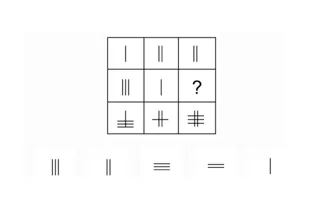
Question: Which symbol completes the matrix?
Visual described in words: Visual description: 3×3 matrix of line symbols; the bottom row combines vertical and horizontal line counts.
View answer & full teaching solution
Correct answer: A — Three vertical lines
Solve the visual by separating features before choosing an option. The detailed reasoning below turns the diagram into explicit rules so you can reuse the method on unfamiliar figures.
Work it out step by step
- Analyse by columns rather than assuming the rule is row-based.
- The top cell contributes the vertical-line component.
- The middle cell is rotated 90° when it contributes to the final combined cell.
- In the third column, the combined result requires three horizontal lines coming from a pre-rotation set of three vertical lines.
- Therefore the missing middle-right symbol must be three vertical lines.
Why this is the right answer
The correct option is the only one that satisfies every confirmed feature simultaneously.
Why the other answers are wrong
- Option B copies the visible vertical count from the combined cell instead of reversing the rotation rule. C has the right count but wrong pre-rotation orientation.
Inductive Practice 6: Quadrant Symbol Order
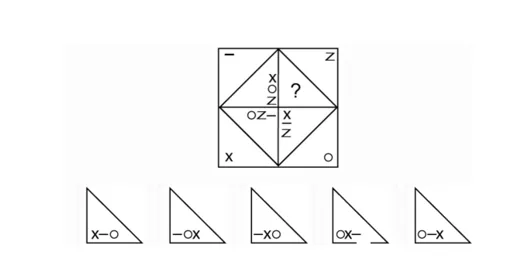
Question: Which triangular response completes the diagram?
Visual described in words: Visual description: a square is divided into triangular sectors containing the symbols dash, Z, X and O; one sector is missing.
View answer & full teaching solution
Correct answer: D — OX— arrangement
Solve the visual by separating features before choosing an option. The detailed reasoning below turns the diagram into explicit rules so you can reuse the method on unfamiliar figures.
Work it out step by step
- For each quadrant, exclude its own outer corner. Read the other three outer-corner symbols anticlockwise, starting at the next corner.
- The inner symbols show that order from the outside towards the centre: top-left X, O, Z; bottom-left O, Z, dash; bottom-right Z, dash, X.
- For the missing top-right quadrant, the outside-to-centre order is dash, X, O.
- This quadrant is read right to left towards the centre. On the answer card, the left-to-right display must therefore be O, X, dash: D.
Why this is the right answer
The correct option is the only one that satisfies every confirmed feature simultaneously.
Why the other answers are wrong
- Option E contains the same symbols but places the dash between O and X. It fails the outside-to-centre ordering rule.
Inductive Practice 7: Rotation and Dot Count
Question: Which panel comes next?
Track the arrow direction and the number of dots independently.
View answer & full teaching solution
Correct answer: E — upward arrow and five dots.
- The arrow makes a 90° clockwise turn at each step: up → right → down → left → up.
- The count increases by one: 1, 2, 3, 4, then 5 dots.
- E satisfies both rules. A and C have the wrong count. B and D have the wrong direction.
SHL Test Practice Free – Deductive Reasoning: 7 Rule-Based Questions
Deductive questions are about using the rules exactly as written. These examples move from simple if–then logic to ordering, classifications and several rules working together. The explanations show both what you can conclude and what you cannot.
Deductive Practice 1: Rule + Fact + Contrapositive
All employees of Company Z wear a black coat. Giannis works at Company Z. Anna does not wear a black coat.
Question: Which statement must be true?
View answer & full teaching solution
Correct answer: C — Anna does not work at Company Z
The central rule is conditional: working at Company Z guarantees wearing a black coat. Anna is explicitly stated not to wear a black coat, so she cannot satisfy the condition of being a Company Z employee.
A → B ⇒ ¬B → ¬AWork it out step by step
- Formalise the rule: Z employee → black coat.
- Fact: Anna → not black coat.
- Use the contrapositive: if not black coat, then not Z employee.
- Therefore Anna does not work at Company Z.
- Giannis is a distractor: Giannis works at Z, so he must wear a black coat.
Why this is the right answer
C follows by valid contrapositive reasoning.
Why the other answers are wrong
- B directly conflicts with the contrapositive.
- A contradicts the explicit fact that Giannis works at Z.
- D contradicts the group rule applied to Giannis.
Deductive Practice 2: Connect Two Rules into One Chain
Maria, and everyone who works in Room A, wears a red hat. Ioanna works in Room A. Despoina does not wear a red hat. Anyone who wears a red hat also wears grey trousers.
Question: Which statement must be true?
View answer & full teaching solution
Correct answer: B — Ioanna wears grey trousers
This question is a chain. Once Ioanna is placed in Room A, two consequences follow automatically.
A → B; B → C ⇒ A → CWork it out step by step
- Room A → red hat.
- Ioanna is in Room A, therefore Ioanna wears a red hat.
- Red hat → grey trousers.
- Therefore Ioanna wears grey trousers.
- The chain can be compressed to Room A → red hat → grey trousers.
Why this is the right answer
B is forced by two linked rules and a direct membership fact.
Why the other answers are wrong
- A conflicts with Despoina’s lack of a red hat because everyone in Room A must wear one.
- C is false because Maria is explicitly included among red-hat wearers, and red hat implies grey trousers.
- E is unsupported because grey trousers do not imply red hat; the second rule is one-directional.
Deductive Practice 3: Category Inclusion without Added Assumptions
All liquid samples must be stored in glass containers. Some plasma samples are stored in plastic containers. Some liquid samples are stored in a refrigerated environment. Anna is responsible for the glass containers. Every plasma sample is both stored and analyzed using the same equipment.
Question: Which statement must be true?
View answer & full teaching solution
Correct answer: C — Anna is responsible for containers used for liquid samples
This is a set-inclusion problem. The key is to follow only guaranteed category membership and responsibility.
Work it out step by step
- All liquid samples → glass containers.
- Anna is responsible for the glass containers.
- Therefore containers required for liquid samples fall within Anna’s stated responsibility.
- The premises do not say Anna personally stores or analyzes the samples; responsibility for containers is narrower than those actions.
Why this is the right answer
C is the only statement that follows directly from the universal liquid→glass rule plus Anna’s responsibility.
Why the other answers are wrong
- A and E invent duties not stated.
- D turns “some refrigerated” into “all refrigerated.”
- B makes a claim about plastic storage/analysis that the premises do not force.
Deductive Practice 4: Apply Transaction Rules in the Correct Order
When recording customer transactions, begin with the account type, then record the amount in euros, and finally add the appropriate transaction codes.
- Account types: 700 and 800.
- Withdrawal → code 100.
- Deposit → code 200.
- 700 withdrawal above €1,000 → add 30.
- 800 withdrawal above €2,000 → add 40.
- 700 deposit above €1,500 → add 07.
- 800 deposit above €1,500 → add 08.
Question: What is the correct sequence for a 700-type account that makes a deposit of €1,800?
View answer & full teaching solution
Correct answer: B — 700, 1800, 200, 07
The safest approach is procedural: build the code from fixed fields first, then transaction type, then conditional suffix.
Work it out step by step
- Account type is 700 → start with 700.
- Amount is €1,800 → second field is 1800.
- Transaction is a deposit → use core code 200, not withdrawal code 100.
- For a 700-type deposit above €1,500, append 07.
- Final sequence: 700, 1800, 200, 07.
Why this is the right answer
B is the only option that satisfies account type, transaction type and threshold-specific suffix simultaneously.
Why the other answers are wrong
- A and C incorrectly use withdrawal code 100.
- D uses the 800-withdrawal suffix 40.
- E uses the 800-deposit suffix 08.
Deductive Practice 5: Combine Two Comparisons into a Ranking
Boxes A, B and C contain from 1 to 5 kilograms of rice. Box A contains more rice than Box B. Box C contains less rice than Box B.
Question: Which statement must be true?
View answer & full teaching solution
Correct answer: C — Box C contains less rice than Box A
Exact quantities are unnecessary. The problem is solved by transitive ordering.
A > B and B > C ⇒ A > CWork it out step by step
- A > B.
- C < B, which is equivalent to B > C.
- Combine the inequalities: A > B > C.
- Therefore C < A must be true.
Why this is the right answer
C is guaranteed by the ranking chain even though no exact kilogram values are known.
Why the other answers are wrong
- A and B reverse stated comparisons.
- D and E assign exact values that are not forced by the premises.
Deductive Practice 6: Carry an Equality through a Comparison Chain
Buses A, B, C and D each have between 30 and 50 seats. Bus A has the fewest seats of all. Buses B and C have the same number of seats. Bus C has 10 more seats than Bus D.
Question: Which statement must be true?
View answer & full teaching solution
Correct answer: D — Bus A has fewer seats than Bus D
This combines an equality, a strict comparison and a global minimum statement.
Work it out step by step
- B = C.
- C = D + 10, so C > D.
- Because B = C, B > D as well.
- A has the fewest seats of all, so A < B, A < C and A < D.
- Therefore D is guaranteed.
Why this is the right answer
The “fewest of all” condition alone establishes A < D; the other relations help eliminate distractors and verify consistency.
Why the other answers are wrong
- A is impossible because every bus has at least 30 seats.
- B is false because B=C>D.
- C conflicts with A being the fewest within a 30–50 range.
- E is false because B and C are equal.
Deductive Practice 7: Ability, Membership and Action
Anyone who is not a member of the Access Committee cannot give approvals for entry to the Archive. All members of the Access Committee can give approvals for entry to the Archive. Eleni has given approvals in the past. Kostas is a member of the Committee, but he has never given an approval. No one who has given an approval ignores the access rules.
Question: Which statement must be true?
View answer & full teaching solution
Correct answer: B — Kostas can give approval, but has not done so
This item tests the difference between ability, membership and observed action. Those are related but not interchangeable.
Work it out step by step
- Rule 1: non-member → cannot approve.
- Rule 2: member → can approve.
- Fact: Kostas is a member → Kostas can approve.
- Fact: Kostas has never given an approval → he has not exercised that ability.
- Therefore B combines two directly supported statements.
- Cross-check: anyone who has approved does not ignore the rules. Eleni’s past approvals alone do not establish her current membership status; Kostas’s membership and unused authority are stated directly.
Why this is the right answer
B is fully supported without reversing or strengthening any rule.
Why the other answers are wrong
- A contradicts the rule about people who have given approval.
- C is not established: the passage does not state that Eleni is currently a non-member.
- D invents a relationship between non-membership and ignoring rules.
- E directly contradicts the fact that Kostas is a member.
SHL Test Practice Free – Test-Day Rules Candidates Often Get Wrong
Preparation is more effective when you separate general advice from the instructions that actually apply to your assessment. The following points reflect current SHL candidate guidance, but your own on-screen instructions remain the final authority because assessment configurations can differ.
How SHL Test Practice Free Should Teach You to Solve New Questions
Direct answer: good SHL practice should teach a repeatable method, not encourage memorisation of one answer. Each worked solution on this page identifies the question type, formalises the rule or formula, solves it in explicit steps and then diagnoses the distractors.
The numerical questions use charts, tables and formulas; the verbal questions preserve evidence strength and wording; the inductive questions separate visual layers; and the deductive questions translate natural-language rules into explicit logical consequences. The aim is a transferable study method rather than a collection of isolated answer keys.
How the 28 Practice Questions Are Selected and Reviewed
The exercises on this page are selected from ReasoningCampus reasoning workbooks and organised from foundation questions to multi-rule problems. The numerical source material includes bar charts, stacked charts, line charts, pie charts and combined-trap calculations; the published solutions are written to explain both the method and the arithmetic.
Four Error Patterns This Practice Set Is Designed to Expose
Common SHL Mistakes We Train Candidates to Avoid
Direct answer: many avoidable SHL-style errors come from the method used under pressure rather than from difficult mathematics or vocabulary. ReasoningCampus practice materials repeatedly target the error families below so candidates can recognise the mistake, name it and replace it with a specific checking habit.
1. Using the wrong percentage base
A candidate sees a percentage change and divides by the final value, the larger value or the most visually prominent number instead of the required base. This can produce an answer that looks plausible but answers a different question.
percentage change = change ÷ original value × 100. Label the denominator before calculating.2. Applying business rules in the wrong order
Returns, deductions, thresholds, caps, commissions and bonuses often interact. Calculating the right numbers in the wrong sequence still gives the wrong result.
3. Accepting a visual answer that matches only one rule
In inductive reasoning, a distractor may have the correct rotation but the wrong count, or the correct position but the wrong fill. Partial correctness is still incorrect.
4. Reversing a deductive rule
From “If A, then B,” candidates sometimes assume “If B, then A.” That converse is not guaranteed. A valid contrapositive is different: “If not B, then not A.”
5. Letting a verbal answer become stronger than the passage
Words such as may, only, some, all, after and because control the strength of a conclusion. A polished option can be wrong because it turns a possibility into certainty or chronology into causation.
6. Searching randomly instead of eliminating systematically
Under time pressure, candidates can keep inventing new theories after one rule fails. This increases working-memory load and makes simple patterns feel complex.
How to use this section: after each wrong answer, record the error type rather than only the question number. If the same error family appears repeatedly, practise that decision rule before adding more speed.
SHL Practice Test with Answers: How to Learn from Every Question
An SHL practice test with answers is most useful when the answer does more than identify the correct option. After each attempt, compare your own reasoning with the worked method, identify the exact point where your approach diverged, and record the rule, formula or reading error that caused the mistake.
On this page, Practice Mode gives immediate feedback and a complete teaching solution, while Test Mode keeps the solutions hidden until submission. This lets you use the same 28 SHL practice questions first for learning and later for timed self-assessment.
How should I review a free SHL practice test?
When you make a mistake, review the type of mistake rather than simply repeating the same question. For numerical items, check the denominator, units and order of operations. For verbal items, locate the exact evidence in the passage. For inductive items, verify every visual rule. For deductive items, distinguish what must follow from what is merely possible.
SHL Test Candidate Guide: Important Questions Before Your Assessment
These are the practical questions candidates should resolve before test day. The answers below use current SHL candidate guidance where the point is provider-specific; your own invitation and on-screen instructions remain the final instructions for your assessment.
What is an SHL test?
An SHL test is an employment assessment used by organisations to evaluate job-relevant abilities or characteristics. Depending on the role, the assessment process may include cognitive reasoning, personality or motivation questionnaires, situational judgement, simulations or other job-related tools. For cognitive preparation, use the exact assessment name in your invitation to decide whether you need numerical, verbal, inductive, deductive or mixed practice.
Is there a free SHL assessment practice test?
Yes. SHL provides a selection of free practice tests through SHL Direct. SHL states that practice is not available for every assessment or language and that not every practice test produces a report. SHL describes the main purpose of these practice tests as helping candidates become comfortable with how the assessments work. This page adds 28 original practice questions with longer worked explanations for additional learning.
How do I know which SHL test I am taking?
Use the exact name shown in your invitation email, candidate portal and pre-test instructions. Do not prepare only from a generic “SHL test” label. If the invitation is unclear, ask the recruiter which assessment or ability areas are included. The assessment name matters because timing, interaction style and the skills measured can differ.
What is SHL Verify Interactive G+?
Verify Interactive G+ is a general cognitive ability assessment that includes Numerical, Deductive and Inductive Reasoning. If your invitation names Verify Interactive G+, practise switching between these three reasoning modes rather than training only one category in isolation.
How should I prepare for SHL numerical reasoning?
Build the foundations first: percentages, ratios, fractions, averages and accurate reading of tables or charts. Then move to reverse calculations, thresholds, returns, caps, currency conversion and multi-stage business problems. Before calculating, identify the base quantity and the order in which the rules must be applied. After calculating, reconcile the result against the original data.
How should I prepare for SHL verbal reasoning?
Train yourself to separate what the passage states from what merely sounds plausible. Practise detail retrieval, main point, inference, summary selection, contextual vocabulary and evidence strength. Pay special attention to qualifiers such as only, some, may, must, all and unless; one word can change whether a conclusion is fully supported.
How should I prepare for SHL inductive reasoning?
Separate the visual information into features instead of staring at the whole figure. Check count, position, movement, rotation, fill, shape, inside/outside relationships and dependencies. Test a proposed rule across every relevant panel and reject an option if it breaks even one confirmed rule. Progress from simple sequences to matrices and compound patterns only after the foundations are reliable.
How should I prepare for SHL deductive reasoning?
Translate each sentence into a rule or constraint, then apply only what logically follows. Watch for invalid reversal: from “A implies B” you cannot automatically conclude “B implies A.” Practise contrapositives, rule chains, classifications, ordering and multi-condition problems, checking every answer against all active constraints.
Can I use a calculator, paper or pencil during an SHL test?
SHL Candidate Support states that candidates completing a numerical or calculation test may use a calculator unless instructed otherwise. SHL also notes that a piece of paper and a pencil can be useful during an assessment. Always check the instructions shown for your specific assessment before relying on a general rule.
Are SHL tests timed, and can I go back to a previous question?
Timing depends on the assessment. In adaptive assessment flows, SHL Candidate Support states that candidates may be unable to return to a previous question after it has been submitted because later questions can depend on earlier responses. Treat your on-screen timer and navigation controls as the authoritative rules for the assessment you are actually taking.
Do incorrect SHL answers reduce my score, or should I leave questions blank?
SHL Candidate Support states that incorrect responses do not decrease the test score in the assessment flow it documents and that candidates are expected to answer all questions rather than leave them blank. Do not import a guessing penalty from a different assessment provider. Follow the exact instructions displayed in your own test.
What is a good SHL score or the SHL pass mark?
SHL does not set one universal passing score. SHL advises candidates to contact the recruiter or organisation that requested the assessment, because the employer decides how results are interpreted and what threshold, comparison group or selection rule is used.
Do official SHL practice tests show the correct answers?
SHL states that answers to its full-length timed practice tests are not available. For most of those tests, candidates may instead receive a feedback report showing the percentage answered correctly. SHL’s short example questions work differently: after an attempt, they show whether the answer is right or wrong, provide the correct answer and give a short explanation.
What is the best way to use free SHL practice before a real assessment?
Use official practice first for familiarisation with the provider’s instructions and environment, then use additional questions to build reasoning depth. Work by category until the method is reliable, review every error, and only then add realistic timing and mixed sets. The goal is not to remember one question; it is to recognise the underlying calculation or rule when the numbers, wording or visual design changes.
Sources & Methodology for This 2026 SHL Practice Guide
Source policy: current factual statements about SHL candidate practice, calculator use, navigation, answer feedback and pass marks are checked against primary SHL candidate resources. The 28 practice questions, worked calculations, visual exercises and teaching explanations are ReasoningCampus educational material selected for progressive practice.
Primary SHL Sources Used for Candidate Guidance
- SHL Direct — Practice Tests and Assessments · accessed 19 August 2026
- SHL Direct — Example Questions · accessed 19 August 2026
- SHL Candidate Support · accessed 19 August 2026
- SHL Candidate Support — calculator and test resources · accessed 19 August 2026
- SHL Candidate Support — incorrect answers and scoring · accessed 19 August 2026
- SHL Candidate Support — pass marks · accessed 19 August 2026
Review Standard Used on This Page
Numerical answers are checked by recomputing the arithmetic from the stated values and conditions. Verbal answers are checked against the exact evidence strength of the passage. Inductive answers are checked against every confirmed visual rule rather than a single matching feature. Deductive answers are checked against the stated rules without adding unstated assumptions. The published explanation is then reviewed for whether a candidate could apply the same method to a new question.
Finished the Free Practice? Keep Building from Here
Use your score to decide what to work on next. If numerical questions slowed you down, focus there. If verbal, inductive or deductive questions caused more mistakes, spend your next practice session on that area instead of repeating everything.
When you want a broader and more structured route, continue with the complete ReasoningCampus SHL preparation programme.
