
ReasoningCampus · SHL Inductive and Spatial Reasoning
SHL spatial reasoning practice involves preserving relationships while an object is folded or turned. Start by identifying opposite and adjacent faces on a cube net, then check orientation. The original diagrams and examples below make each inference explicit. ReasoningCampus teaches these spatial checks with original diagrams and step-by-step explanations as part of independent SHL preparation.
Independent learning resource · English · Content revised 16 October 2026
View full preparationSHL spatial reasoning practice: preserve adjacency and orientation
At ReasoningCampus, we separate where an object is, which way it faces and whether it has been mirrored. For folding tasks, we track which faces meet and which become opposite. This keeps a rotation from being mistaken for a reflection and a flat neighbour from being assigned to an impossible cube face.
Rotation and reflection preserve different features
Rotating a labelled object moves its orientation without reversing its handedness. A reflection reverses handedness. The directions exchanged depend on the mirror line: reflection across a vertical line exchanges left and right while preserving up and down. Use an asymmetric object, such as an L shape with a marked end, to practise the distinction. A plain square has too much symmetry to reveal some transformations clearly.
| Transformation | What to track |
|---|---|
| Quarter-turn clockwise | Each direction advances 90° clockwise |
| Half-turn | Each direction moves to its opposite |
| Mirror across a vertical line | Left and right exchange; up and down remain |
| Translation | Position changes without rotation |
Worked rotation example
An arrow points northeast. One 90° clockwise rotation makes it point southeast. A second 90° clockwise rotation makes it point southwest. Choosing northwest after the first turn would rotate anticlockwise; choosing southwest after the first turn would apply 180° instead of 90°. Draw the compass directions during untimed practice if that helps establish the movement.
A cube net with a complete explanation
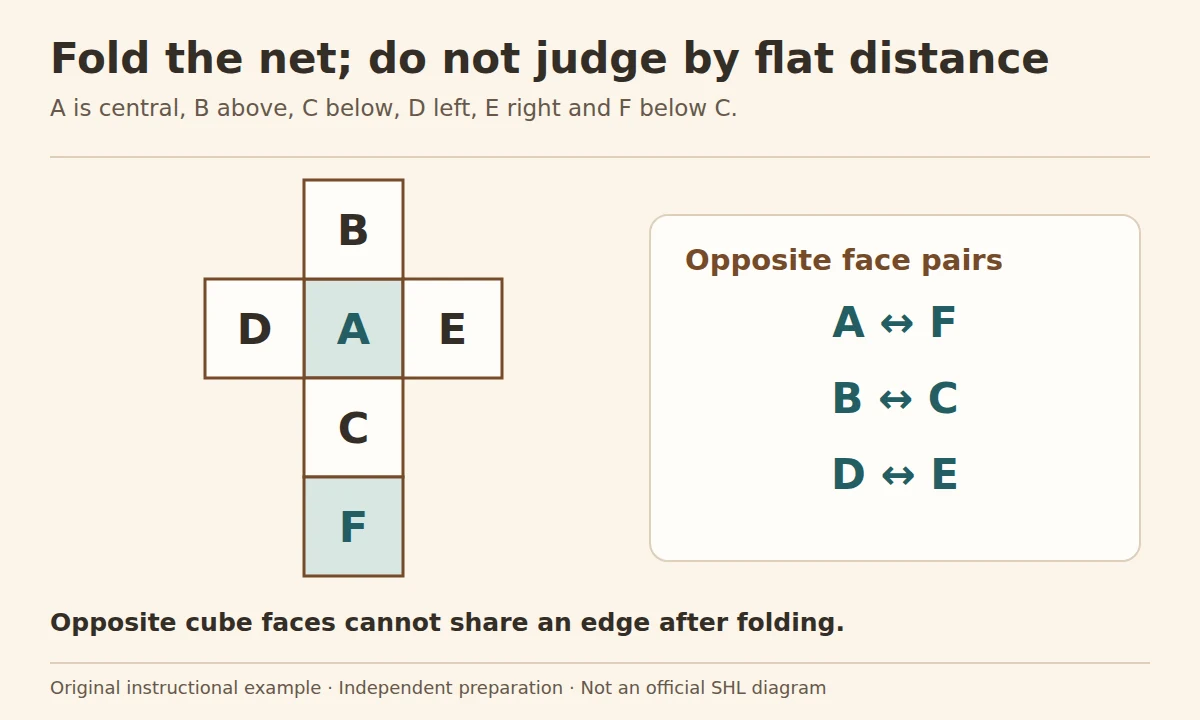
Consider this net: A is the centre square; B is above A; C below A; D left of A; E right of A; and F below C. When folded into a cube, B, C, D and E wrap around A. F folds across to close the cube opposite A. Thus A–F, B–C and D–E are opposite pairs.
Opposite faces cannot share an edge on the folded cube. A and F are separated in the net by C, but their final relationship is determined by folding, not by the flat distance alone. If uncertain, make a paper version during ordinary practice; use only permitted materials in an assessment.
Check what the task actually asks
Identifying an opposite face is different from identifying the orientation of a symbol after folding. Labels on faces solve the first problem, but arrows or marked edges may be needed for the second. Do not assume a correct face pairing determines every orientation detail.
A second cube net: transfer the folding method
Fold C as the front face. B and D become opposite side faces; A and F become opposite top and bottom faces; E folds round to oppose C. The opposite pairs are therefore A–F, B–D and C–E.
Do not copy the opposite pairs from a differently labelled net earlier in the lesson. The labels have meaning only through the layout. A rotation of the completed cube preserves opposite pairs, but it changes which face appears at the top of a drawing.
Check your understanding: original practice
Keep the two labelled cube nets separate. Use the stated layout or movement in each question, then check which relationship the alternatives overlook.
Looking for a structured course alongside these free questions? View full preparation.
Questions about SHL spatial reasoning practice
Are all abstract reasoning questions spatial?
No. Abstract tasks can involve several kinds of relationship. Match your practice to the task described in the invitation.
Can I rotate the paper or screen?
During your own study you can experiment with a paper model. During an assessment follow the available controls and permitted materials.
Why use asymmetric shapes?
Their orientation and handedness are easier to distinguish. Symmetry can make two different transformations look identical.
Sources and scope
The practice-support link explains official familiarisation availability, not the mathematics of these cube nets or an assertion that your test includes them. Each spatial answer is derived from the explicitly drawn original net.
Where to go next
Feature tracking treats movement over time; diagrammatic operators treat transformations. Mechanical examples use different, explicitly physical relationships.
