
ReasoningCampus · SHL Inductive and Spatial Reasoning
SHL diagrammatic reasoning often becomes clearer when you write the intermediate output of each operation. A swap followed by a reversal may differ from the same actions in reverse order. Practise both known operators and a code that must be inferred from examples. ReasoningCampus teaches this written trace so candidates can explain each operation in their SHL preparation.
Independent learning resource · English · Content revised 16 October 2026
View full preparationSHL diagrammatic reasoning: keep the operation order explicit
At ReasoningCampus, we use change one feature, test the operator, preserve the sequence. Compare an input and output carefully before naming the rule. When several operators act in succession, record the intermediate state. That makes order errors visible and helps you work backwards when an operation has a unique inverse.
Define two operators precisely
| Operator | Rule on a three-item sequence |
|---|---|
| R | Reverse the order of all three items |
| S | Swap positions 1 and 2 |
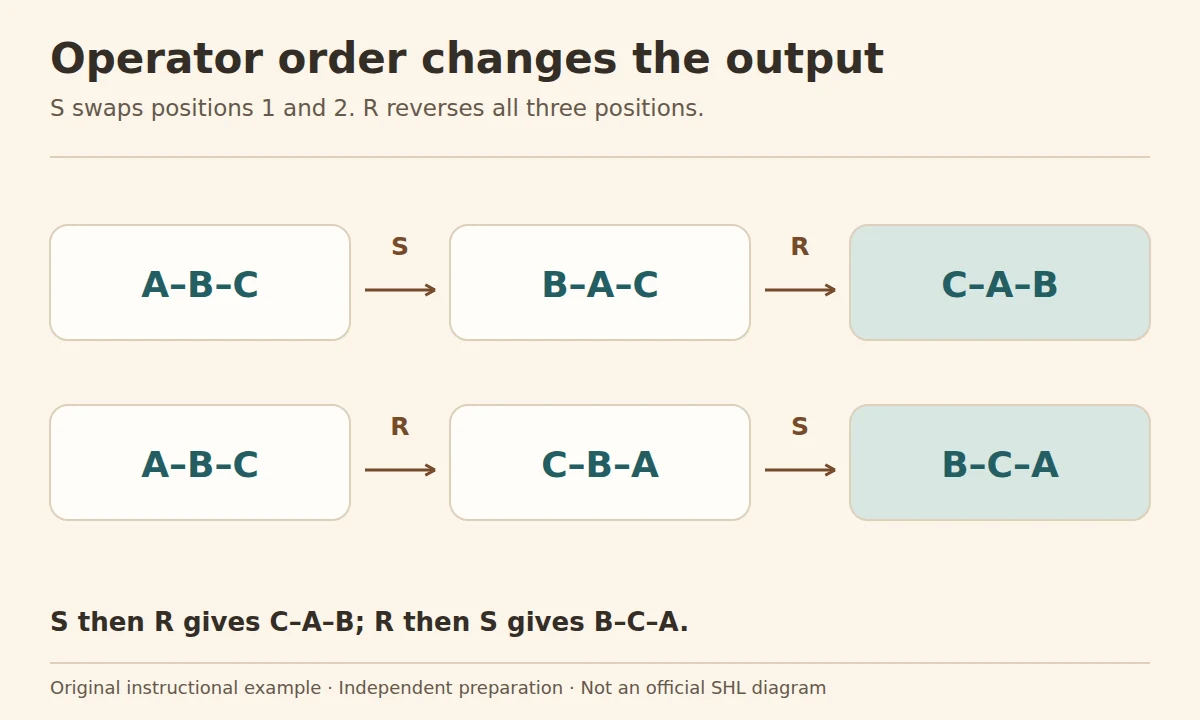
Start with A–B–C. Apply S first: B–A–C. Then apply R: C–A–B. If you apply R first, A–B–C becomes C–B–A; applying S then produces B–C–A. The outputs differ. This is why “use R and S” is incomplete unless the order is specified.
Track the intermediate state: a full backward solution
Suppose the final output is C–A–B, and the instructions say apply S then R. Undo the last operation first: reversing C–A–B gives B–A–C. Undo S by swapping its first two positions, giving A–B–C. Both operators are self-inverse in these examples: applying the same operation again restores the previous state.
This does not mean every operator can be undone uniquely. An operator that deletes the final symbol loses information. If its output is A–B, the original third symbol cannot be recovered without another condition.
Infer a rule from more than one example
If an operator turns A–B–C into C–B–A, it might reverse the sequence. On three items, “swap first and last” produces the same output. Those descriptions are equivalent for that input size, but they differ on longer sequences. Test the scope of the task rather than claiming you have discovered a universal rule from one pair.
- List exactly what changed.
- Propose the simplest rule consistent with the given examples.
- Test it on every available example.
- Apply operations in the specified direction and order.
- Check the final output, including unchanged features.
Do not confuse an operator task with a free visual pattern
In a sequence task you may infer a relationship between successive frames. In an operator task the symbol itself represents a transformation. The exercises can share skills, but an operator’s meaning must remain consistent wherever it appears within the defined task.
Infer an unknown operator using two examples
An unknown operator changes A–B–C into C–A–B and D–E–F into F–D–E. Among “swap the first two”, “reverse all three” and “move the last item to the front”, only the final rule fits both examples.
Apply it to P–Q–R: the output is R–P–Q. Now apply the same operator twice: R–P–Q becomes Q–R–P. A second application is not automatically an undo operation; after three applications the original order returns.
Check your understanding: original practice
Record the intermediate state after each operator. The worked explanations make it easier to locate a reversal or order error.
Looking for a structured course alongside these free questions? View full preparation.
Questions about SHL diagrammatic reasoning
Should I always work backwards?
Use backward reasoning when the desired output is known and the operations can be inverted. If an operation loses information, you may need to test candidates instead.
Can two operators be applied in either order?
Only if that is true for the defined operations. The R and S example shows that order can change the answer.
How do I avoid losing a symbol?
Write or mentally preserve an intermediate sequence after each operation. Check that the number of symbols changes only when a rule requires it.
Sources and scope
Official familiarisation is separate from the original operator code defined here. This code is a teaching model, not an SHL product specification or an official operator list.
Where to go next
Compare operators with matrix combinations, spatial transformations and rule discovery. Do not assume that the same transformation applies across all three.
