
ReasoningCampus · SHL Workplace Assessments
SHL video interview preparation combines a supported recording setup with an answer that makes your own contribution clear. Compare a vague response with a more specific example and practise an honest account of the situation, your action and the result. ReasoningCampus teaches an answer structure that helps you explain your own experience in a recorded interview.
Independent learning resource · English · Content revised 16 October 2026
View full preparationSHL video interview preparation: make your own contribution clear
At ReasoningCampus, we teach situation, task, action, result and reflection as an organising aid. Keep the background short enough to leave space for your contribution. Distinguish “the team achieved” from “I did”, and use a genuine outcome rather than inventing a percentage to make the story sound stronger.
Understand the recorded interview task
SHL’s recorded interview guidance describes responses recorded with a camera and microphone for assessment. Check the equipment and session instructions in your invitation, then practise explaining your action and its outcome. That guidance does not establish one scoring method for every interview product.
A useful answer structure
| Part | What to include | What to avoid |
|---|---|---|
| Situation | Enough context to understand the problem | A long history of the organisation |
| Task | Your responsibility and constraints | An unclear role |
| Action | The specific steps you took | Only saying “we worked hard” |
| Result | What happened and how you know | Invented metrics or guaranteed causation |
| Reflection | What you learned or would change | A generic claim of perfection |
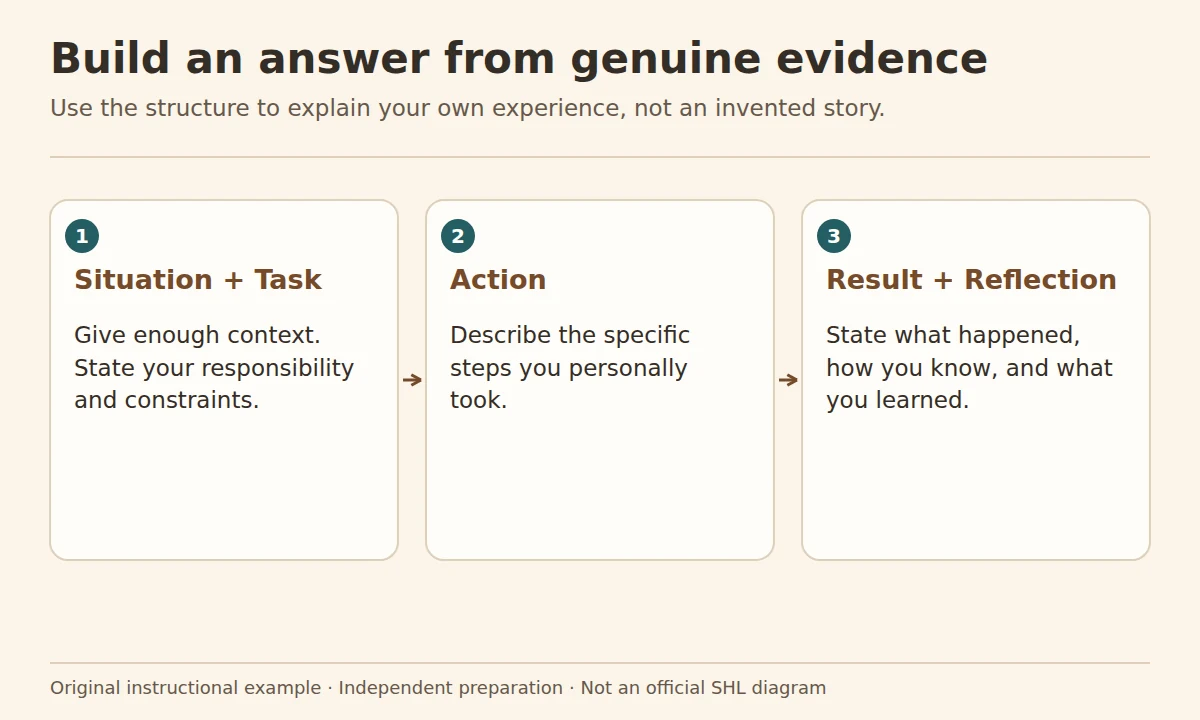
Worked example: resolving a reporting problem
A fictional example shows the structure: “Our weekly report combined data from two teams, and the totals did not reconcile. I was responsible for preparing the summary before the review meeting. I checked the definitions with both owners and found that one file counted cancelled orders while the other excluded them. We agreed a common definition, I recalculated the summary and documented the change. The meeting used the corrected figures. Afterwards I added a definition check to the preparation checklist.”
The answer is useful because it identifies the problem, the candidate’s action and an observable outcome. If this is not your experience, do not adopt it as your own. Use its structure to explain a genuine example, including what remained unresolved if that is part of the story.
Rehearse clarity with a final reflection
Record a practice answer outside the assessment if you wish. Listen for an unclear role, missing evidence or excessive background. Rewrite a few prompts rather than memorising every sentence. If the actual interview sets a time limit, practise fitting the relevant example within it; this guide does not prescribe a universal duration.
Check the recording format and permissions
Confirm preparation time, response time, retakes, device requirements and support instructions from the invitation. A recorded video, a live interview and an avatar-led interaction can have different interfaces. A product label alone does not establish who reviews the recording or what is measured. Ask for the applicable information instead of relying on claims that eye contact or a keyword automatically changes a score.
From a vague answer to an evidence-based example
Vague: “I am good at teamwork and we always meet deadlines.” This names a quality but gives the listener little evidence.
Illustrative stronger structure: “Before our event, three volunteers had overlapping assignments. I listed the tasks with them, agreed one owner for each and checked which tasks needed a handover. We had an agreed rota before opening. Afterwards, I suggested sharing the rota a day earlier.”
This is a fictional teaching example, not a story to present as your own. Replace it with a real event. Keep the problem, your action and the observed result distinct. An honest limitation — for example, that you did not own the final approval — can make the account more precise.
Questions about SHL video interview preparation
Should I repeat words from the job description?
Use relevant language when it accurately describes your experience. Repetition without evidence does not explain your contribution.
Do I need numerical results in every answer?
No. A concrete, truthful outcome can be qualitative. Do not manufacture a percentage or imply causation you cannot support.
Does STAR guarantee a strong interview score?
No. It is a communication framework. The relevance and truth of your example and the actual assessment criteria still matter.
Sources and scope
- SHL Candidate Support: the recorded Video Interview flow
- SHL Smart Interview Professional: product-specific support and proctoring
The official candidate resources below provide assessment context and support. The answer structure and fictional examples are teaching aids; use your own experience and your invitation’s recording instructions.
Where to go next
Use language practice for clarity and the device guide for compatibility. Motivation reflection can help you explain genuine work preferences without inventing an interview story.
