
ReasoningCampus · SHL Workplace Assessments
The SHL motivation questionnaire concerns conditions that increase or reduce motivation at work. That is different from asking what you can do or how you usually behave. Use the cited MQ factsheet and original reflection examples to keep those distinctions clear. In ReasoningCampus preparation, these work drivers help you practise reading the rating scale and reflecting honestly on your preferences.
Independent learning resource · English · Content revised 16 October 2026
View full preparationSHL motivation questionnaire: identify what changes your motivation
At ReasoningCampus, we distinguish what you enjoy, what you do well and what the role requires. Those can overlap, but they are not identical. Use concrete examples to understand your preferences, then answer the questionnaire’s wording honestly. Do not turn a job advertisement into instructions to impersonate an ideal candidate.
What the SHL Motivation Questionnaire measures
The SHL Motivation Questionnaire factsheet (2020) describes 18 dimensions concerning energy and drive, organisational culture, the work itself and external rewards. The published version is untimed and uses a five-point rating scale. Its purpose is to explore what increases or reduces motivation at work. A rating is therefore about motivation, rather than proof of technical ability.
Work drivers: a reflection table you can fill in
| Area to reflect on | Useful evidence | A question to ask |
|---|---|---|
| Autonomy | A task with freedom over the approach | Did freedom help, or did missing direction slow me down? |
| Structure | A task with a clear procedure | Did the clarity support my work? |
| Variety | A week with several different tasks | Was switching energising or disruptive? |
| Collaboration | A shared project | What part of working together suited me? |
| Recognition | Feedback on a completed task | Which kind of feedback mattered and why? |
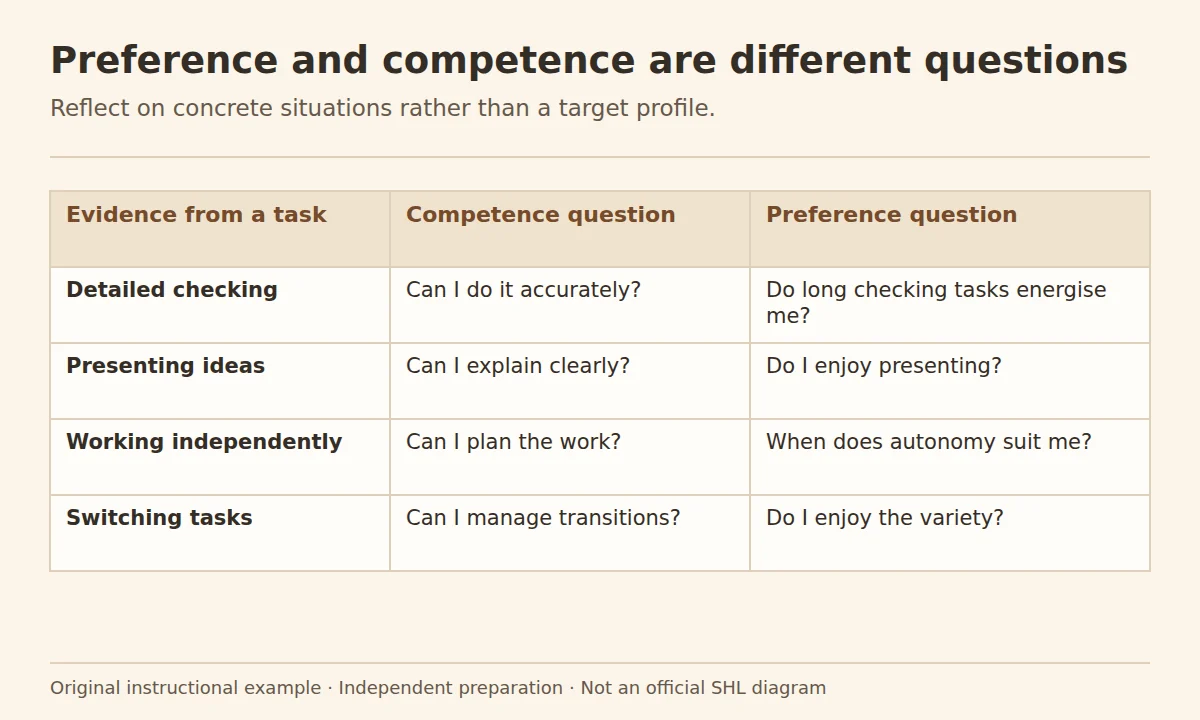
Worked reflection: competence is not the same as preference
You may be good at detailed checking yet find long periods of it tiring. You may enjoy presenting ideas while still wanting more practice at public speaking. A statement about what motivates you should not automatically be answered as if it asks what you can already do well. Read the verb: enjoy, prefer, feel motivated by and perform well are different claims.
Write two short examples for an important preference, ideally from different situations. If they conflict, examine the conditions rather than forcing a neat label. You may enjoy autonomy when the goal is clear but dislike it when expectations are missing.
Read the rating scale before rating each motivator
For the five-point format described in SHL’s factsheet, consider how each situation would affect your motivation and choose the corresponding rating. Use an ordinary example from work or study to clarify the statement. Avoid stereotypes such as assuming that every sales role requires maximum competition. Your task is to describe your motivation in the context requested.
Use the reflection after the assessment too
Your notes can help you ask sensible questions about a role: how priorities are set, how feedback works and how much autonomy the work involves. Keep those questions separate from claims about the questionnaire’s official score. A useful preparation exercise should leave you with clearer self-understanding, not just a rehearsed response pattern.
The same behaviour can have different motivations
Two people volunteer to lead a project. One is attracted by autonomy; the other by public recognition. The observed behaviour is the same, but the motivating conditions differ. Conversely, someone who values autonomy may decline this particular project because its decisions are tightly prescribed.
For an original reflection exercise, write one condition that increases your engagement, a concrete situation where it mattered and a limit or trade-off. Avoid converting a motive into a claim of ability: enjoying analytical work does not, by itself, establish numerical performance. The MQ factsheet groups 18 dimensions into four broad areas; that description is separate from an ideal candidate profile.
Questions about motivation and honest reflection
Is motivation the same as personality?
They are related ideas but not interchangeable questions. Attend to whether a statement asks about behaviour, preference or what energises you.
Should I select the motivators mentioned in the vacancy?
Do not replace your own answer with a guessed desired profile. Use the vacancy to understand the role, and use real examples to understand yourself.
Does this lesson reproduce an MQ scoring model?
No. The table is an original reflection aid. It does not reproduce an official scale, algorithm or result interpretation.
Sources and scope
The MQ description refers to the cited 2020 factsheet. The original reflections illustrate motivation rather than reproduce questionnaire items or provide an employer’s preferred responses.
Where to go next
Compare motivation with OPQ work preferences, then use an interview example or retail scenario to describe a real situation rather than an idealised profile.
