
ReasoningCampus · SHL Study Skills
The SHL practice score calculator below reports three transparent measures: accuracy among attempts, completion and correct answers across the whole set. Enter your own practice counts to see the formulas in action. It does not estimate an official SHL percentile or pass mark. ReasoningCampus uses practice accuracy, completion rate and correct share to help candidates review their own work without presenting these measures as official SHL scores.
Independent learning resource · English · Content revised 16 October 2026
View full preparationSHL practice score calculator: three different denominators
The ReasoningCampus practice review keeps total, attempted and correct distinct. An incomplete set and a completed set with many errors call for different follow-up work. A single “score” can hide that difference, so the calculator reports the measures separately and explains their denominators.
Practice accuracy, completion rate and correct share
| Measure | Formula | Question answered |
|---|---|---|
| Accuracy among attempts | correct ÷ attempted × 100 | How often were my attempted answers correct? |
| Completion | attempted ÷ total × 100 | How much of the set did I attempt? |
| Correct share of whole set | correct ÷ total × 100 | How much of the full set did I answer correctly? |
The inputs must be whole numbers with total greater than zero and 0 ≤ correct ≤ attempted ≤ total. If you attempted no questions, accuracy is undefined rather than 0%; the tool says “not available”. Completion and correct share are then both 0%.
Worked example: 15 correct from 18 attempts in a 24-item set
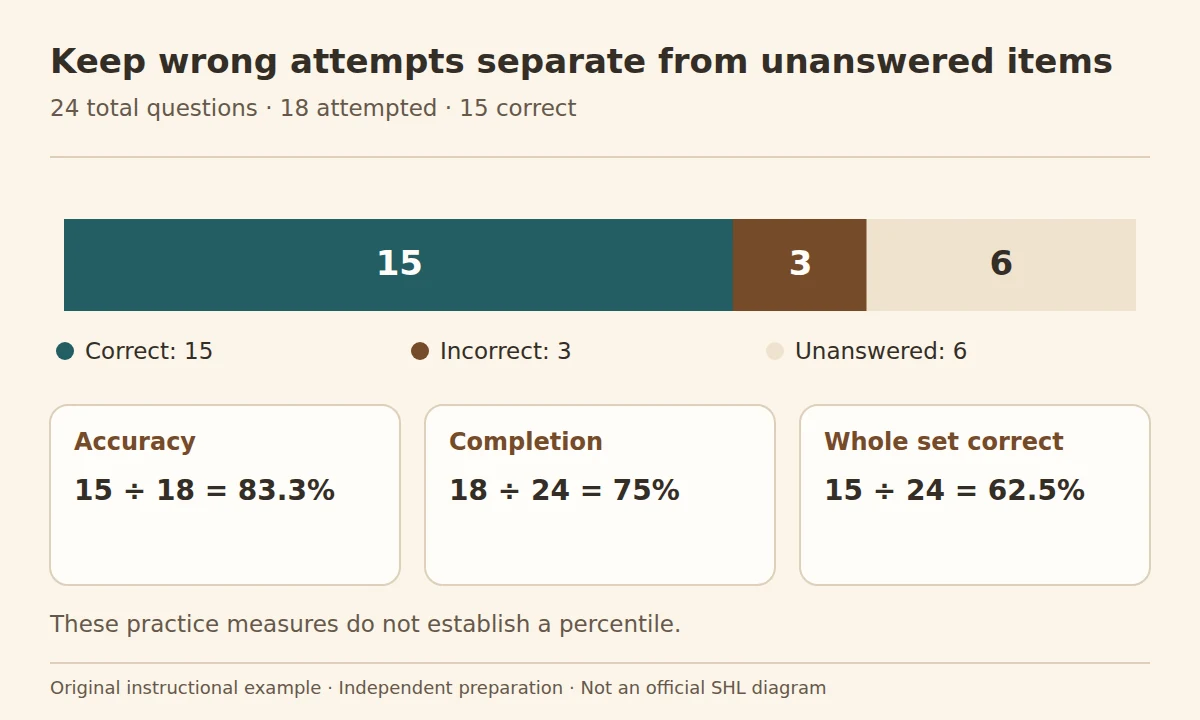
Accuracy is 15 ÷ 18 × 100 = 83.3%. Completion is 18 ÷ 24 × 100 = 75.0%. Correct share is 15 ÷ 24 × 100 = 62.5%. There are 24 − 18 = six unanswered questions and 18 − 15 = three incorrect attempts. Keeping those categories separate prevents a review error.
Your next step depends on the pattern. Inspect the three wrong attempts for a repeated misunderstanding, and inspect why six items were not reached. Do not assume that increasing attempts alone will improve accuracy or an official outcome.
Why there is no percentile conversion
A percentile needs a relevant comparison distribution and a defined method. A list of your correct answers supplies neither. Two practice sets can also differ in difficulty. This tool therefore does not contain a banking, technology or graduate conversion table, and it does not pretend that a score out of 18 maps to an official sten.
If you later receive a report with a percentile or a band, read its own explanation and comparison information. Keep that result separate from this local practice record.
Record comparable sessions
| Session note | Example |
|---|---|
| Set and conditions | Original numerical set, untimed |
| Result | 15 correct, 18 attempted, 24 total |
| Main error | Wrong percentage base on two items |
| Next action | Practise the denominator decision with new values |
Use fresh questions of comparable demand when judging progress. A repeated set can confirm that you understand corrections, but memory can increase its score. The tool runs in the page and does not need to send your numbers to a server.
Try the original practice tool
Enter your practice counts. The tool reports transparent arithmetic, not an official score or percentile.
The accuracy and completion formulas remain readable without JavaScript. The calculator processes total, attempted and correct locally without sending those entries to a server.
Same practice accuracy, different completion rate
| Practice set | Attempted | Correct | Accuracy | Completion |
|---|---|---|---|---|
| A: 20 items | 10 | 8 | 80% | 50% |
| B: 20 items | 20 | 16 | 80% | 100% |
Both attempts have the same accuracy among attempted items. They do not have the same completion. This comparison is useful only alongside the set’s difficulty and rules; it is not proof of equal ability or a conversion into an SHL percentile.
Use the two measures to choose the next drill. If you leave many questions untouched, inspect where your time went. If you attempt most questions but make repeated errors, review those error types before increasing speed. A fresh set under comparable conditions will give you more useful feedback than repeating a set whose answers you remember.
Calculator inputs and interpretation
Can I use this to predict whether I pass?
No. It measures your practice inputs, not an employer decision or official scoring model.
Why is accuracy unavailable with zero attempts?
The denominator would be zero. Reporting a percentage would conceal that no attempted-answer accuracy has been observed.
Can I compare every practice set directly?
Be cautious. Different content, difficulty, timing and prior exposure can change the result. Record those conditions alongside the numbers.
Sources and scope
- SHL Interactive G+ sample ability report (2019): scales and comparison group
- SHL Candidate Support: who sets passing scores
The official report and pass-mark guidance establish why a practice fraction should not be labelled an SHL percentile. The calculator’s three formulas are stated openly on this page.
Interpret the numbers and plan the next session
The scores guide explains official reporting. The pacing guide and study plan turn your practice measures into a next action.
