
ReasoningCampus · SHL Workplace Assessments
SHL retail assessment preparation on this page uses store-level decisions: stock accuracy, queues, customer communication and escalation. Apply the stated operating rules to the immediate situation rather than assuming that a generic “customer first” response overrides every constraint. ReasoningCampus uses original customer service scenarios to teach decisions that respect the facts and the authority given in the task.
Independent learning resource · English · Content revised 16 October 2026
View full preparationSHL retail assessment preparation: balance customer service and operating rules
The ReasoningCampus retail practice method connects the customer issue, the stated procedure and the role’s authority. Read the scenario before deciding what “helpful” means. A generous promise can be ineffective if you have no authority to deliver it; a correct procedure can still be communicated poorly.
Different responsibilities, different questions
| Situation | Frontline focus | Supervisory focus |
|---|---|---|
| Price discrepancy | Check the displayed and recorded information | Resolve recurring process causes within authority |
| Customer complaint | Listen, clarify and follow the permitted response | Coordinate resolution and communicate next steps |
| Stock issue | Record accurate information and notify appropriately | Prioritise and allocate resources |
| Safety concern | Follow the stated immediate procedure | Ensure the response and required reporting occur |
Worked scenario: a disputed price
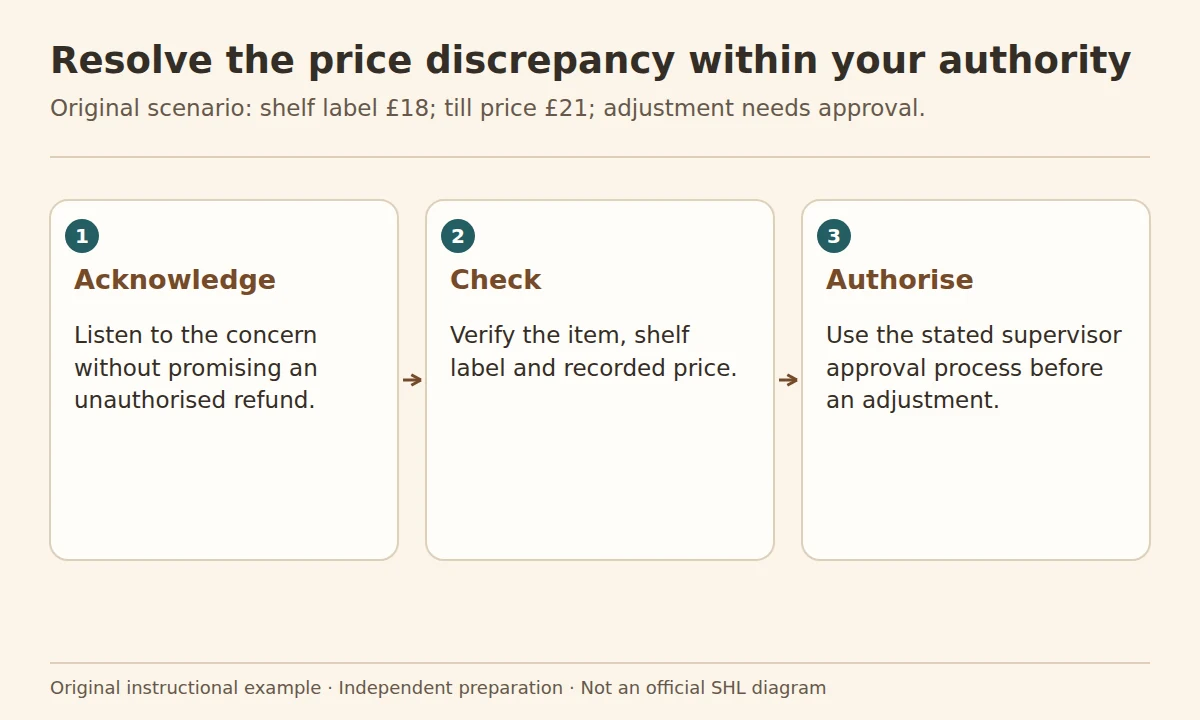
A customer says a shelf label shows £18 while the till shows £21. Your role permits you to verify the label and ask a supervisor to authorise any adjustment. The strongest response is to acknowledge the concern, check the item and label, then follow the authorisation process. Promising an immediate refund of any amount exceeds the stated authority. Dismissing the customer without checking ignores relevant evidence. Changing unrelated prices would not solve the specific issue.
The method is not “always escalate”. It is “act within the authority described”. If a different scenario authorises you to make the correction yourself, the appropriate next step may differ.
Stock accuracy: add a numerical and checking task
A store has 24 units at £15 and sells 6. Remaining units are 18. Their value at the same unit price is 18 × £15 = £270. The original stock value was £360 and sales value was £90. A question about remaining stock asks for £270, not either of those other useful quantities. Labels prevent a correct calculation from answering the wrong question.
Integrity: handle uncertainty transparently
If a scenario includes a discrepancy you cannot explain, do not invent a reason to close the issue quickly. State what is known, preserve the relevant information through the permitted process and involve the responsible person when required. This is an original practice principle; it does not replace an organisation’s actual cash-handling, privacy or safety procedures.
A queue and a price discrepancy need different actions
Original situation: one customer disputes a shelf price while several customers wait. You are allowed to call a colleague for queue support, but only a supervisor may authorise a disputed price override. The defensible action is to request queue support and the authorised price check while explaining the next step to the customer.
Overriding the price yourself breaches the stated authority limit. Ignoring the dispute sacrifices the unresolved customer issue; leaving all tills unattended creates another problem. The retail-specific skill is allocating available help while following the store rule, not repeating a generic management slogan.
Check your understanding: original practice
Read the service problem together with the stated rules and authority. Compare options by what they would actually do for the customer and the operation.
Looking for a structured course alongside these free questions? View full preparation.
Questions about SHL retail assessment preparation
Is this specific to a current SHL retail product?
No. It is role-relevant original practice. Verify the assessment named in your invitation before assuming a product or version.
Should the customer always receive what they request?
The best response depends on the facts, policy and authority in the scenario. A helpful explanation and an appropriate resolution matter more than an unlimited promise.
How is store-manager preparation different?
Practice can include coordination, prioritisation and follow-through as well as individual service decisions. The actual assessment requirements still need confirmation.
Sources and scope
The support page provides platform-specific guidance. The retail stock and service examples here are original: no claim is made that every employer uses the same scenario or scoring key.
Where to go next
Move to management decisions for team-level trade-offs, simulations for multi-step tasks and checking practice for stock and record accuracy.
