
ReasoningCampus · SHL Workplace Assessments
SHL job simulations preparation should connect the information you receive to the work you must deliver. An inbox task, spreadsheet task and coding work sample require different outputs. The original exercises below show how to check both the method and the final response. ReasoningCampus offers independent SHL preparation with worked examples that connect evidence, decisions and the requested output.
Independent learning resource · English · Content revised 16 October 2026
View full preparationSHL job simulations: connect the evidence to the deliverable
The ReasoningCampus work-sample method is understand the requested output, respect constraints, produce it, verify it. A fast action is useful only if it meets the task. Explain your decisions during ordinary practice so that errors become visible; in the assessment, use the response format and resources the instructions permit.
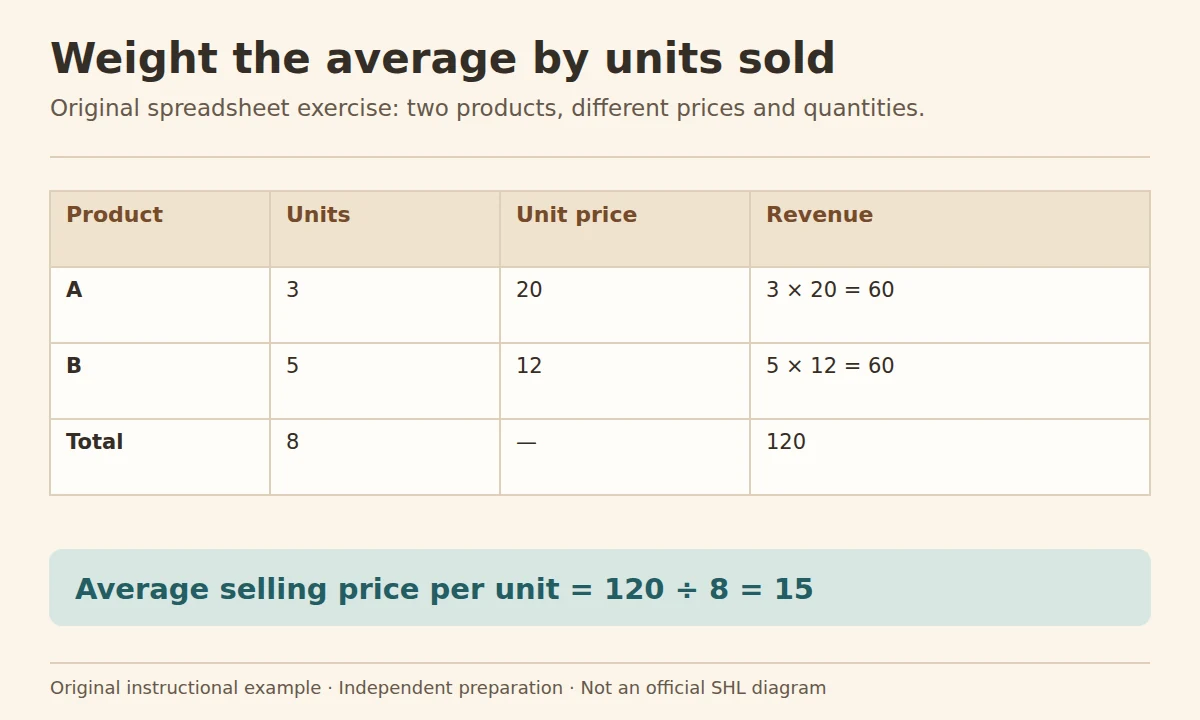
Spreadsheet example: calculate a weighted result
| Product | Units | Unit price |
|---|---|---|
| A | 3 | 20 |
| B | 5 | 12 |
Total revenue is 3 × 20 + 5 × 12 = 120. If units are in B2:B3 and prices in C2:C3, an Excel-style formula is =SUMPRODUCT(B2:B3,C2:C3). The average selling price per unit is 120 ÷ (3 + 5) = 15. The unweighted average of the two prices is 16 and answers a different question. Check ranges, numeric formats and what the task actually requests.
Do not assume that keyboard shortcuts are universally blocked or that one exact function is required. A task may specify a method or simply an output; follow its instructions.
Coding example: define edge cases before implementation
Suppose an original task asks you to count values strictly greater than 10 in a list. For [10, 11, 8, 15], the answer is 2. A correct approach checks each value against value > 10. Using >= 10 incorrectly counts the boundary value and returns 3. An empty list should return 0 under this task definition.
- Restate the input and required output.
- Identify boundary and empty-input cases.
- Implement the simplest correct approach allowed by the task.
- Test the ordinary case and the boundaries.
- Check any stated performance or library restrictions.
Inbox example: priority needs context
An inbox contains a routine meeting request, a client query due tomorrow and an explicit urgent service incident that your procedure says to report immediately. The incident takes priority under those stated facts. The meeting may be easy to answer, but ease does not determine urgency. Record why you prioritised each item, and check whether you have authority to resolve it or need to notify someone.
Virtual assessment activities: make your contribution observable
For a practice group discussion, state the problem, share relevant evidence, invite missing information and help the group reach a reasoned next step. Dominating the conversation is not the same as making a useful contribution. For a written work sample, a clear structure and correct result matter more than adding unexplained technical language. This lesson does not claim access to a particular assessor rubric.
An inbox decision should end in an actionable response
Original work sample: a customer asks for dispatch confirmation by noon. The warehouse says stock is available, but the quality team has not released the batch. A useful response is not “I prioritise the customer”. It identifies the unresolved release, asks the authorised team for a decision and gives the customer an honest update without promising dispatch.
Write three lines: status — stock exists but release is pending; action — request the quality decision through the authorised route; communication — confirm the next update time without inventing an outcome. Your final deliverable must remain consistent with the evidence in the inbox.
Check your understanding: original practice
Identify the requested deliverable before calculating or prioritising. The explanations show why a plausible-looking output can still answer the wrong question.
Looking for a structured course alongside these free questions? View full preparation.
Questions about SHL job simulations
Will my assessment use Excel 365?
Check the invitation. This lesson uses an Excel-style formula as an example; it does not identify the software in your assessment.
Should I memorise XLOOKUP or VLOOKUP?
Learn a function when it matches the task. Understand lookup direction, exact versus approximate matching and the required result instead of memorising a name alone.
Can I use an AI coding assistant?
Only if the assessment explicitly permits it. During preparation, check any generated code with meaningful examples and boundary cases.
Sources and scope
- SHL Candidate Support: device compatibility and system requirements
- SHL Candidate Support: platform-specific assessment, calculator and reset guidance
The official assessment resources provide context for work-related tasks. The inbox, spreadsheet and arithmetic examples are original practice activities with their own stated rules.
Where to go next
Management cases sharpen priorities, checking practice helps verify records and retail examples show how the same discipline applies to store operations.
