
ReasoningCampus · SHL Study Skills
Good SHL scratch paper keeps the important information visible: the starting value in a percentage, the units in a table and the restrictions in a rule problem. These original layouts show what to write and what to leave out. Confirm that paper is permitted in your actual assessment. These are ReasoningCampus teaching examples from our independent SHL preparation, with separate layouts for arithmetic and logical restrictions.
Independent learning resource · English · Content revised 16 October 2026
View full preparationSHL scratch paper: make the decisive information visible
The ReasoningCampus method is to give each note a job: label, calculate or constrain. A label preserves the meaning of a number. A calculation records the operation. A constraint rules a position in or out. If a note serves none of those purposes, it may be clutter rather than support.
Three compact layouts
| Task | Suggested layout | Final check |
|---|---|---|
| Numerical | Asked-for quantity → values with units → expression | Does the answer use the requested unit? |
| Scheduling | Slots across the page, restrictions underneath | Does every assignment satisfy every rule? |
| Ranking | Ordered positions and short relation symbols | Did “before” become “immediately before” by mistake? |
Do not use shorthand you cannot read under pressure. A clear label such as “2025 revenue £000” can prevent more errors than a compressed string of numbers with no units.
Worked numerical layout
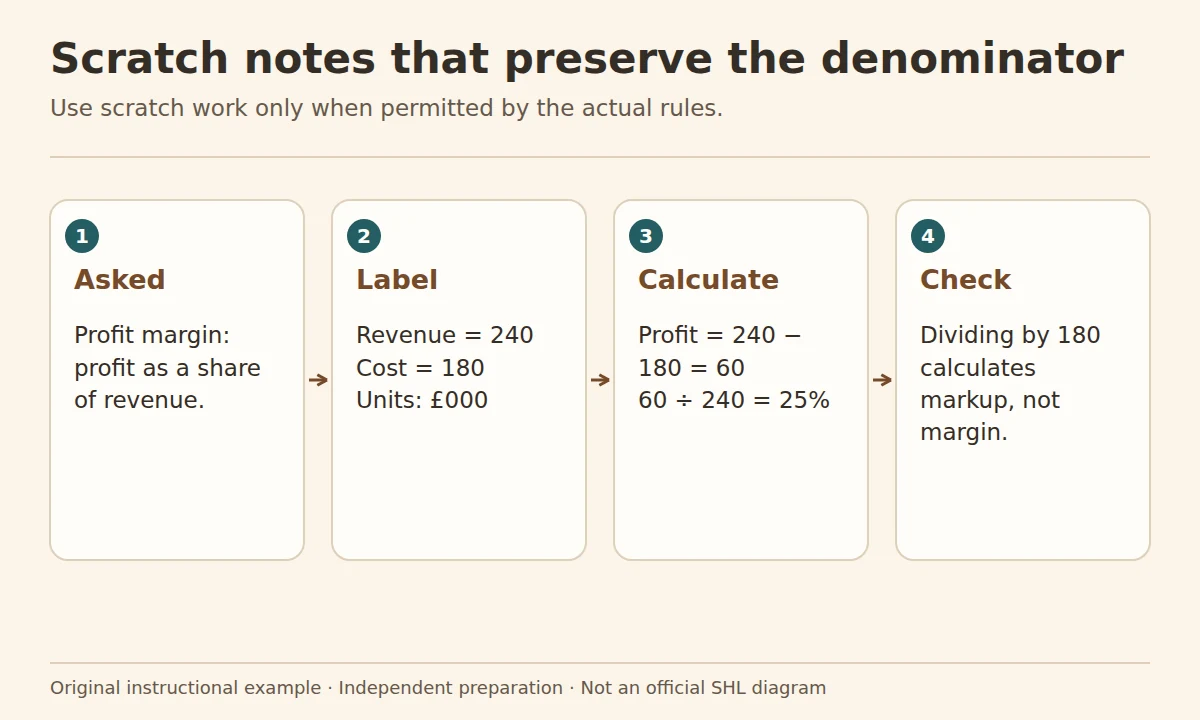
Suppose revenue is £240,000 and cost is £180,000. The question asks for profit margin. Your notes can read: “Asked: profit ÷ revenue. Profit = 240 − 180 = 60 (£000). Margin = 60 ÷ 240 = 25%.” Keeping the scale consistent lets you use 240 and 180 rather than writing all the zeros. The £000 label explains why that simplification is valid.
If you instead write only “60 / 180”, you may calculate markup, 33.3%, and forget that the question asked for margin. The layout is useful because it preserves the decision about the denominator.
Worked constraint layout
Three presentations, A, B and C, occupy slots 1, 2 and 3. A is before B. C is not in slot 1. Write “A < B” and “C ≠ 1”. If A were in slot 2, B would be in slot 3, leaving C in slot 1, which breaks the second rule. Therefore A is in slot 1. B and C may fill slots 2 and 3 in either order. A neat note should preserve that uncertainty rather than invent a unique schedule.
A scratch layout for constraints, not only arithmetic
For a four-slot schedule, draw four boxes and write fixed placements above them. Put a consecutive pair such as C–D on a separate line until its location is forced. Record “A after D” as D < A rather than placing A in the last slot immediately.
Separate three kinds of note: a given fact, a deduction and a temporary trial. Mark the trial with a question mark. If it fails, cross out the trial rather than the original rule. This prevents a rejected possibility from becoming a false premise later in the question.
Review the page after practice
Circle the place where your notes stopped matching the question. Did you drop a minus sign, omit a unit, copy a label incorrectly or turn a possible position into a fixed one? Improve the layout to address that exact issue. Do not judge the page by how much writing it contains. A useful page supports a correct explanation with the fewest necessary marks.
Check your understanding: original practice
Use a small scratch layout for each question. After answering, check whether your notes preserved the important labels and conditions.
Looking for a structured course alongside these free questions? View full preparation.
Questions about SHL scratch paper
Can I bring prewritten formula notes?
Only if the assessment explicitly permits them. Practising with a worksheet does not establish that you can take it into a live session.
Should I draw every arrangement?
Use a representation when it reduces uncertainty. A short order relation may be enough for a simple chain, while a grid can help with several slots and exclusions.
What if scratch paper is prohibited?
Follow the rule. Practise short, labelled mental steps and any permitted on-screen method; do not use hidden notes.
Sources and scope
The official candidate guidance helps you check permitted aids. The note layouts are original teaching examples: use them in a live session only if its instructions permit scratch paper.
Where to go next
Use the formula reference for calculations and scheduling practice for constraints. Distractor review helps identify which note would have prevented a mistake.
