
ReasoningCampus · SHL Study Skills
SHL AI practice prompts can help you request fresh learning exercises and alternative explanations. Treat the output as a draft: recompute the answer and test whether another choice also works. Keep live assessment questions, access links and personal records out of your prompts. ReasoningCampus teaches verification of original exercises so that a plausible answer key is checked against the actual question.
Independent learning resource · English · Content revised 16 October 2026
View full preparationSHL AI practice prompts: build original exercises you can check
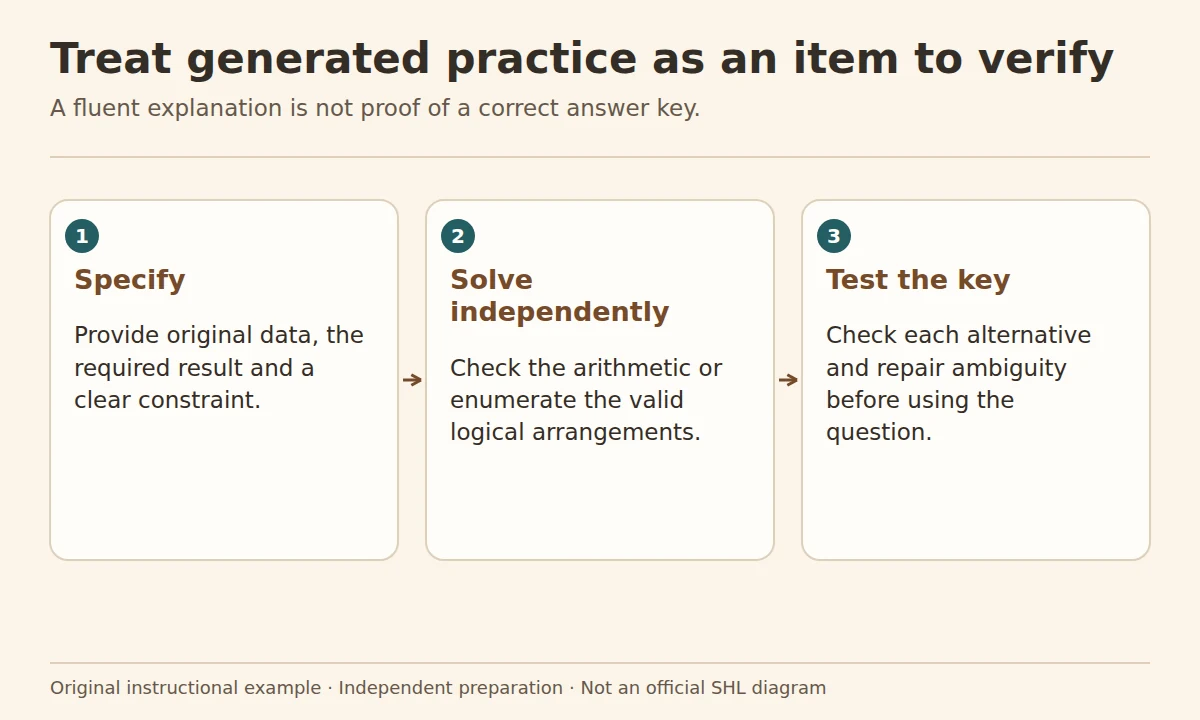
The ReasoningCampus approach is specify, solve independently, challenge, revise. Ask for explicit data and a complete solution, but do not accept the answer key merely because it sounds confident. Recalculate numerical answers, test logical alternatives and reject exercises that do not have the promised unique solution.
Numerical prompt: make the denominator visible
Create one original practice question about percentage change using a small fictional business table. Give all units and periods. Provide three answer options with one correct answer. Show the expression before the calculation and explain the precise error behind each wrong option. Do not claim the item is official SHL material or estimate a percentile.
Check that the starting value is nonzero, the percentage base matches the wording and rounding does not make two options equivalent. Change the values and recompute to see whether the explanation still works.
Deductive prompt: require a uniqueness check
Create an original four-item linear ordering problem. State every constraint. Ask one “must be true” question with three options. List all valid orders and verify the correct option against every order. Explain one counterexample for each incorrect “must” claim. Do not use confidential or remembered assessment questions.
The list of valid orders is a checkable object. Verify that each respects every rule and that no valid arrangement has been omitted. For a small problem, enumeration is feasible; for a larger one, ask for a transparent reasoning proof instead of accepting a huge unverified list.
Verbal prompt: distinguish missing evidence from contradiction
Write a short original passage and three statements using True, False and Cannot Say. Include one explicit contradiction and one genuinely unresolved claim. Use precise quantifiers. Explain the supporting or contradicting sentence, and for the unresolved claim show how both possibilities fit the passage.
Reject an answer key that marks a claim false solely because it is not mentioned. Also check that background knowledge has not supplied evidence the passage lacks.
Visual and mechanical prompts need extra care
Create an original visual-rule exercise using named grid positions and an accessible text description. State the intended rule and verify it across every frame. Give three options that differ on identifiable features. Do not rely on an image alone for the answer explanation.
For mechanical practice, specify idealisation, geometry and units. A generated pulley drawing can be physically ambiguous even when the accompanying calculation looks polished. If you cannot verify the diagram and assumptions, do not use it as a scored item.
Verification: improve an explanation and check it yourself
A useful follow-up is: “Here is my solution. Identify the first step that does not follow, and explain why.” Another is: “Construct a counterexample to this conclusion.” Asking the same model to declare its own answer correct ten times is not independent validation. Keep any exercise you cannot resolve out of a published quiz.
A generated answer key can look plausible and still be wrong
Suppose a generated exercise says: “After a 20% discount, the price is 96 units. What was the original price?” The draft key gives 115.2 by adding 20% to 96. That does not undo the discount.
Recompute from the relationship: 96 = original × 0.80, so original = 120. Check forward: 120 × 0.80 = 96. The 115.2 option is a useful distractor only if it is labelled wrong and its denominator mistake is explained.
Generate one original reverse-percentage question. State the assumptions, solve it algebraically and verify the result by applying the discount forward. For each wrong option, explain the exact mistake that produces it. Do not use live or proprietary assessment items.
Questions about SHL AI practice prompts
Can I use these prompts during a live assessment?
Only if that assistance is explicitly allowed. These prompts are designed for preparation, not for answering confidential live assessment items.
Are generated questions equivalent to SHL questions?
No such equivalence is established. They are original study exercises that still require checking for clarity and correctness.
What if two answers appear correct?
Do not guess the author’s intention. Review the wording, constraints and precision. Revise or discard the item before scoring it.
Sources and scope
- SHL Candidate Support: available practice tests and familiarisation
- SHL Candidate Support: platform-specific assessment, calculator and reset guidance
The official assessment information establishes context for preparation. The prompts and verification routines are independent learning tools; generated questions still need their calculations and assumptions checked.
Where to go next
Use distractor analysis to test an answer key and the numerical reference to recompute calculations. Review permitted-help guidance before any live assessment.
